Antiques Know How Research
Vintage Enamel Brooches Value
Our Antiques Know How team’s review of eBay sales shows enamel brooches can range from modest prices to several thousand dollars, with rare examples reaching $5,000 or more. The most collectible pieces include those by Tiffany & Co., Marcus & Co., David Andersen, Meyle & Mayer, and Trifari, featuring precious metals, gemstones, and techniques like plique-à-jour, Cloisonné, and Guilloché. The value of these brooches depends on the complexity of the enamel technique, the maker’s signature, precious materials such as gold or gemstones, and overall condition.
Antiques Know How
Brief History of Enamel Jewelry
Enameling is a technique of fusing powdered glass to metal through intense heat to create a colored glass-like finish. It dates back to ancient civilizations, but it reached a creative peak during the Victorian and Edwardian eras.
Jewelers used it to mimic the colors of nature, often creating sentimental “mourning” jewelry or romantic floral tributes. By the early 20th century, the Art Nouveau movement pushed enamel into high art, using it to create ethereal insects and flowers.
Later, Mid-Century designers in Scandinavia and Italy simplified these forms, making enamel jewelry a staple of the modern woman’s wardrobe. Today, enamel jewelry, especially brooches, is highly collectible for its unique techniques.
What Makes an Enamel Brooch Valuable?
While a pure gold brooch has its own melt value, an enamel pin gains its value through the intricacy of the technique involved, the type of other materials used, and the name of the house that made it.
Technique
The enamel technique is the first step to look for when appraising an old brooch. The amount of expertise required in each process will affect the price. Some popular techniques you should know are:
- Cloisonné: This technique uses thin metal wires soldered onto the base of small cells filled with colored enamel and fired. You can see the wire outlines between color sections.
- Champlevé: Channels are carved or etched into the metal, then filled with enamel. The metal surface stays visible between colored areas. It is frequently found on Celtic and medieval revival brooches.
- Guilloché: A unique technique of Norwegian silversmithing and Fabergé, this style entails an engraved design cut into the metal by machinery, which is covered with translucent enamel to reveal the design underneath.
- Plique-à-jour: The toughest technique, which requires placing the enamel in cells without backing. Gives the look of stained glass in sunlight. A very delicate, time-consuming process; intact pieces are worth a lot.
- Basse-taille: Like guilloché except that it uses engravings done by hand instead of on machinery beneath translucent enamel.
- Cold enamel / Cold paint: This isn’t true vitreous enamel. This is paint or resin applied without firing. Generally, it’s the least durable and valuable. If the surface feels plasticky or shows brush strokes, it’s probably painted enamel.
Maker or Brand
A piece that is signed by a known maker is usually worth more than one that does not have a signature. If you see names like Tiffany & Co., Marcus & Co., David Andersen, Meyle & Mayer, and Trifari, especially the designs made by Alfred Philippe, it’s likely a high-end piece.
So, always make sure to check the back of the brooch for stamps or marks that say who made it.
Materials (Gold, Silver, Gemstones)
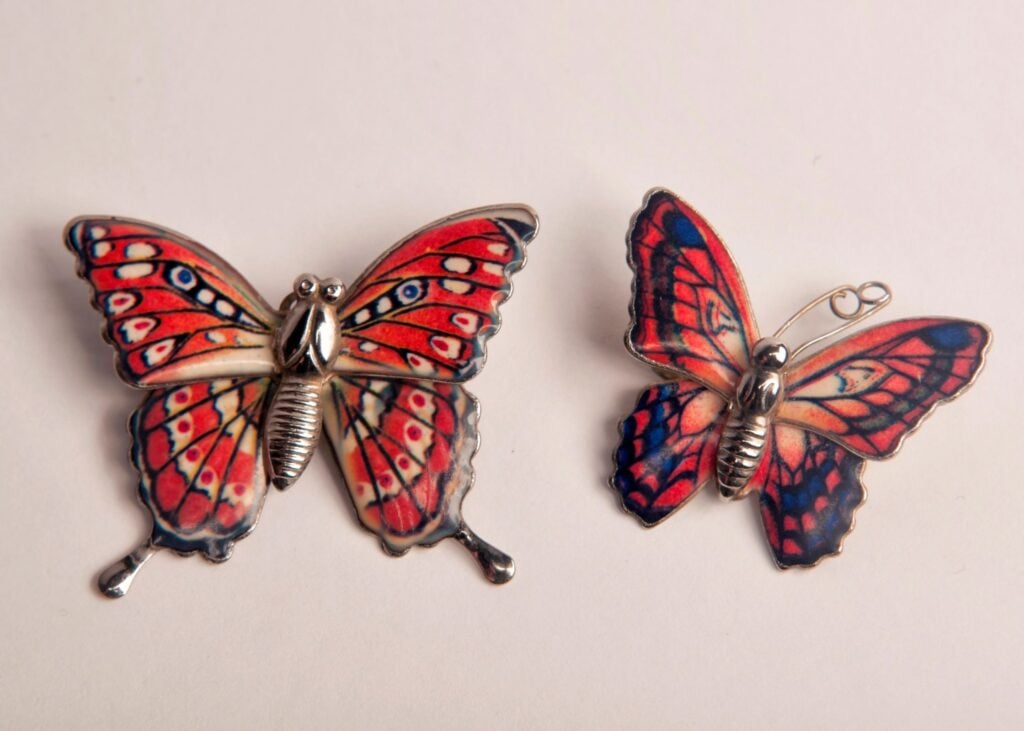
Enamel brooches made of 14K or 18K gold are highly valuable. So are brooches made of sterling silver. Overall, precious metal brooches are worth more than those made of base metals or plated finishes.
Apart from this, if a brooch has gemstones on it, like diamonds, pearls, rubies, and amethysts, it becomes more valuable. This is especially true for fine jewelry pieces.
Condition (of Enamel)
Enamel condition comes second to make and type in terms of value considerations. If there are cracks or chip damage on the enamel or if the enamel has started flaking off from the metal piece, the value of the brooch could be reduced by as much as 50%.
To check the enamel, run your fingernail over the surface. The enamel should feel smooth, like glass. There must be no scratch marks or tiny pits.
If your brooch is made using the guilloche enamel technique, then scratching may be a major problem.
10 High Value Enamel Brooches Worth Collecting
These are some of the most collectible vintage enamel brooches on the secondary market right now. Each represents a different technique, era, or maker, and each has specific details that affect the value.
1
Jaques & Marcus Enamel Crescent Moon Brooch
Typically sells for $3,000 – $6,000
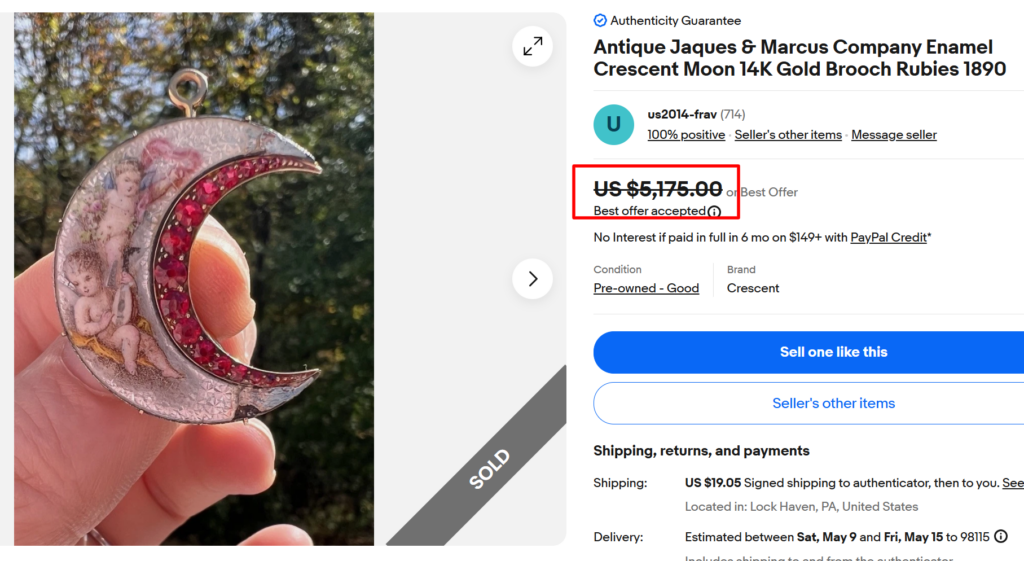
| Average Value | $3,000 – $6,000 |
| Production Period | 1884 – 1892 |
| Key Features | 14K gold, painted enamel, rubies, crescent |
| Collector Notes | Highly rare due to 8-year production window. |
This crescent moon brooch is from Jaques & Marcus. It’s a 14K gold piece with a hand-painted enamel scene, usually a cherub or allegorical figure, and natural rubies along the crescent edge.
The painting was done by trained miniaturists, and the quality of that brushwork is what makes it a museum piece today.
This brooch bears the “Jaques & Marcus” hallmark at the rear. Notably, Jaques & Marcus only operated between 1884 and 1892 before the company was renamed Marcus & Co., for just eight years altogether. Therefore, items with this mark are increasingly rare.
2
Marcus & Co. Lily of the Valley Brooch
Typically sells for $4,000 – $8,000
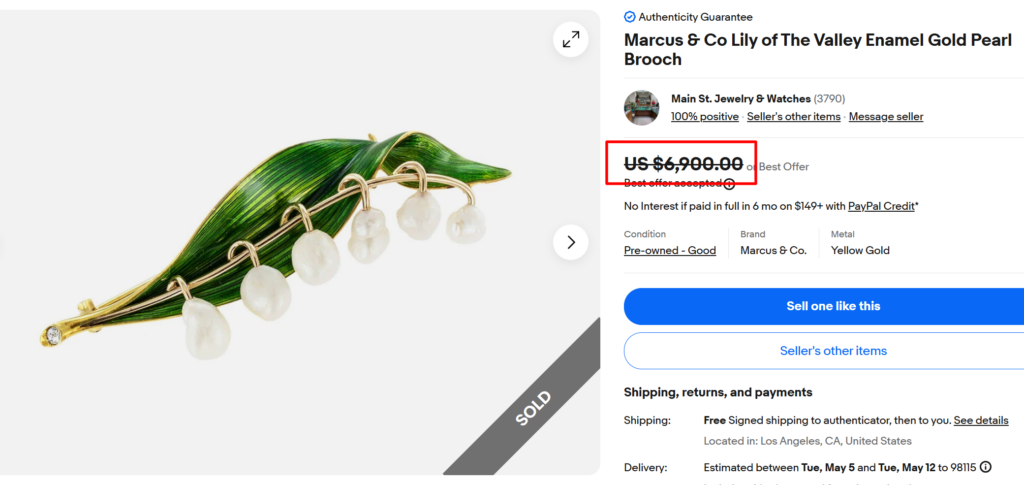
| Average Value | $4,000 – $10,000 |
| Production Period | 1900 – 1920s |
| Key Features | 18K gold, curved enamel, pearl flowers |
| Collector Notes | Verify the Marcus & Co. mark. |
This brooch is 18K gold with hand-applied green enamel on the leaf, and the bell-shaped flowers are formed from natural pearls. It’s commonly called the “Leaf of the Valley.”
What makes Marcus & Co. pieces special is that the firm was one of the only American jewelers applying enamel on curved surfaces. That gave their flowers a lifelike, three-dimensional shape that other firms couldn’t replicate easily.
The value of this pin lies in its solid-gold body and natural pearls. If you see faux pearls in the same design, it’s likely a cheap reproduction.
3
Garavelli Gold Enamel Diamond Bird Brooch
Typically sells for $1,500 – $5,000
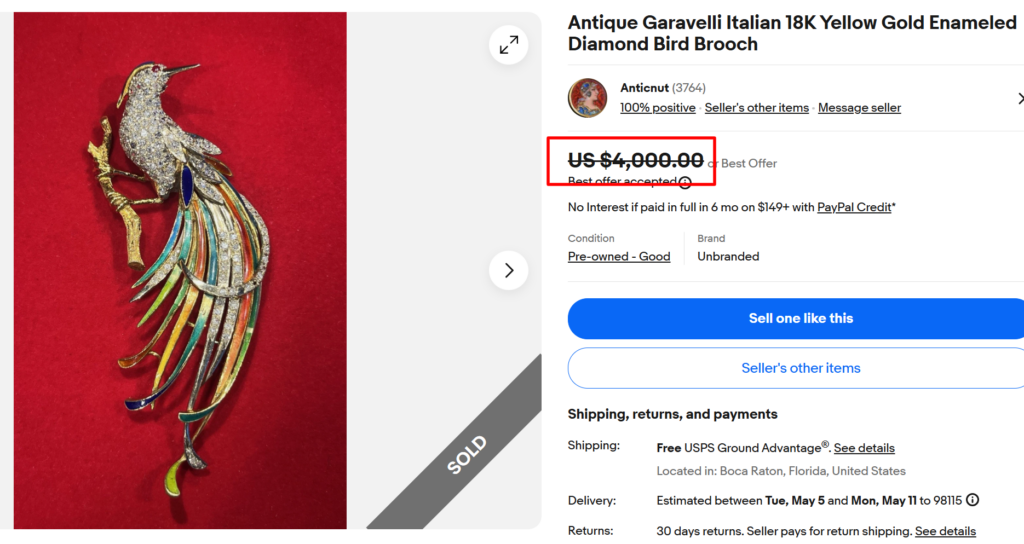
| Average Value | $1,500 – $5,000 |
| Production Period | 1950s – 1970s |
| Key Features | 18K gold, polychrome enamel, diamonds, bird |
| Collector Notes | Check tail feather enamel for chips |
These nature-inspired bird brooches from Aldo Garavelli, Italy, have polychrome enamel over 18K gold. The designs usually depict an exotic bird with long, colorful, enameled tail feathers and a diamond-set body. This one shows a bird perched on a golden branch.
You can identify these pieces by the “750,” “237 AL,” and “Italy” hallmarks on the back. The tail feathers are where enamel chips show up most, since that’s where the coating is thinnest.
4
Plique-à-jour Gold Amethyst Flower Brooch
Typically sells for $2,500 – $5,000
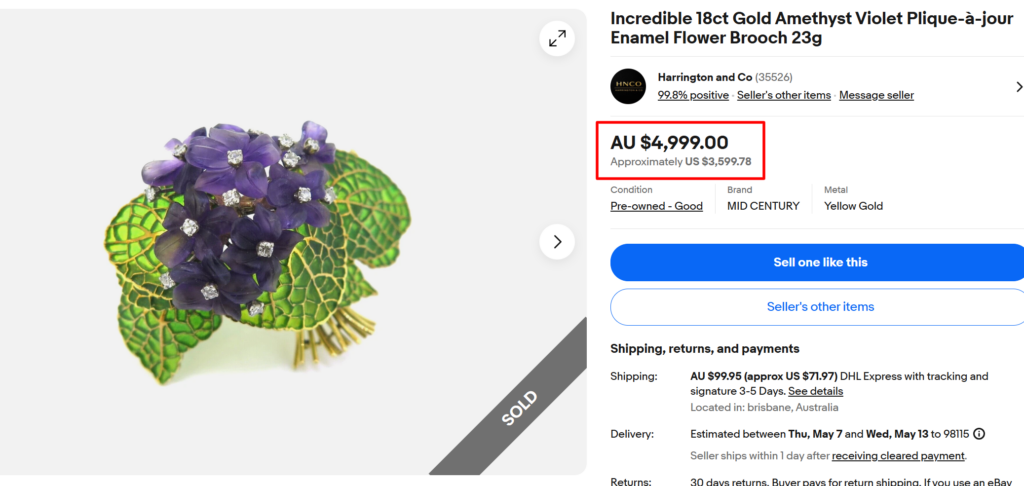
| Average Value | $2,500 – $5,000 |
| Production Period | Early to mid-20th century |
| Key Features | Plique-à-jour leaves, amethyst, 18K gold |
| Collector Notes | Inspect each enamel cell for hairline cracks |
The leaves on this 18K gold brooch are done in plique-à-jour, translucent enamel with no metal backing. Hold it up, and the leaves look like tiny stained-glass panels. Carved amethyst makes up the violet petals, while diamonds fill in the rest.
The plique-à-jour technique is considered among the most difficult enamel techniques, with a high chance of failure when placed in the kiln. That is why there are fewer surviving examples, especially in mint condition.
Well-attributed Plique-à-jour brooches in high-karat gold or Sterling can fetch even higher than this $5,000 unsigned piece.
5
Tiffany & Co. Gold Enamel Bumble Bee Brooch
Typically sells for $3,000 – $4,500
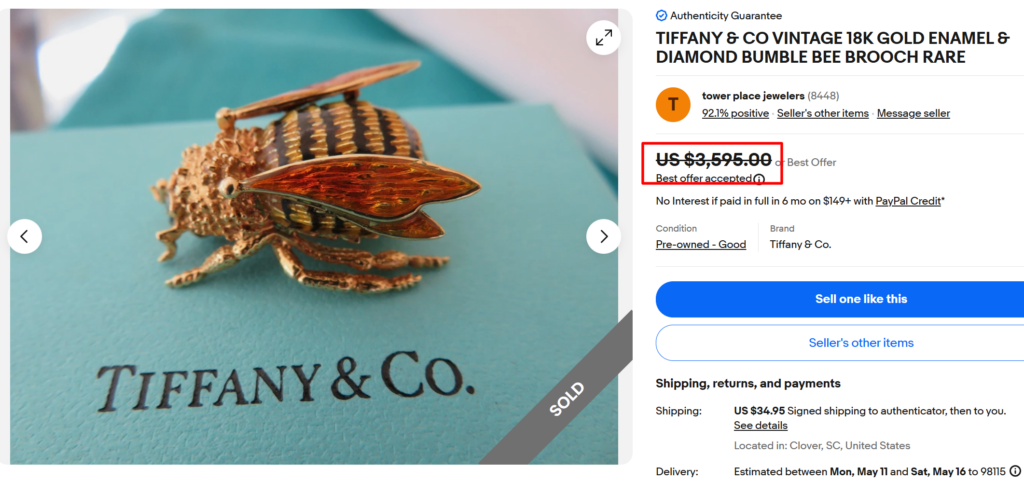
| Average Value | $3,000 – $4,500 |
| Production Period | 1960s – Present |
| Key Features | 18k gold, realistic texture |
| Collector Notes | Always verify the Tiffany signature. |
Tiffany made several versions of the bee brooch from the 1950s through the 1970s, all in 18K yellow gold with enamel-striped wings in brown, amber, and black. Some add diamond wings or ruby eyes.
The body has a textured, slightly grainy surface that’s hard to replicate, which makes these easy to authenticate. Besides, original pieces are always marked “Tiffany & Co.” with “18K” or “750.”
The solid gold alone gives these enamel brooches a solid floor price, but the Tiffany name adds a big premium on top.
6
Trifari Patent Arum Lilies Enamel Cabochon Pin
Typically sells for $400 – $1,500
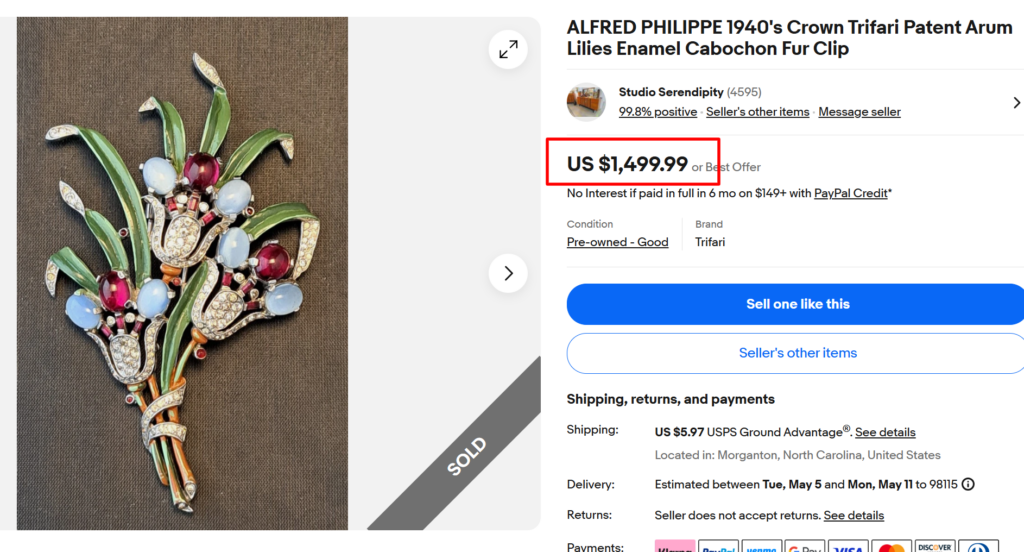
| Average Value | $400 – $1,500 |
| Production Period | 1939 – early 1940s |
| Key Features | Floral design, green enamel, cabochons |
| Collector Notes | Check for the patent number on the back |
The floral pin was made by Alfred Philippe for Trifari, and each is marked with its design patent number on the reverse side. It consists of cold-enameled leaves that look like arum lilies, and there are fake cabochon stones and rhinestones used to make the arum lily shapes.
Look for the Crown Trifari mark and a “Des. Pat.” number on the clip mechanism to confirm authenticity. As for value, intact enamel and clear rhinestones are crucial for top value.
7
Jack Kinkelaar Sterling Cloisonne Enamel Unicorn Brooch
Typically sells for $500 – $800
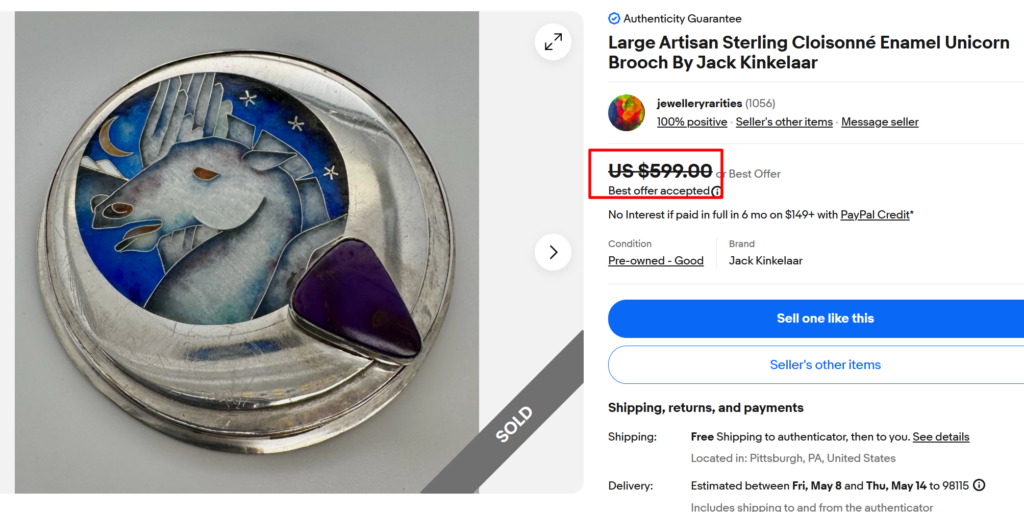
| Average Value | $500 – $800 |
| Production Period | 1970s – 1980s |
| Key Features | Artisan cloisonné, sterling silver |
| Collector Notes | Rare, one-of-a-kind artist piece. |
Jack Kinkelaar was a modern artisan who specialized in bold, painterly cloisonné. This large brooch features a stylized unicorn in a moonlit scene. Unlike mass-produced vintage, this is a piece of “Studio Jewelry,” where the artist’s unique hand and vision are the primary value drivers.
Authentic pieces must have an engraved “Sterling” mark and an etched artist’s signature on the back. Since these are newer, Jack Kinkelaar’s enamel brooches sit on the lower end of the value range.
8
David Andersen MCM Guilloché Owl Brooch
Typically sells for $75 – $400
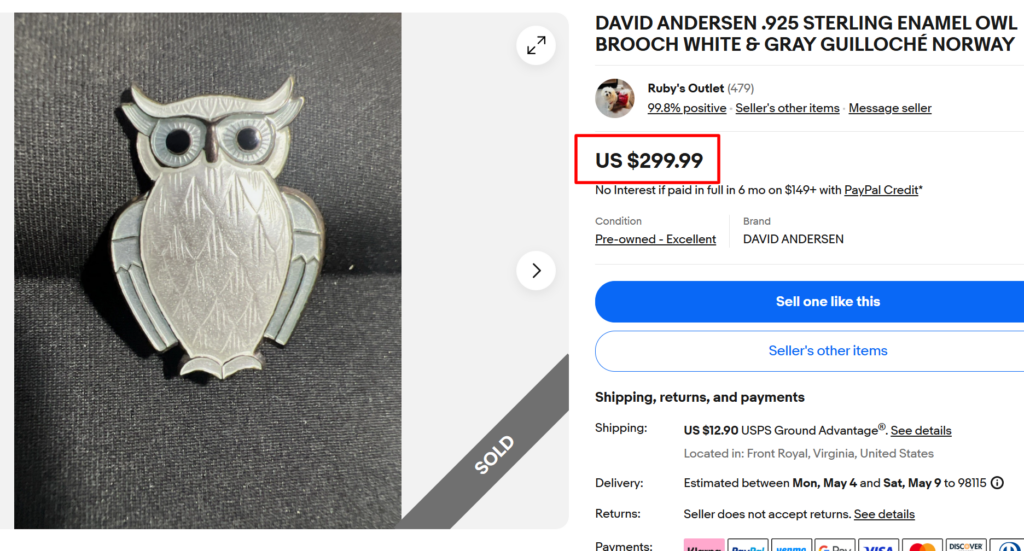
| Average Value | $75 – $400 |
| Production Period | 1940s – 1970s |
| Key Features | Sterling, guilloché enamel, nature motifs |
| Collector Notes | Matching sets and rare designs sell for higher |
Andersen started his jewelry shop in Oslo in 1876. His firm’s mid-century brooches come in a bunch of shapes, leaves, butterflies, owls, and flowers, all on sterling silver with guilloché enamel. Colors go from white and pale blue to deep green and purple.
The leaf designs are the most common and sell on the lower end. Owls, the Four Seasons series, and complete sets with matching earrings bring more.
Look for “D-A” or “David Andersen” on the back, plus “Norway Sterling 925S” to identify original pieces.
9
Meyle & Mayer Sterling Enamel Marcasite Brooch
Typically sells for $100 – $300
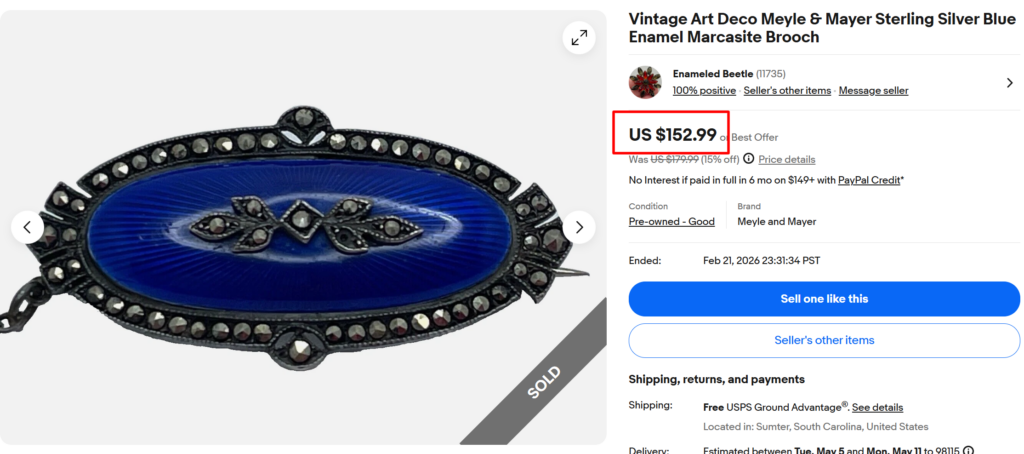
| Average Value | $100 – $300 |
| Production Period | 1890s – 1930s |
| Key Features | Guilloché enamel, marcasite, dragonfly mark |
| Collector Notes | Check for the 935 silver mark. |
Meyle & Mayer worked out of Pforzheim, Germany, which was basically the jewelry capital of the country. This brooch features blue guilloché enamel over sterling silver (935 grade), with marcasite accents.
The company used real vitreous enamel and hand-set the marcasites, which adds decent value. Although it’s not gold, it’s high-quality enamel work that sells. Their Art Deco and Art Nouveau brooches with bird or insect motifs are most desirable today.
You can identify Mayer pieces by the tiny dragonfly mark on the back.
10
Ivar T Holth Sterling Guilloche Brooch
Typically sells for $50 – $150
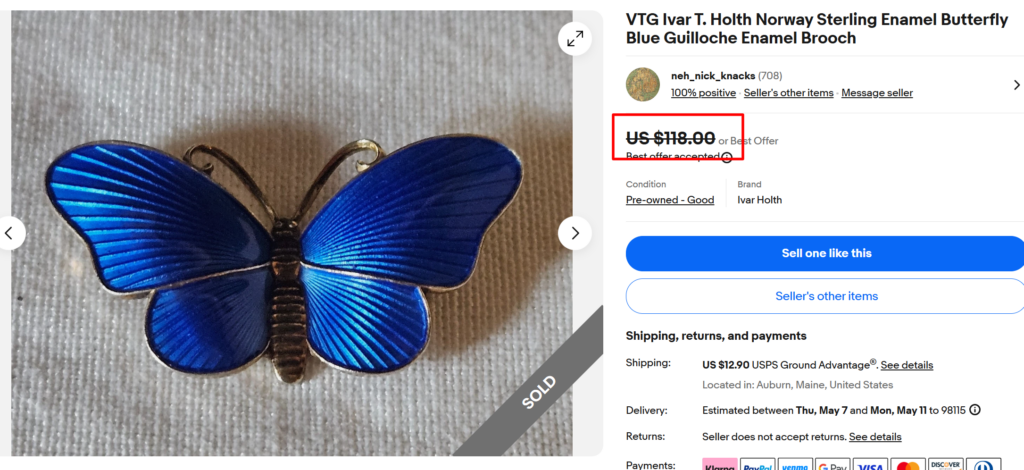
| Average Value | $50 – $150 |
| Production Period | 1940s – 1990s |
| Key Features | Sterling, guilloché enamel, butterfly |
| Collector Notes | Rare colors and intact gold wash add value |
These butterflies have sterling silver wings covered in translucent guilloché enamel, usually in one bold color like blue, green, or red, with gold-washed silver underneath. Holth started his workshop in Oslo in 1943 and kept producing into the 2000s.
Since they were mostly made for export, they’re not hard to find. Look for the circled “H” mark and “Sterling Norway” on the back. The common blue ones sell for less than unusual colors like red or yellow.
Note: This article is intended for informational, educational, and entertainment purposes only. Some images are illustrative and may not represent actual brands, products, or related entities. All trademarks, product names, brand logos, packaging, and other intellectual property referenced remain the exclusive property of their respective owners. Any brand mentions or references are provided solely for descriptive and educational context and do not imply any formal or commercial association.