Antiques Know How Research
Westmoreland Glass Value
Antiques Know How’s in‑depth analysis of eBay sales and auction results shows that vintage Westmoreland milk glass usually sells for $5-$50 for common pieces, while rare patterns, forms, and sets go for $150-$500 or more. Most collectible pieces are Paneled Grape punch sets, English Hobnail vases, Thousand Eye and Wakefield fairy lamps, Della Robbia flashed sets, Maple Leaf in rare colors, and rare “Hen on Nest” sets. Check the Westmoreland marks, specific glass types and colors, decoration details, condition, and completeness of pairs and sets for authenticity and value.
Antiques Know How
Ever held a piece of milk glass to the light and noticed a glowing rim? We are not talking about magic here. Collectors call that “RING OF FIRE,” and it’s a dead giveaway that you have found a piece of history.
Westmoreland reigned as the “King of Milk Glass” for nearly a century before closing in 1994. But since their original molds are still being used by other brands, spotting a genuine treasure takes more than a lucky guess. So, let’s head into the patterns and marks that matter in this guide.
History of Wastemoreland Glass Company
The company started in 1889 in Grapeville, Pennsylvania. From then, Westmoreland spent nearly a century making everything from apothecary jars to those iconic milk-glass hens, until its closure.
From the 1920s through the 1950s, roughly 90% of Westmoreland’s output was milk glass. They also produced carnival glass starting in 1908 and later made decorated glass, slag glass, and crystal tableware across dozens of patterns.
The Brainard family controlled the company from 1937 until 1980, when they sold it to David Grossman. The factory closed for good on January 8, 1984.
After that, most molds were sold at auction, and some companies still produce glass from original Westmoreland molds. Today, it’s the original pieces and patterns that collectors actively search for in estate sales and auctions.
12 Highly Collectible Westmoreland Glass Patterns & Pieces
Let’s explore some of the most popular and collectible Westmoreland glass designs, pieces, and variations below.
1. Paneled Grape (Line #1881)
Paneled Grape is Westmoreland’s most popular and most widely produced pattern. It started in the late 1940s and continued until the factory closed in 1984.
Like its name, the pattern features raised grape clusters and leaves on paneled sections. Westmoreland copied the design from an earlier Kokomo Glass Company pattern and eventually built it into a full dinner service with over 100 different forms.
Common pieces like plates and cups are easy to find, but rare forms like the punch bowl set, lipped epergne, fireside basket, and canisters are rare and valuable.
| Average Value | $5 – $500+ (based on form) |
| Production Period | Late 1940s – 1984 |
| Key Features | Raised grape clusters, leaves on panels |
| Value Factors | Rare forms (punch sets, epergnes) & colors, hand-painted decorations |
| Collector Notes | “Beaded Grape” is a different design from 1963 |
Milk Glass Paneled Grape Punch Bowl Set
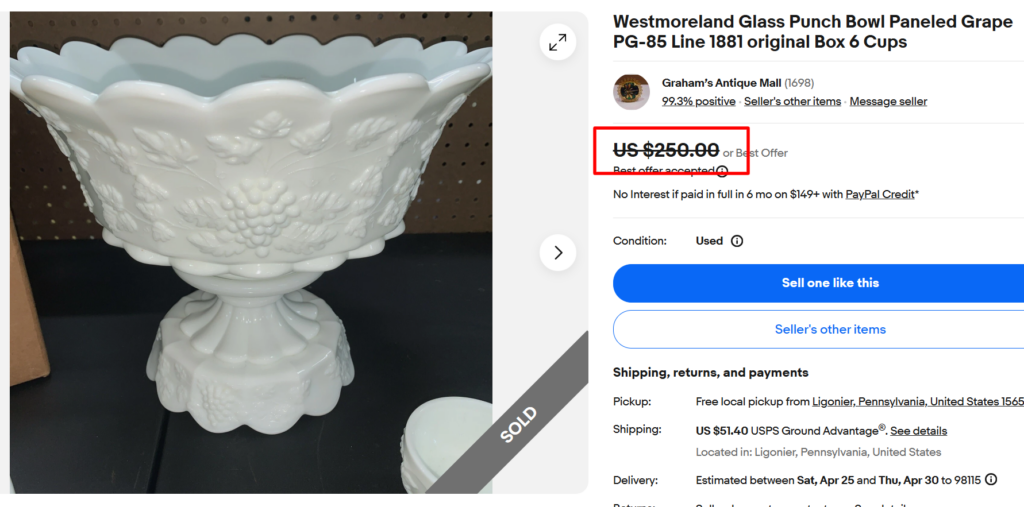
This example is a milk glass punch bowl set (Line PG-85, #1881) in the Paneled Grape design with its original box and six cups. Punch bowl sets are among the rarest forms of this pattern, especially with original packaging.
2. Della Robbia (Line #1058)
Westmoreland’s Della Robbia pattern takes its name from the 14th-century Italian sculptor family known for their fruit-garland ceramic work. The pattern features heavy, sculptural fruit motifs molded around each piece.
This pattern ran from the late 1920s through the 1960s, and was made in crystal, milk glass, and crystal with hand-painted color accents. The “flashed” versions with hand-applied luster colors on the fruit motifs are the most collectible.
| Average Value | $10 – $60 per piece (sets higher) |
| Production Period | Late 1920s – 1960s |
| Key Features | Heavy fruit-garland motif, ground bottoms, hand-finished edges |
| Value Factors | Applied color accents, complete sets, serving pieces |
Westmoreland Della Robbia Flashed Salad Plates
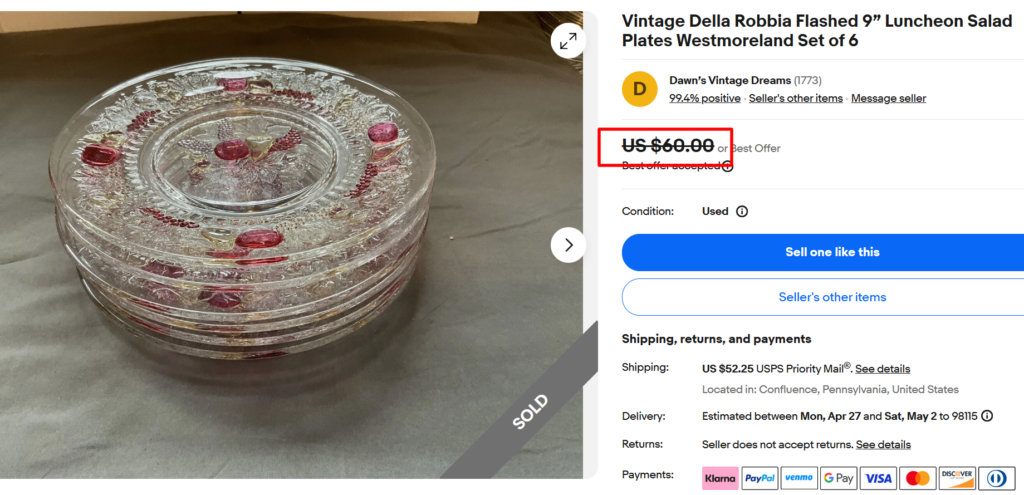
This set of six 9-inch luncheon/salad plates has the Della Robbia fruit border with hand-applied color flashing on the raised fruit motifs. Sets of six or more plates are harder to find than individual pieces.
3. Maple Leaf (Bramble)
This pattern is commonly referred to as “Bramble.” It’s famous for its heavily-molded, overlapping maple leaf motifs. Westmoreland made it primarily in milk glass, but the uncommon colored versions are what attract more collectors.
While milk glass versions are abundant, the pattern truly shines in rare colors like Lilac Opalescent or Ruby Amberina, which can command much higher prices due to their UV reactivity and visual depth.
| Average Value | $25 – $150+ |
| Production Period | 1950s – 1984 |
| Key Features | All-over raised maple leaves |
| Value Factors | Rare colors (Lilac, Ruby, Amberina, black), larger serving pieces |
| Collector Notes | Slag or swirled glass variations are rare. |
Black Milk Glass Maple Leaf Serving Bowl
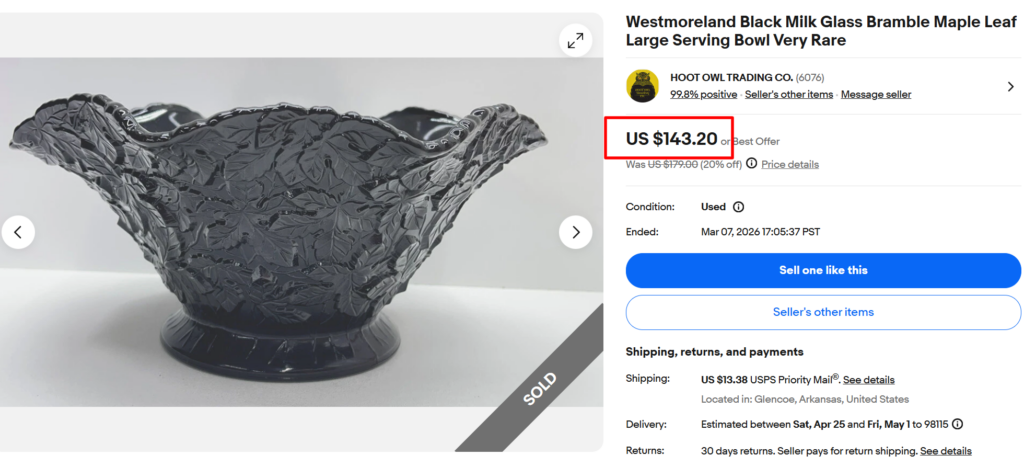
Black milk glass Westmoreland pieces had limited production runs during the 1950s-60s. Larger serving pieces like this in this color are harder to find than small dishes or compotes. Similar maple leaf bowls in white milk glass typically sell for $20 to $40.
4. Old Quilt (#500)
This pattern features a grid of raised diamond or square blocks across the surface, looking like a quilted textile. Also known as Checkerboard, it is among Westmoreland’s oldest designs, appearing in their catalogs as early as 1917.
The company released it in crystal, milk glass, carnival glass, and slag glass over a very long production run. In the 1950s and 60s, Old Quilt featured heavily in their milk glass lines.
| Average Value | $8 – $160+ |
| Production Period | 1917 – 1984 |
| Key Features | Raised diamond-block grid pattern |
| Value Factors | Carnival glass versions, complete pitcher sets, dresser sets |
Old Quilt Carnival Glass Pitcher & Tumblers
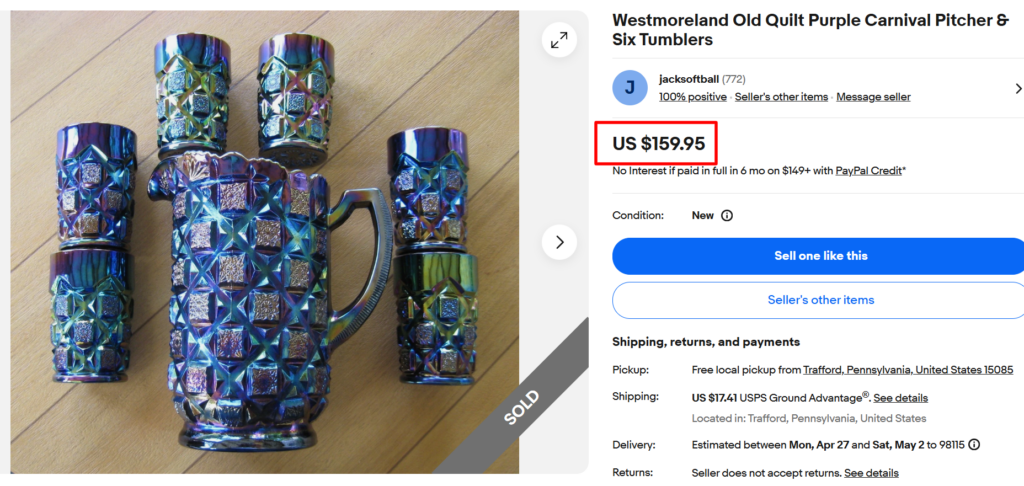
This complete Old Quilt glass pitcher and tumbler set in purple carnival glass is a rare find. Individual tumblers in carnival glass typically sell for $10 to $20 each, making a complete set with a pitcher considerably more valuable.
5. Thousand Eye (Line #1000)
Thousand Eye looks a bit like a hobnail design, except that the bumps are quite larger, almost like bubbles. Westmoreland introduced this design in the early 1930s in crystal, drawing from an older pattern first made by Adams & Co. around 1874.
The crystal tableware line ran from the early 1930s through 1956, with over 30 different forms available. But the pattern found a second life in fairy lamps during the 1970s.
These two-piece candle lamps were made in ruby, crystal, blue, brown, pink, multi-colored, and Mother-of-Pearl finishes.
| Average Value | $15 – $380+ |
| Production Period | Early 1930s – 1956 (tableware) 1977 – 1984 (fairy lamps) |
| Key Features | Raised rows of circular “dots” |
| Value Factors | Fairy lamps in pink/iridescent finishes, colored tableware, full sets |
Pink Thousand Eye Fairy Lamp
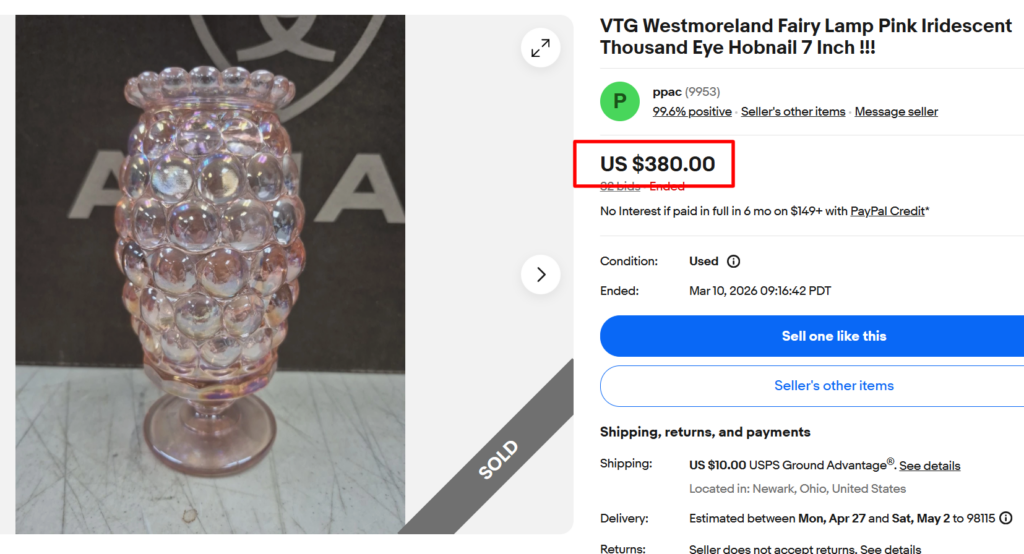
This 7-inch two-piece pink lamp features the bubble pattern with an iridescent Mother-of-Pearl finish. This iridescent colored lamp is one of the harder Thousand Eye pieces to find today.
6. Roses & Bows (Decoration #32)
Roses & Bows is a hand-painted design that Westmoreland applied to several base patterns. It’s most commonly seen on their milk glass pieces with the diamond or quilted surface texture.
The decoration features pink roses with purple ribbon bows and small blue flowers, all painted by hand with gold trim accents. Pieces with intact gold trim and clean, unfaded painting bring the best prices.
Because every piece was hand-decorated, they always look slightly different. The decoration was applied to fairy lamps, wedding boxes, bowls, candlestick holders, and other giftware forms during the 1960s and 1970s.
| Average Value | $25 – $60 (single, small pieces) $150 – $350 (fairy lamps) |
| Production Period | 1960s – 1984 |
| Key Features | Hand-painted pink roses, purple bows, blue flowers, gold trim on milk glass |
| Value Factors | Intact gold trim, unfaded paint, fairy lamps, larger pieces |
| Collector Notes | Gold trim chips and fades easily, reducing value significantly |
Roses & Bows Gold Trim Fairy Lamp
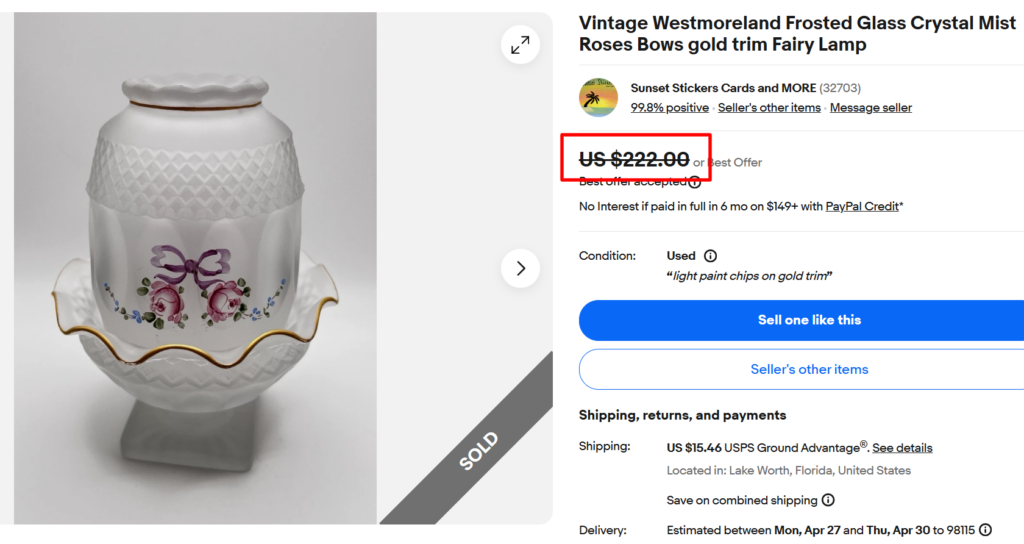
This Crystal Mist Roses & Bows fairy lamp features a frosted white glass body with a quilted diamond texture. Roses & Bows pieces’ value lies in fully intact gold trim and crisp paint.
This decoration is also found on the Cameo Mini Lite and Picture Frame Mini Lite forms.
7. Buzz Star
This is a classic Early American Pattern Glass (EAPG) design that features bold, pinwheel-like star bursts and fan motifs with sawtooth edges. It was introduced around 1910.
Pieces were made primarily in crystal (clear glass) and include celery vases, punch bowls, serving bowls, nappies, and other tableware. Since this is an early pattern, most pieces are unmarked, making identification harder. If you see the Keystone “W” mark, it’s likely a piece from 1910-1940s
| Average Value | $20 – $40 (small pieces) $60 – $125 (large pieces) |
| Production Period | 1910s – 1930s |
| Key Features | Pinwheel star design, sawtooth/scalloped edges |
| Value Factors | Large bowls or lidded pieces |
Clear Buzz Star Serving/Punch Bowl
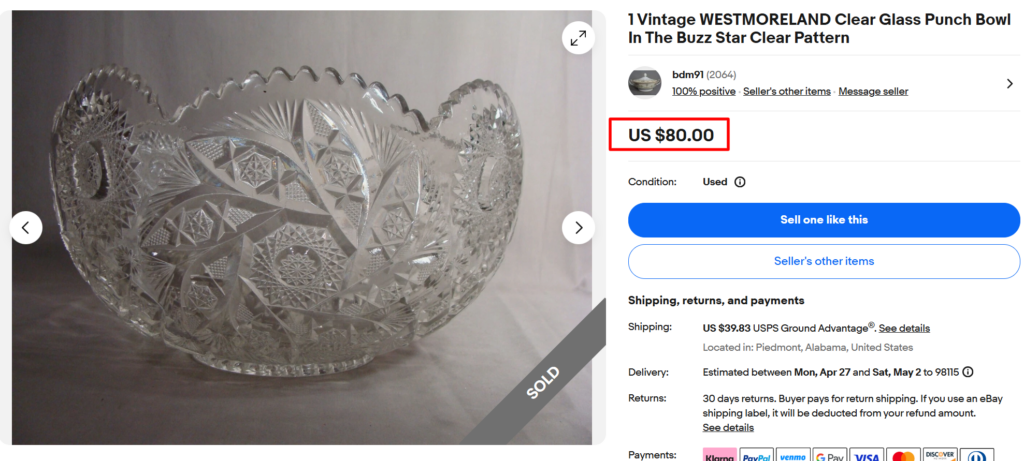
This vintage clear glass punch/serving bowl clearly shows the intricate details of the Buzz Star patterns. Larger pieces like this are harder to find than smaller nappies or celery vases.
8. Lotus (Line #1921)
The Lotus pattern looks like a blooming lotus flower. You can spot it by its flower-shaped base with petal-like extensions and a spiral twist column. Westmoreland made it primarily in milk glass and colored glass, including pieces in green uranium (vaseline) glass.
The pattern was primarily used for candle holders, compotes, and bowls. Uranium glass Lotus pieces are particularly collectible.
| Average Value | $10 – $30 (singles) $75 – $175 (small sets/pairs) |
| Production Period | 1930s – 1970s |
| Key Features | Petal-like curved ridges, spiral stem |
| Value Factors | Uranium glass pieces, pairs, frosted/satin finishes |
| Collector Notes | Uranium pieces must glow green under UV blacklight. |
Green Uranium Glass Lotus Candle Holders
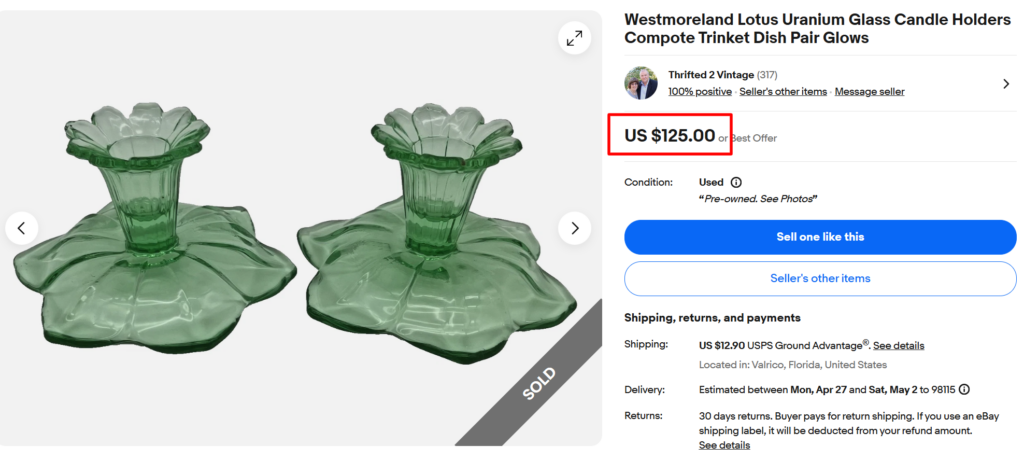
This pair of Lotus candle holders is in uranium glass. Uranium glass Lotus pieces are hard to find because Westmoreland produced relatively few forms in this glass type. The 1940s blue opaline milk glass version is another rare color variation to look for.
9. Wakefield (Line #1932)
Wakefield (also sold as Waterford) is a geometric cut-glass style pattern featuring a crisscross diamond grid with fan accents. Westmoreland used this pattern primarily for fairy lamps, which became a major product line in the 1970s.
| Average Value | $40 – $65 (clear singles) $250 – $500+ (carnival glass) |
| Production Period | 1970s – 1984 |
| Key Features | Diamond crosshatch grid with fan motifs |
| Value Factors | Ice blue carnival, ruby red flashed, artist signs |
| Collector Notes | Hand-painted, artist-signed pieces are rare. |
Ice Blue Carnival Glass Wakefield Fairy Lamp
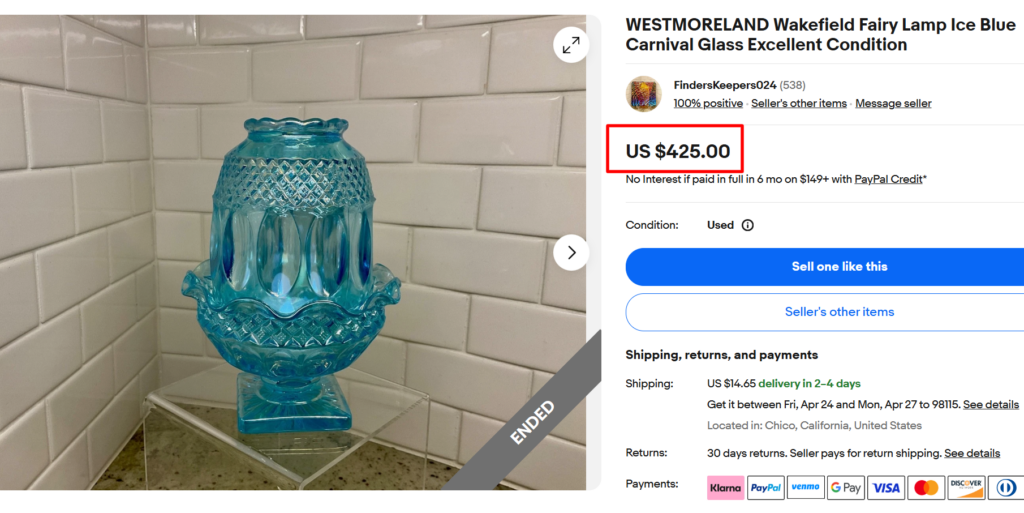
The Wakefield fairy lamp is a two-piece design with a dome shade and a matching footed base. It was produced in crystal, ruby red flashed, ice blue carnival, green carnival, vaseline satin, and hand-painted versions.
Ice Blue is one of the rarest carnival glass colors. This fairy lamp combines this rare color with a notable pattern and unique shape, resulting in a premium price tag.
10. Agronaut Shell (#1048)
This pattern is based on the French “Dauphins” design, which was originally made by Portieux Vallerysthal around 1908. Westmoreland copied the mold and called it a “faithful reproduction of a classic design.”
Westmoreland’s version features raised seashells around the body, a beaded lip, three dolphin-shaped feet, and an argonaut shell as the lid handle.
This design was released in over 20 colors, starting in the late 1950s through 1984. This is one of Westmoreland’s most distinctive designs, and it’s almost exclusively found as a covered candy dish or compote.
| Average Value | $25 – $50 (milk glass) $60 – $280 (slag colors) |
| Production Period | Late 1950s – 1984 |
| Key Features | Nautilus shell with dolphin feet |
| Value Factors | Slag glass or Blue Mist colors |
| Collector Notes | Milk glass versions were discontinued in 1963 |
Slag Glass Agronaut Shell Candy Dish
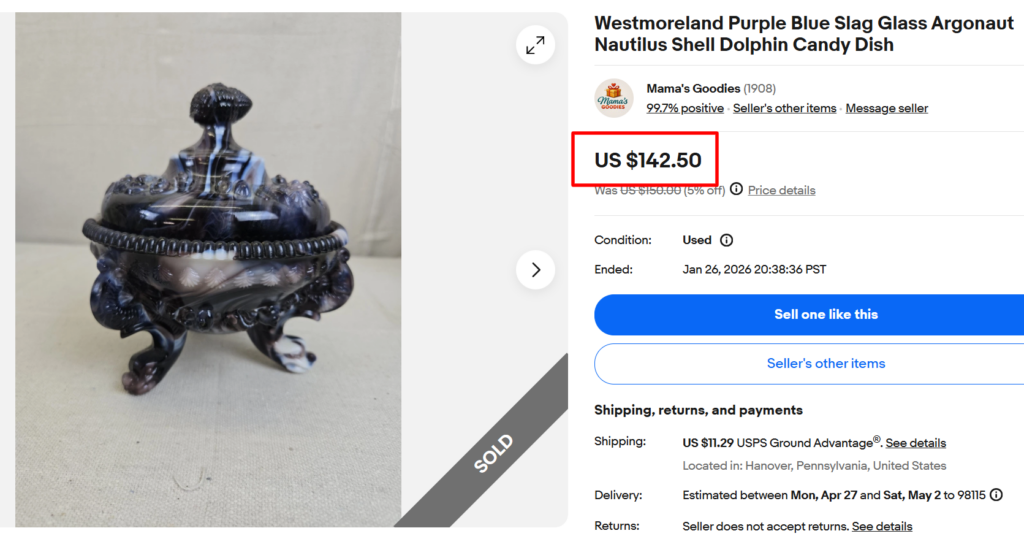
Purple slag is one of the more common Argonaut Shell colors, but it still holds value because of the pattern’s distinctive form. Ruby red slag and Olive green slag versions are harder to find and bring the highest prices in this category.
11. English Hobnail (Line #555)
English Hobnail is one of Westmoreland’s longest-running patterns, first introduced around 1915. Unlike Fenton’s standard hobnail, English Hobnail features a diamond-grid layout with flat-topped bumps that are cross-scored into four tiny nubs. Each “hob” sits in a diamond arrangement rather than rows.
The pattern was made in full table service with over 135 different forms at peak production. Colors included crystal, amber, green, rose, blue, topaz, and milk glass.
| Average Value | $5 – $50 (common pieces) $60 – $150 (rare forms) |
| Production Period | 1915 – 1970s |
| Key Features | Small raised diamond points |
| Value Factors | Rare colors (rose, Moonstone), specialty forms |
Clear English Hobnail Vase
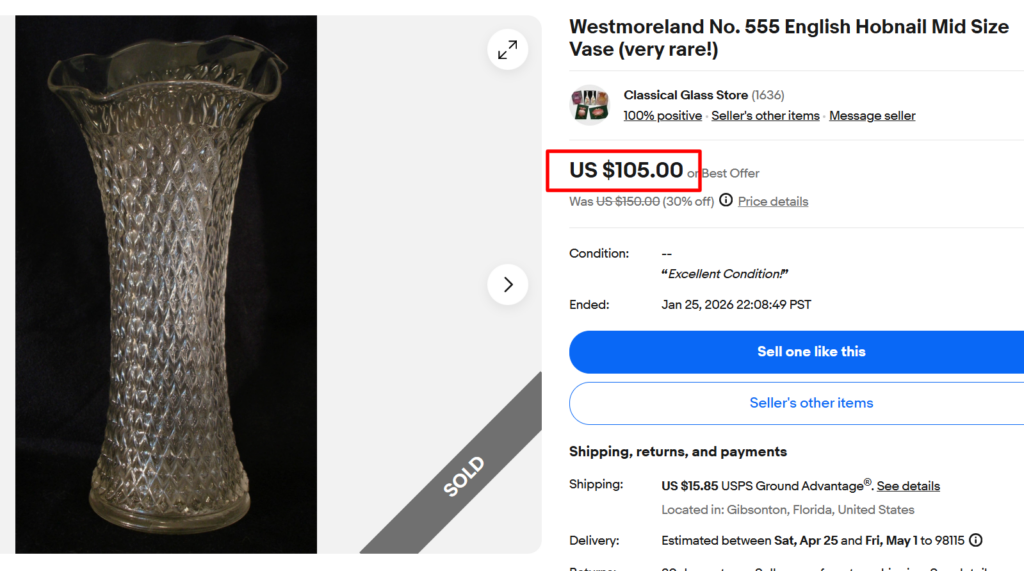
This is a clear mid-size vase in English Hobnail pattern. Vases are among the harder-to-find forms in English Hobnail compared to plates, cups, and common flatware. Similarly, colored pieces, rose or Belgian Blue, are more valuable than clear ones.
12. Figural Animal Design
Westmoreland’s figural animal covered dishes are some of their most recognizable products. The company made its first milk glass hen on nest around 1889, and these dishes remained in production for nearly a century.
While many other companies produced this design, it’s actually Westmoreland that’s credited with coining the term “hen on a nest” in the 1930s.
The dishes come in multiple sizes (the 5-inch is most common), and were made in milk glass, colored glass, carnival glass, slag glass, and hand-painted versions. Early versions had no painted details on the comb, while later pieces added red or colored accents.
| Average Value | $15 – $35 (milk glass) $40 – $350; (rare colors/carnival) |
| Production Period | 1889 – 1984 |
| Key Features | Two-piece figural hen lid on basket-weave nest base |
| Value Factors | Colored pieces, carnival glass for Levay, unusual animals |
| Collector Notes | Check for mismatched “married” tops and bases |
Blue White “Hen on Nest” Dish
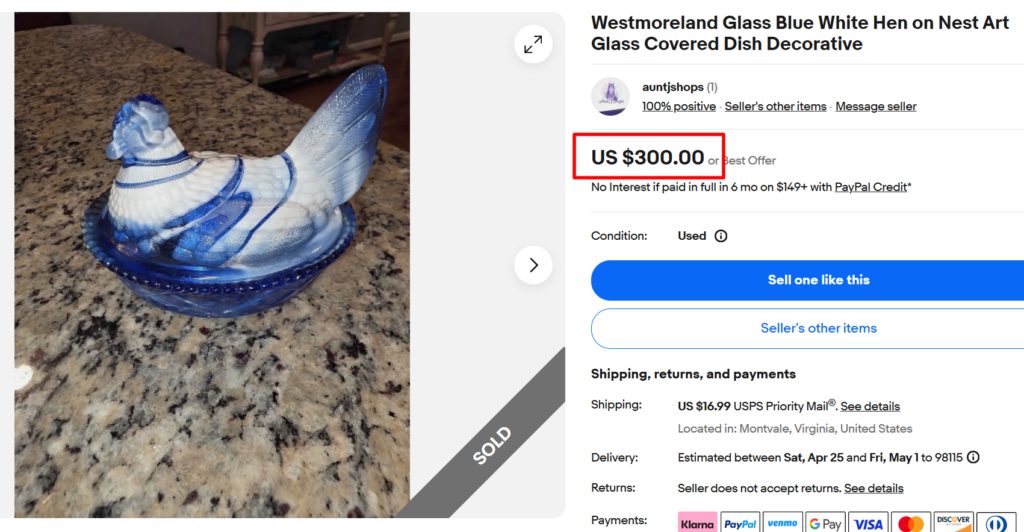
Blue glass Westmoreland hens are harder to find than the standard white milk glass versions, which usually go for $15 to $30. Purple slag pieces are also quite collectible
Always ensure that the top and base of these animal dishes are from the same manufacturer. “Married” pieces (a top from one maker with a base from another) are common and worth less than an original set.
How to Spot Valuable Westmoreland Glass?
Now that you know some of the most interesting Westmoreland glass designs, let’s understand how to find out whether a specific piece is authentic and valuable. Check the following things:
The Maker’s Mark
The marking is one of the most reliable ways to identify genuine Westmoreland glass. The company used two main marks during production.
From 1910 through the mid-1940s, they stamped a “W” inside a Keystone shape. Starting in 1946, they switched to the more familiar intertwined “WG” logo that most collectors are familiar with today.
However, you must remember that marks sometimes wore out of the molds, and Westmoreland didn’t always fix them. So, some genuine unmarked pieces also exist. In such cases, examine the other features for authenticity.
Glass Type (Weight & Feel)
Westmoreland made their glassware range with different types of glasses, including milk glass, crystal, colored glass, slag glass, and carnival glass. Knowing the differences between these glasses can help you identify a genuine piece.
If a certain type of glass piece, which the company never actually made, is claimed to be Westmoreland, then it is a red flag.
Also, genuine Westmoreland glass is hand-pressed and generally heavier than machine-made reproductions. If you run your fingers over the pattern, you’ll feel slightly sharper mold details and minor hand-finishing marks on rims and bases on the original pieces.
Similarly, ground bottoms (flat, polished bases) are a sign of higher-quality Westmoreland production, especially on patterns like Della Robbia.
The Color
If you’re looking at colored Westmoreland glass, compare the shade carefully against known and documented examples.
Post-1984 productions from other companies using Westmoreland molds often have slightly different color tones. This is especially true for slag glass, where the marbling pattern may look different from authentic Westmoreland production.
Besides, get familiar with Westmoreland’s specific palette, such as “Golden Sunset” or “Mist” via catalogs or guides. This helps you spot a reproduced or fake colored glass piece claimed to be Westmoreland, because you know that the company never made that color.
Condition & Completeness
Like all vintage glassware, the condition is crucial for the value of Westmoreland glassware. Any severe chips, cracks, scratches, or cloudiness significantly hurt the value. Minor scratches and light wear are usually acceptable.
For two-piece items like hen on nest dishes, fairy lamps, and covered candy dishes, complete matters a lot. So, always confirm that both pieces belong together by matching glass color, consistent mold quality, and similar marks. “Married” sets (a lid from one manufacturer paired with a base from another) are common and worth less.
The same goes for common dinnerware pieces like plates, cups, and bowls. Complete and matching sets are way more valuable than single pieces.
Note: This article is intended for informational, educational, and entertainment purposes only. Some images are illustrative and may not represent actual brands, products, or related entities. All trademarks, product names, brand logos, packaging, and other intellectual property referenced remain the exclusive property of their respective owners. Any brand mentions or references are provided solely for descriptive and educational context and do not imply any formal or commercial association.