Antiques Know How Research
Antique ABC Glass Value
Our Antiques Know How team’s analysis of eBay and auction results shows that antique American Brilliant Cut Glass usually ranges from $100 to $5,000, with rare, signed pieces by top makers fetching the highest prices. Notable high‑value forms include Dorflinger ruby cut‑to‑clear pieces, Hawkes “Chrysanthemum” pitchers, panel‑cut trays, and Libbey “Kimberly” pieces and trays. Assess the value by the maker’s name and marks, glass quality, cutting quality, shape, and condition.
Antiques Know How
What is ABG or ABC Glass?
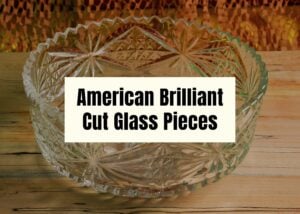
American Brilliant Cut Glass (or ABG) is handmade lead crystal produced during the golden age of cut glass (aka Brilliant Period), 1876–1917. The name comes from the glass’s exceptional clarity and shine, which are due to about 50% high lead content.
The era began at the 1876 Philadelphia Centennial Exposition, where American cut glass outperformed European imports. Demand exploded, and factories across the Northeast hired skilled cutters to handcraft intricate geometric patterns.
The period ended around 1917 when World War I diverted lead for military use, tastes shifted to simpler designs, and cheaper pressed glass took over the market. Today, signed pieces by major makers in excellent condition are actively collected in the antiques market.
Quick Test: Lead glass from the Brilliant Period fluoresces yellow-green (due to manganese) under a long-wave UV (black) light in a dark room. Modern glass appears blue, purple, or pink under UV light.
Rare American Brilliant Cut Glass Pieces to Find
Below are listed some of the most valuable ABC glass pieces, featuring iconic patterns from top glass houses. Some of these are so rare that even a single piece is worth a thousand dollars or way more.
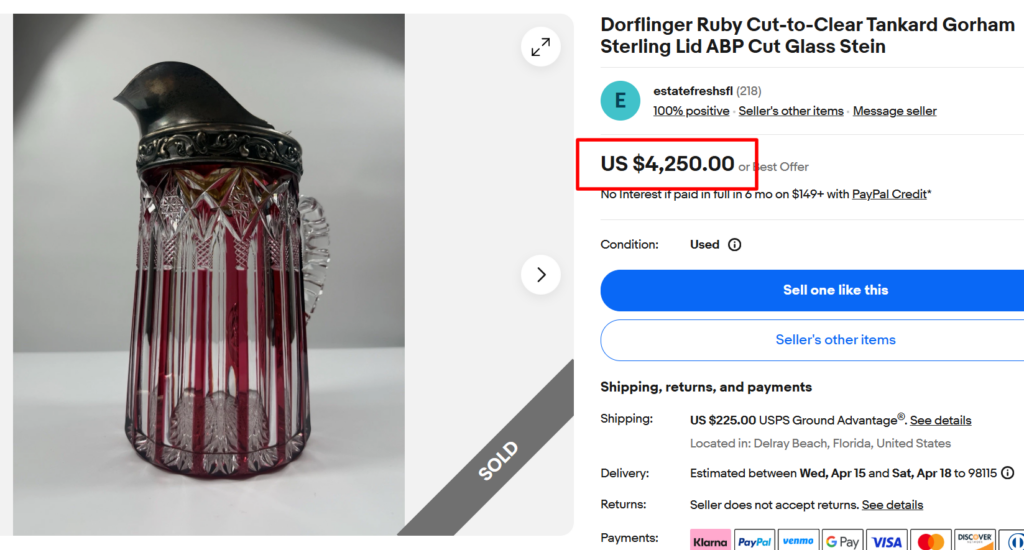
1. Ruby Cut-to-Clear “Panel” Stein with Gorham Lid – Dorflinger
| Average Value | $2,000–$5,000 |
| Production Period | c. 1890–1905 |
| Status | Discontinued |
| Key Features | Ruby overlay, sterling Gorham lid, panel cutting |
| Collector Notes | Confirm Gorham hallmark on the lid. |
This piece shows one of the most valuable combinations in American Brilliant cut glass. It features a Dorflinger ruby cut-to-clear body with panel-cut design, fitted with a hallmarked Gorham sterling silver hinged lid with ornate chasing.
Ruby or cranberry overlay pieces require cased glass: a colored layer fused to a clear body, then cut back to reveal the clear underneath. The process is time-consuming, making these pieces rare and highly desirable. The Sterling lid also adds to the value and rarity.
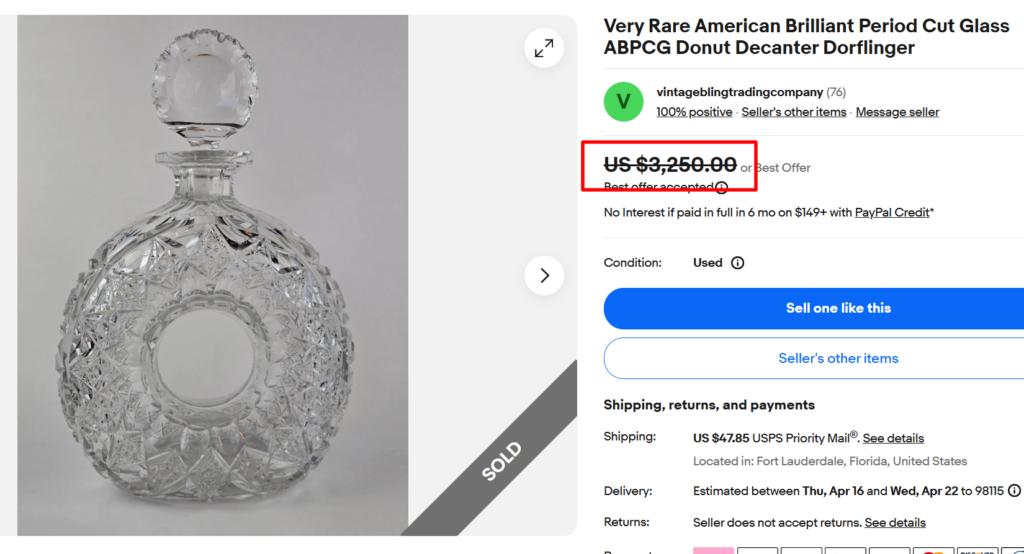
2. “Donut” Decanter – Dorflinger
| Average Value | $2,000–$3,500 |
| Production Period | c. 1895–1910 |
| Status | Discontinued |
| Key Features | Spherical form, circular aperture, all-over cutting |
| Collector Notes | Original stopper matters for value. |
The “donut” or ring decanter is one of the most unusual forms in American Brilliant cut glass. The circular aperture through the center of the body is not decorative; it serves as a handle.
Producing such a design on lead crystal required exceptional skill, making it a valuable piece. This Dorflinger’s version features dense all-over hobstar and fan cutting on what is already a technically demanding blank.
These rarely come to market in perfect condition, which is exactly why a fully intact example with the original stopper can be worth a few thousand.
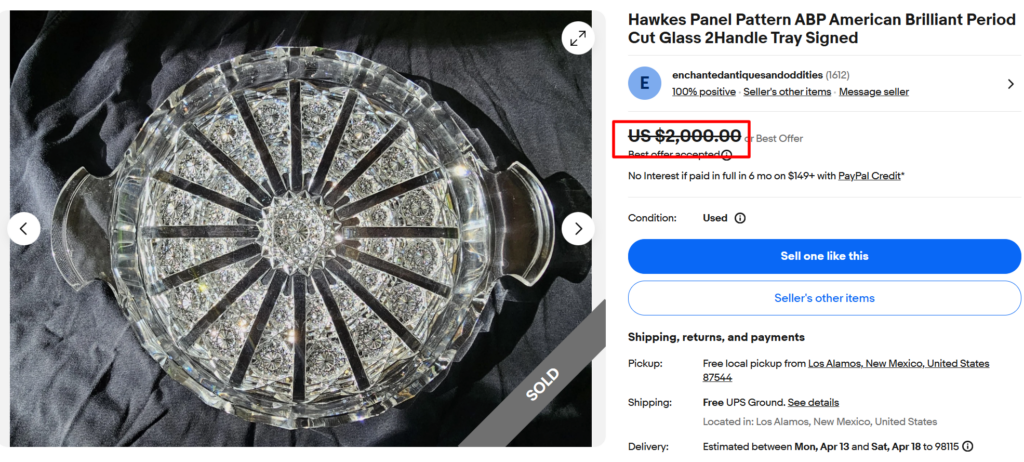
3. “Panel” Two-Handle Tray – Hawkes
| Average Value | $1,000–$3,000+ |
| Production Period | c. 1900–1913 |
| Status | Discontinued |
| Key Features | Panel cutting, hobstar center, handles |
| Collector Notes | Acid-etched Hawkes sign adds value. |
Hawkes’ Panel pattern features exceptionally deep vertical panels alternating with hobstar medallions. The cutting depth on documented examples is notable even among ABP pieces.
This two-handle tray is already a large, high-labor form. Plus, it’s signed by Hawkes at the base, which pushed its value to a whopping $2,000. Hawkes hardly signed their work, so when a piece carries the acid-etched Hawkes sign, it’s a rare and valuable find.
4. “Hobstar & Scroll” Sterling Rimmed Bowl – Whiting
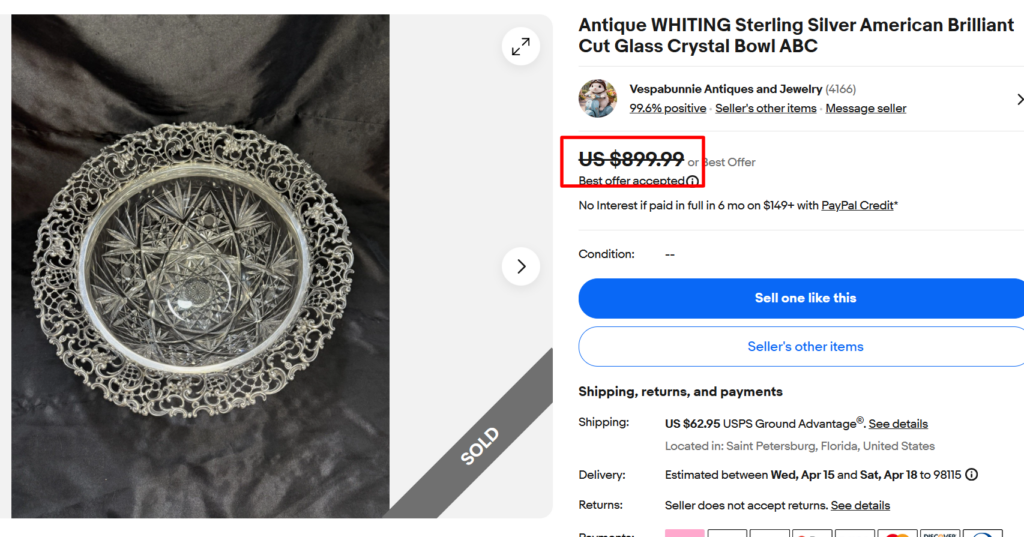
| Average Value | $600–$1,000+ |
| Production Period | 1895–1910 |
| Status | Discontinued |
| Key Features | Sterling rim, hobstar field, scroll motif |
| Collector Notes | Verify the Whiting & Sterling marks. |
This bowl, worth almost $900, combines two high-value elements: a deeply cut ABP crystal body and an ornate sterling silver rim by the Whiting Manufacturing Company of New York.
The hobstar and scroll cutting is dense and well-executed, which matters a lot for an ABC glass piece’s value. Besides, ABC pieces with American silver elements, like lids, rims, or stands, usually command premium prices.
To verify authenticity, look for the Whiting maker’s mark and the “Sterling” hallmark stamped into the underside of the silver rim.
5. “Kimberly” Ice Cream Tray – Libbey
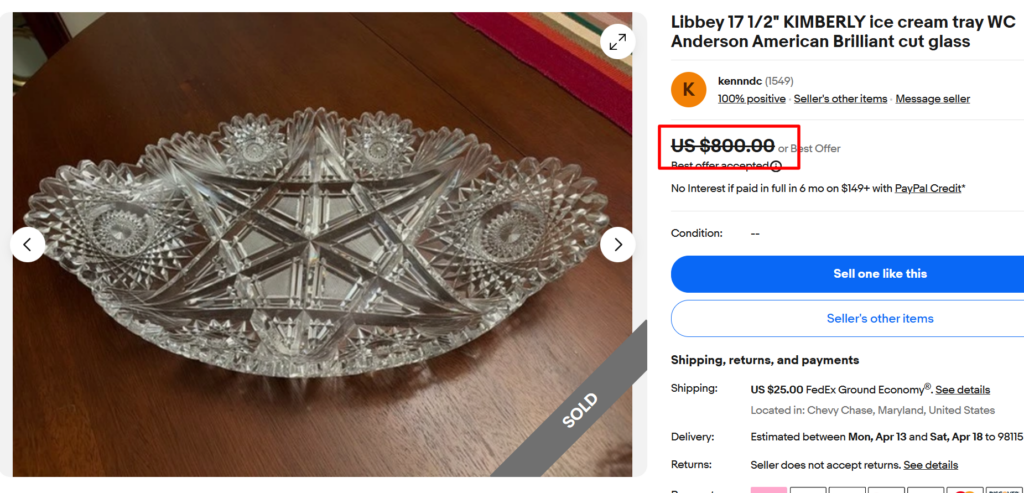
| Average Value | $600–$900 |
| Production Period | Patented December 18, 1891 |
| Status | Discontinued |
| Key Features | Central hobstar, diamond and star field, large format |
| Collector Notes | Look for acid-stamped Libbey saber mark. |
Libbey’s Kimberly pattern was designed by William C. Anderson, and the company patented it in 1892. You can identify it by a large central hobstar surrounded by interlocking circles and a diamond-and-star field covering the full surface.
Large Libbey ice cream trays (measuring around 17.5 inches) are among the most desirable ABP forms, since they need heavy, water-white blanks and extensive cutting time.
Signed examples are even more valuable, so look for the acid-stamped Libbey saber trademark on the interior.
6. “Parisian” Ruby Cut-to-Clear Wine Glass – Dorflinger
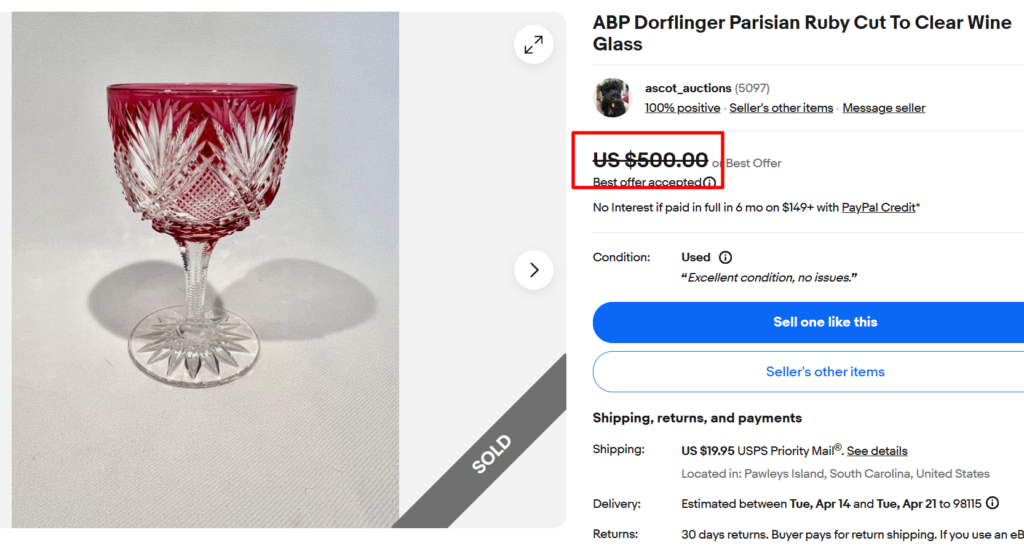
| Average Value | $400–$600 per stem |
| Production Period | c. 1885–1905 |
| Status | Discontinued |
| Key Features | Ruby overlay, Parisian pattern, hobstar foot |
| Collector Notes | Colored glass is rarer than clear. |
The magnificent wine glass displays Dorflinger’s iconic Parisian pattern. It combines the design of “double X vesica” with different patterns, such as fan, flashed blaze, hobnail, Brunswick star, hobstar, single star, and strawberry diamonds.
A good way to authenticate the piece is the hobstar-cut foot with 24-point stars and single stars on the hobnail.
In clear glass, it’s already collectible. In ruby cut-to-clear, it’s significantly rarer. Dorflinger made these cranberry-to-clear wine stems in small quantities, and most available pieces have come from small collections.
7. Chrysanthemum Whiskey Jug – Hawkes
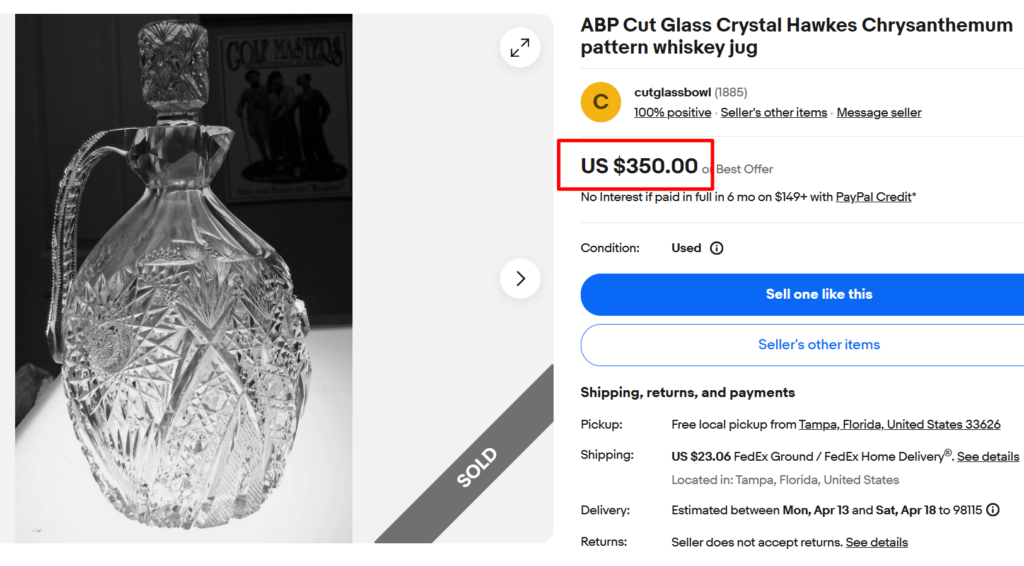
| Average Value | $300–$500 (jugs) $800–$1,500+ (bowls, large forms) |
| Production Period | Patented 1890 produced through c. 1902 |
| Status | Discontinued |
| Key Features | 22-pt hobstar “flowers,” Brunswick stars |
| Collector Notes | Signed examples are rare to find. |
T.G. Hawkes patented the Chrysanthemum pattern on November 4, 1890, and it won the Grand International Prize at the 1889 Paris Exposition. This fact itself makes it one of the most collectible ABC glass designs today.
The pattern translates a chrysanthemum flower into abstract hobstar form, with large 22-point hobstars acting as the flower heads. On a tall form such as this whiskey jug, the design is somewhat shortened to accommodate the barrel’s shape, and the notched flute is cut with an applied old-style handle.
As this pattern is usually found only on bowls and plates, Chrysanthemum pitchers with their stoppers are quite collectible.
8. “Aberdeen” Bowl – Jewel Cut Glass Co.
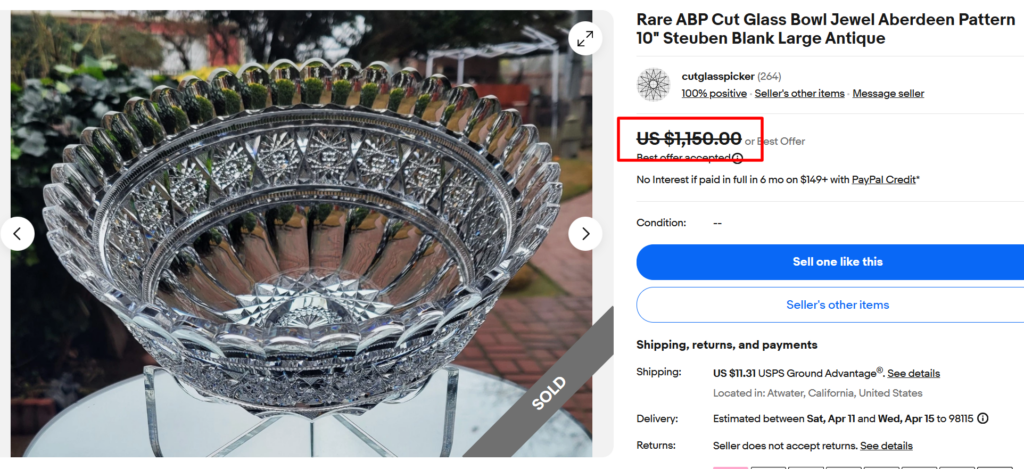
| Average Value | $900–$1,200 |
| Production Period | c. 1900–1915 |
| Status | Discontinued |
| Key Features | Button hobstars, concave flutes, sawtooth rim |
| Collector Notes | Large pieces are worth more. |
This large bowl from the Jewel Cut Glass Co. features the Aberdeen pattern. It’s often considered by collectors to be among the most expertly designed patterns of the entire period.
You’ll see crystal button hobstars arranged in rings, with concave flutes cutting between them, creating a depth effect. A surrounding layer alternates with clear scalloped sections.
Large pieces in Aberdeen, such as punch bowls, serving trays, etc., especially on heavy Steuben blanks, can easily fetch up to $1,000 today.
9. Arcadia Ice Cream Tray – Sterling Cut Glass Co.
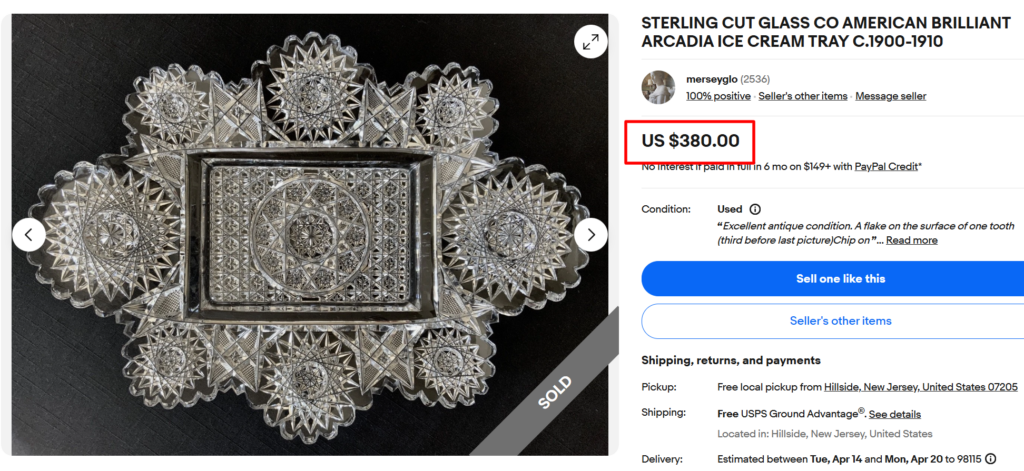
| Average Value | $300–$450 |
| Production Period | c. 1900–1910 |
| Status | Discontinued |
| Key Features | All-over hobstar, sawtooth border |
| Collector Notes | Check for chips on the edge. |
This magnificent Sterling Cut Glass Co’ multi-faceted ice tray features the Arcadia pattern. It’s a rectangular tray surrounded by round facets, all of which feature a dense, all-over hobstar field and a scalloped sawtooth edge.
This combination was considered high-end production at the time. Ice cream trays in large rectangular form are collectible regardless of pattern, given their size and heavy blanks. When combined with a high-end pattern from a notable maker like Sterling, it becomes a valuable find.
10. Bouquet Rock Crystal Card Stand – Pairpoint
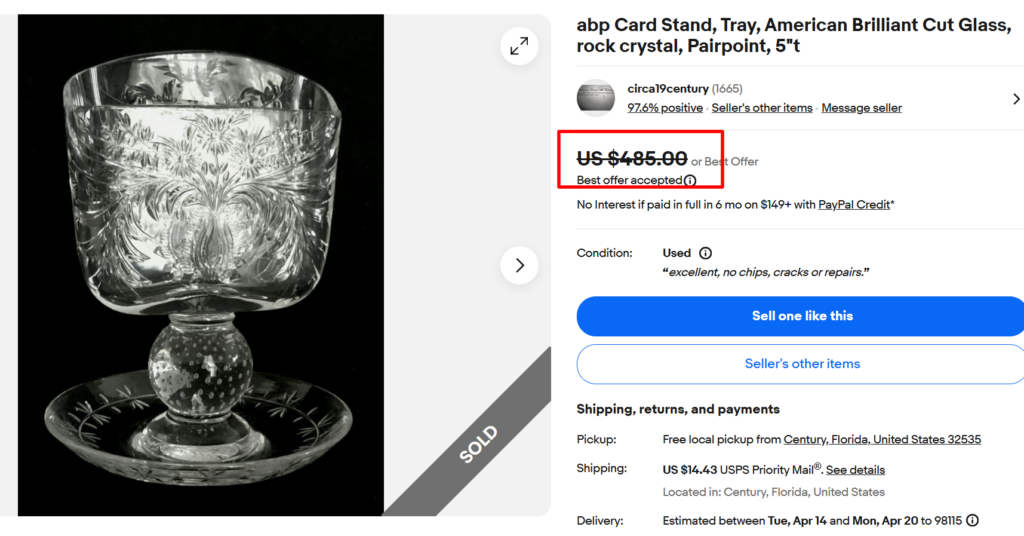
| Average Value | $400–$600 |
| Production Period | 1900–1919 |
| Status | Discontinued |
| Key Features | Natural motifs, ball stem, rock crystal technique |
| Collector Notes | Signed examples are rare and valuable. |
This unique card stand features Pairpoint’s rock crystal work. It’s a naturalistic engraving on a polished, non-frosted surface, among the most technically demanding glass decorations of the Brilliant Period.
This card stand in the Bouquet theme features hand-engraved floral motifs on a square-form cup body, sitting on a ball-knop stem above a small plate.
The combination of rock crystal engraving with a sculptural form like a card stand is unusual, because most Pairpoint rock crystal pieces are compotes and bowls.
What Makes Antique ABC Glass Valuable?
Apart from its “antique” status, several other factors determine which ABG pieces are valuable and which are not. These are:
Glass Quality
Genuine ABP glass contains about 25–50% lead oxide, making pieces noticeably heavy and giving them an exceptional sparkle. A large bowl or tray should feel dense—much heavier than modern glass of the same size.
If a piece feels light, it’s either a reproduction or a later production glass. This isn’t foolproof, but it’s the fastest first check.
Makers & Marks
Knowing the name of an ABP glassmaker is important because pieces from notable glasshouses can be worth significantly more than unattributed pieces. Some of the most collectible ABCG makers are:
- T.G. Hawkes & Co.
- Libbey Glass Company
- Dorflinger Glass Company
- Pairpoint Corporation
- Sinclaire Glass Company
- Jewel Cut Glass Company
- McKee Brothers Glass Company
While attribution matters, it’s challenging because most ABC glass was never signed. Even both of the most prestigious cutting houses, Hawkes and Hoare, seldom marked their pieces.
But when a signature does exist, it matters a lot.
Hawkes occasionally used an acid-etched mark showing a hawk flanked by two shamrocks within a circle. Libbey used an acid-stamped saber mark on the interior. Dorflinger signed only a small fraction of its production.
Patterns & Cutting
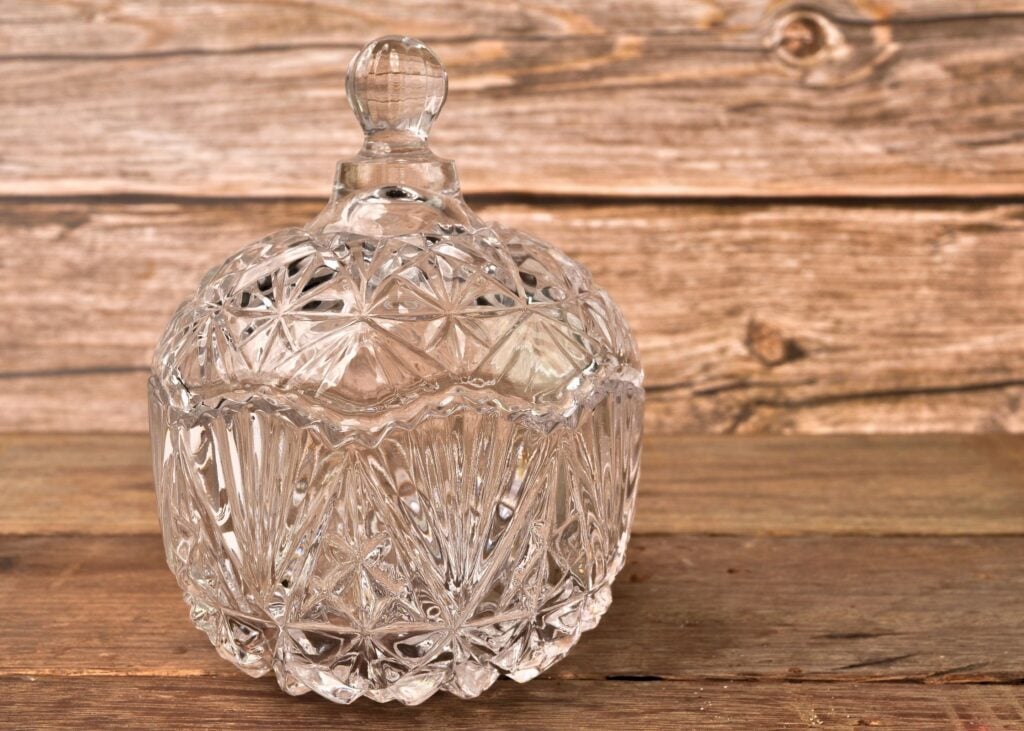
Both of these things go hand in hand and affect the authenticity and value of ABC glass.
Cutting Style
Run your fingertip carefully across the surface to feel the cutting. Authentic hand-cut ABP glass has sharp, crisp edges on every cut, not rounded or grainy.
Reproductions made with diamond wheels and acid-polished finishes often have rounded cut edges and sometimes show parallel abrasion marks under magnification.
Some reproductions may replicate the sharpness of a certain ABC glass pattern, but there will always be other signs, like a lightweight feel and dull sparkle, that will give them away.
Patterns
The pattern itself is a big value driver, since not all ABP patterns are equal. For example, Hawkes’ Chrysanthemum, Jewel’s Aberdeen, and Libbey’s Kimberly are consistently more sought-after than common hobstar-and-fan patterns.
Likewise, colored glass, like ruby, cranberry, cobalt, or amber, cut to clear, is rarer than clear in virtually every pattern because the casing process adds complexity and increases the failure rate.
Within clear glass, patterns with complete coverage and no plain areas bring more than those with open or plain sections.
Rare Forms
Naturally, larger, more complex forms needed better blanks and more cutting hours, making them more labor-intensive pieces. That’s why a signed Libbey ice cream tray at 17 inches is more valuable than a signed Libbey tumbler, even in the same pattern.
Unusual forms, like donut decanters, card stands, ice buckets, loving cups, and ring bottles, carry a premium because they show up less frequently. For pieces that came as a set, like a punch bowl set, completeness plays a crucial role in the value.
Condition
Since ABP glass is at least 110 years old, its condition matters a lot to its value. Pieces in exceptional, uncompromised condition are worth the most.
Even a small rim chip on an otherwise pristine piece can cut the value by 30–50%. Cracks are worse.
“Flea bites” (tiny rim chips) are common on older pieces and have less impact. Cloudiness from improper cleaning (dishwasher damage or exposure to hard water) is difficult to reverse and devalues a piece.
Note: This article is intended for informational, educational, and entertainment purposes only. Some images are illustrative and may not represent actual brands, products, or related entities. All trademarks, product names, brand logos, packaging, and other intellectual property referenced remain the exclusive property of their respective owners. Any brand mentions or references are provided solely for descriptive and educational context and do not imply any formal or commercial association.