Turn any Pyrex item over, and the bottom will tell you almost everything about the age and authenticity. You’ll be able to see the manufacturing date, location, and whether or not your item is worth five dollars or two hundred dollars.
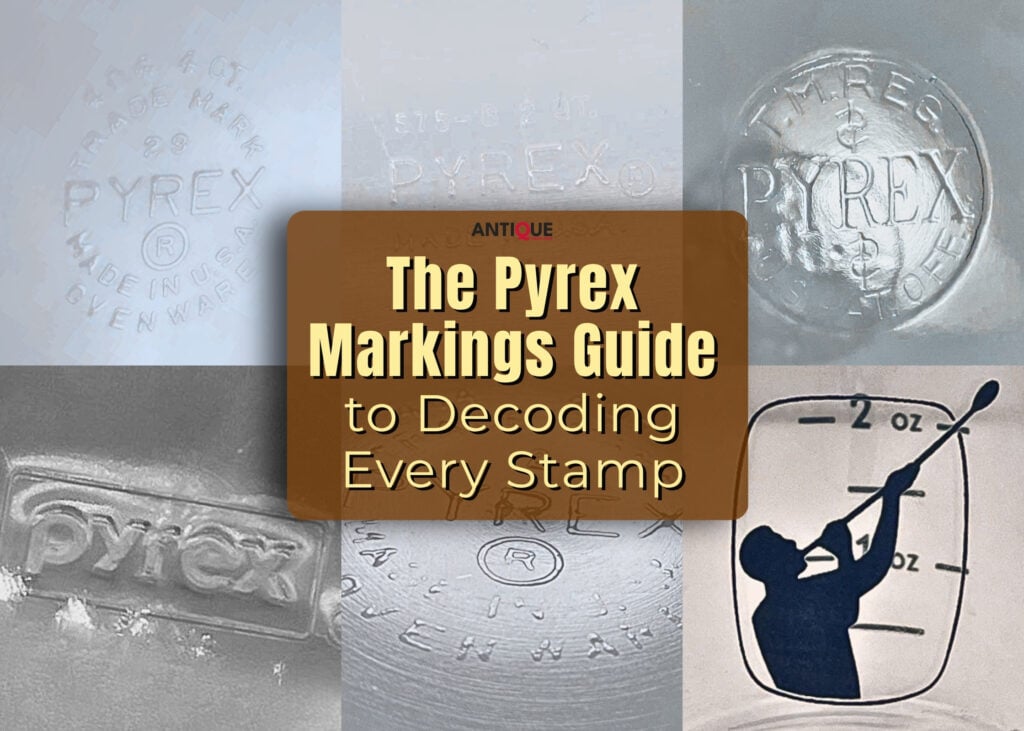
Most people do not bother to look as they should. But decoding a Pyrex stamp is literally the fastest way to tell whether your Pyrex is a true vintage or not.
Here is a breakdown of all the major Pyrex bottom stamps from 1915 up until now, each decade at a time. Keep an item handy while reading.
How to Read a Pyrex Bottom Mark?
Before we start counting decades, find out what you need to look for. The bottom marks on Pyrex items are embossed directly into the glass, not printed. That means they have tactile presence even when faded away to nothing but ghost writing.
Five things to pay attention to for dating clues:
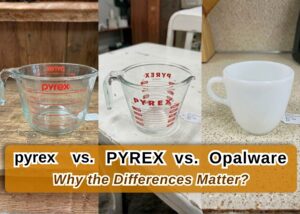
- Capitalization: “PYREX” in all capital letters is likely old Corning glass; lowercase “pyrex” indicates a newer piece.
- Logotype: Circular logotypes are old, straight and horizontal are new.
- CG logo: Small lettering resembling the backward dollar symbol is an abbreviation of Corning Glassworks; appears on only the very oldest Pyrex pieces.
- Model Numbers: Any three- or four-digit model numbers (such as 401, 442, 232) indicate the particular piece.
- Country and usage Designations: “Made in USA,” “No Broiler,” and any metric capacity designation each date from their own periods.
Stamps become faded due to the use of the dishwasher over many years. Should the stamp be soft, you can place it under a lamp and rotate it. Embossing will appear.
Handy Tip: Never rely on decals or stickers. Genuine vintage Pyrex almost always has its mark embossed onto the glass itself. A paper label without any embossing underneath it is a red flag.
All Pyrex Stamps by Decade
1915-1929: First Circle Stamps
PYREX was introduced in 1915 as heat-proof clear bakeware, and the first Pyrex stamps were very basic. The stamps consisted of PYREX written in all capital letters using serif lettering, in a circle, with the CG logo above and below the name.
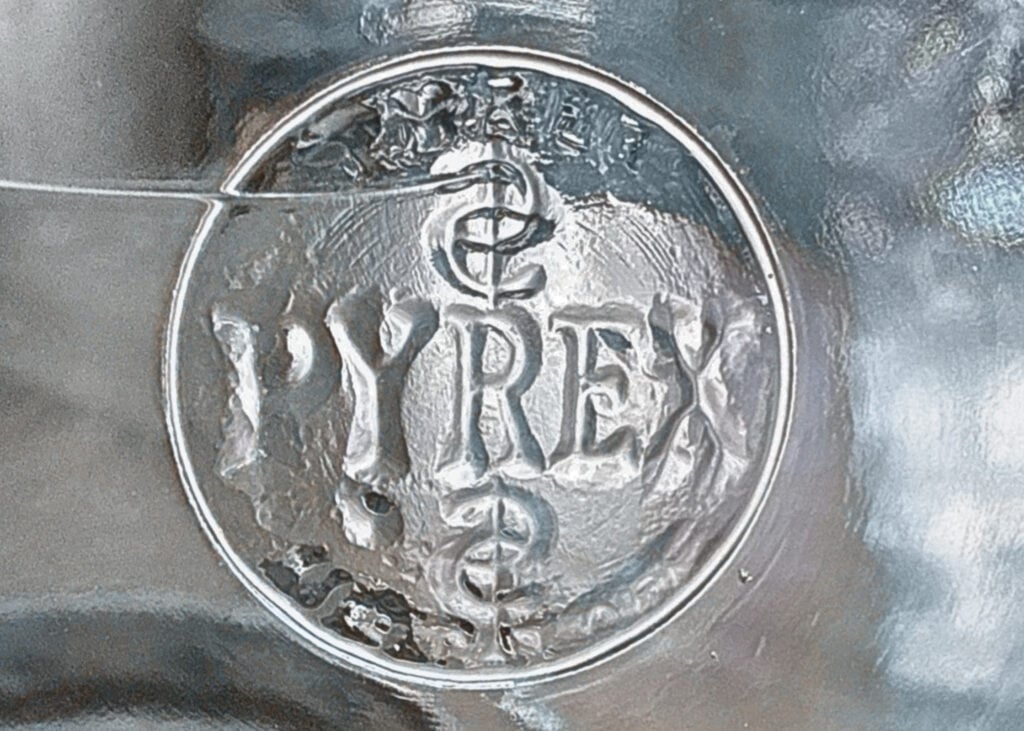
In 1919, the “PATENTED” label appeared above the name, and the date “MAY 27, 1919” appeared below the name on the stamp. This stamp variation with the patent date was one of the easiest to date exactly. From 1924, the new stamp design included “T.M. REG.” and “U.S. PAT. OFF.” encircling the circle.
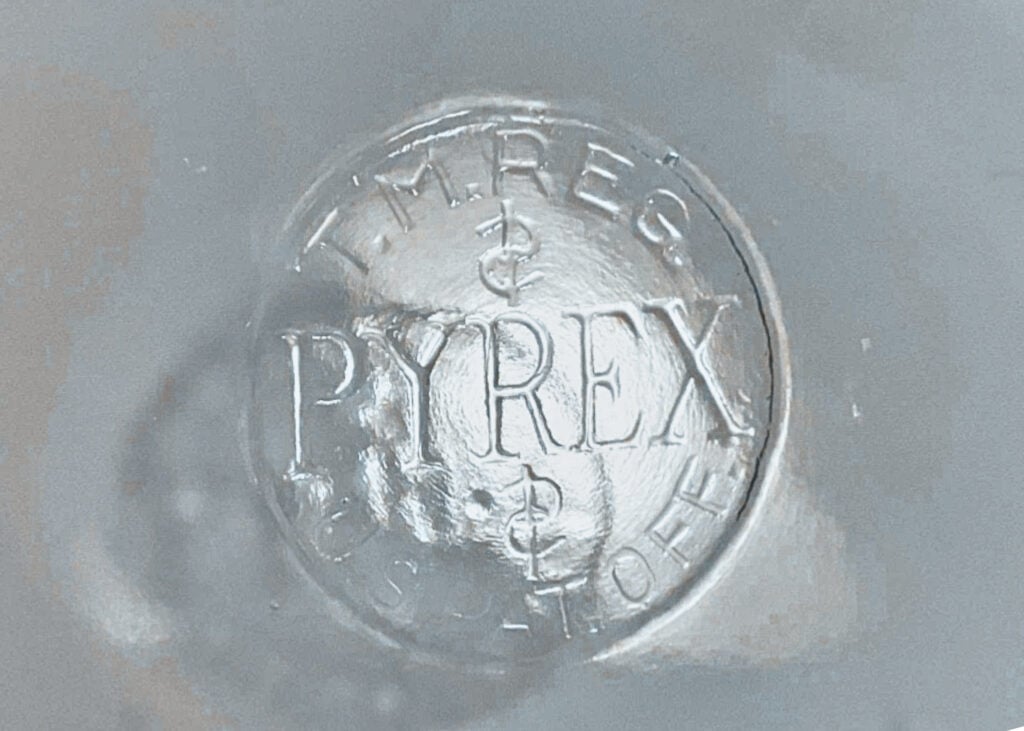
All products of this period were made of clear glass only. Colored opalware had not been invented yet.
1930s & 1940s: Opalware Comes & Markings Diversify
There were two significant shifts in the Pyrex stamp history during this period. Firstly, the company underwent a merger with MacBeth-Evans Glass from Charleroi, Pennsylvania, in 1936 when production of opalware began.
Secondly, the company had to update trademark texts due to the expiration of their patents.
So, here you can observe the continuation of the circle pattern, sometimes featuring the small image of a glassblower named “Little Joe”. This stamp existed before branded opalware from Pyrex and came along with the MacBeth-Evans collection.
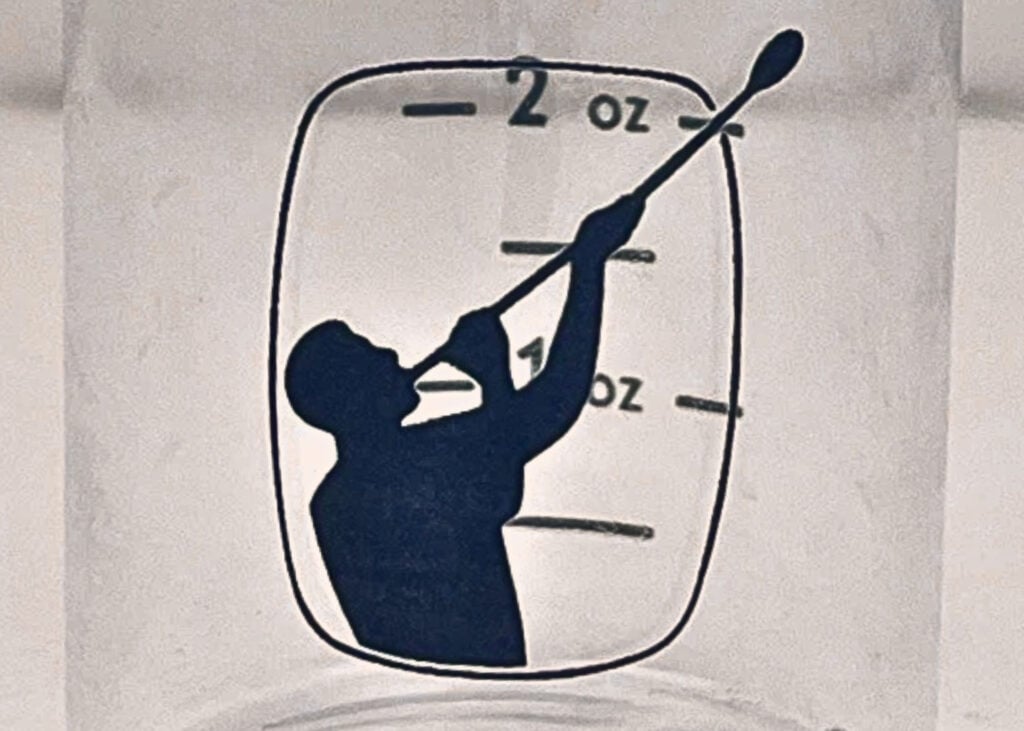
In the middle of the 1940s, the first colored bowls appeared. Primary Colors mixing bowl set was introduced in 1945 in red, yellow, blue, and green colors. They have regular circle stamps with models 401 – 404.
1950s: The Backstamp of the Golden Age
This is the most sought-after period for collectors. By the mid-1950s, “MADE IN THE U.S.A.” in uppercase letters, a trademark logo, and the trademark were added to the stamp, alongside other elements. Although the circle shape remains the same, the ring is now more crowded with text.
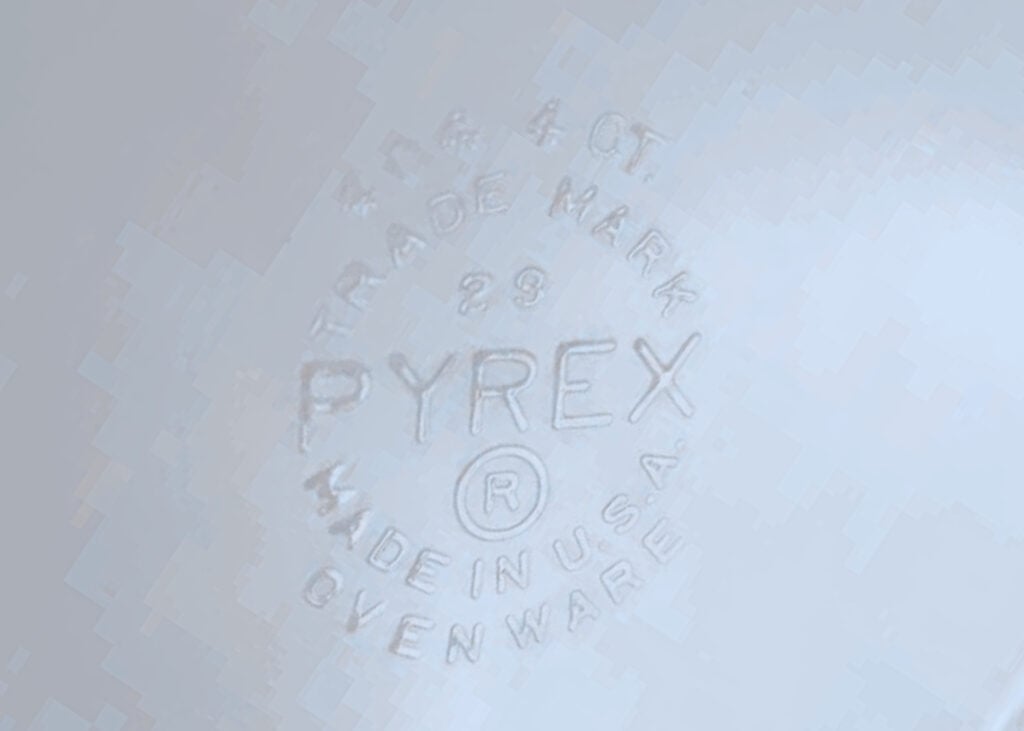
The names of patterns started appearing on backstamps in this decade. For instance, a 1950s Snowflake casserole piece will usually have the name of the pattern printed together with the PYREX mark on its bottom surface.
Some model numbers you might come across are 023 (round casserole), 232 (oblong utility), and 441 to 444 (Cinderella mixing bowls set, which appeared in 1957).
1960s: The Circle Vanishes
Some time during the late 1960s, the round backstamp was replaced by the straight stamp. PYREX in capital letters is now followed by the model and capacity, with “MADE IN U.S.A.” below. One of the clearest ways to date a piece of Pyrex is using the information in this entire guide!
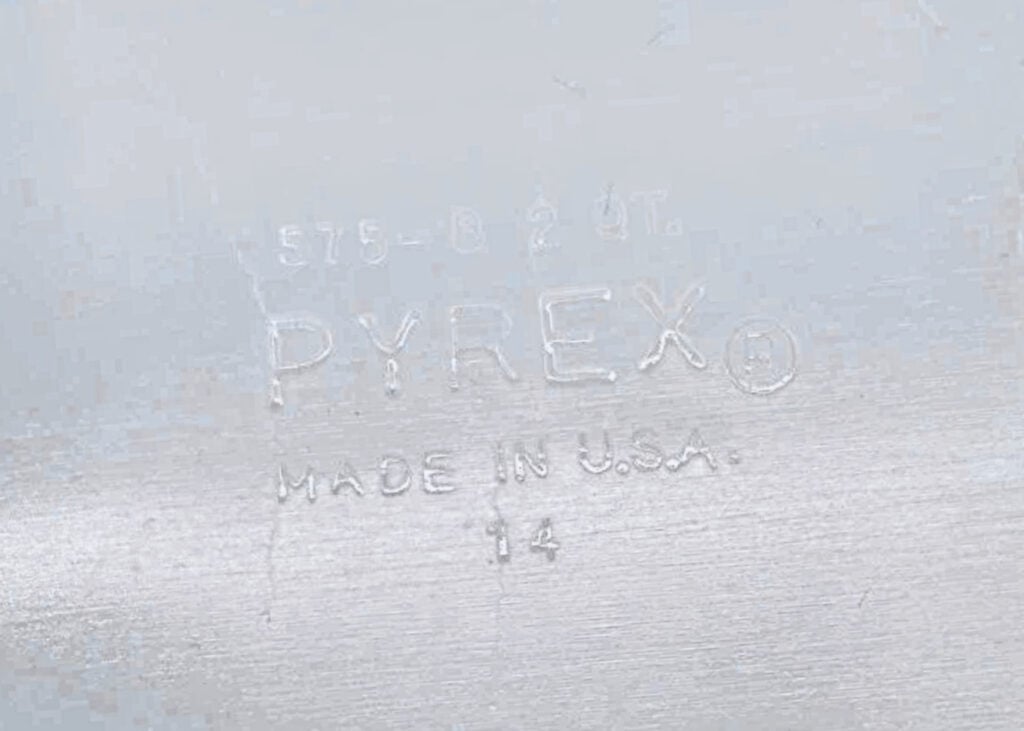
When you see a piece of Pyrex that has a straight backstamp that does not have any sort of circle, chances are good that you’ve found something from the 1960s.
1970s: Metric Marks and Warnings Appear
There are two Pyrex markings that identify the stamps from this decade.
From the mid-1970s on, there were metric capacities added to the imperial. If your pot has an embossing with capacities such as “1.5 QT / 1.4 L,” then it was manufactured after 1975.
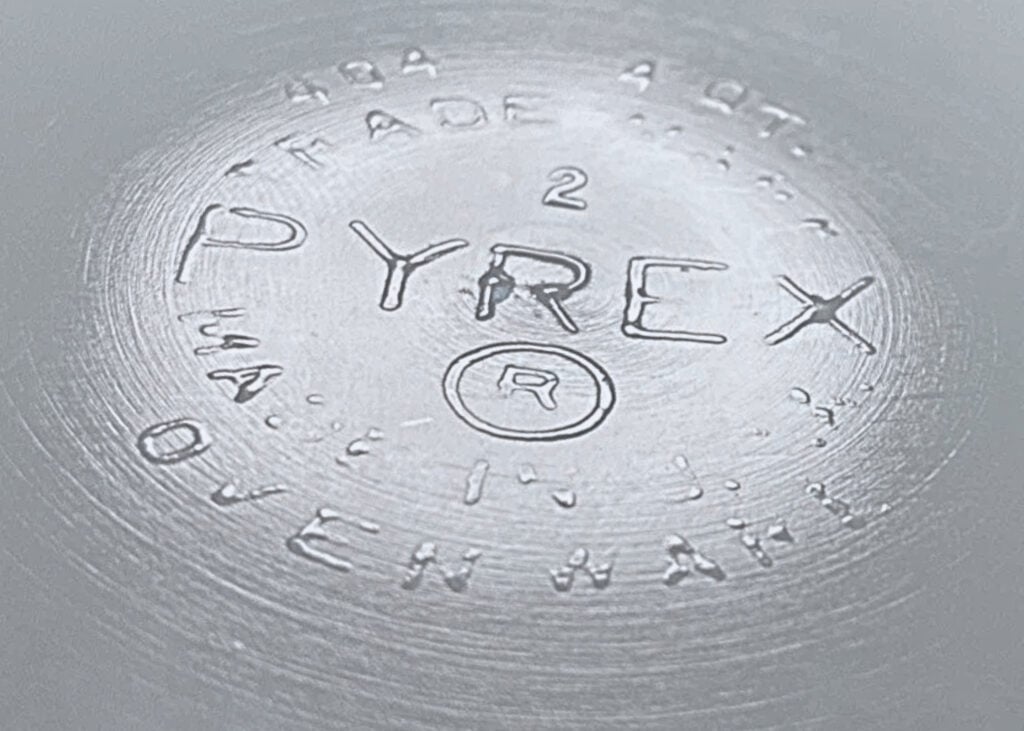
Also around this period, use warnings emerged. For example, “NO BROILER” or “NO STOVETOP.” Any vessel with such words was manufactured after 1970.
There is one more marking from this period – “by CORNING, Corning, NY, USA,” replacing the simple “Made in USA.”
1980s and 1990s: The Lowercase Transition
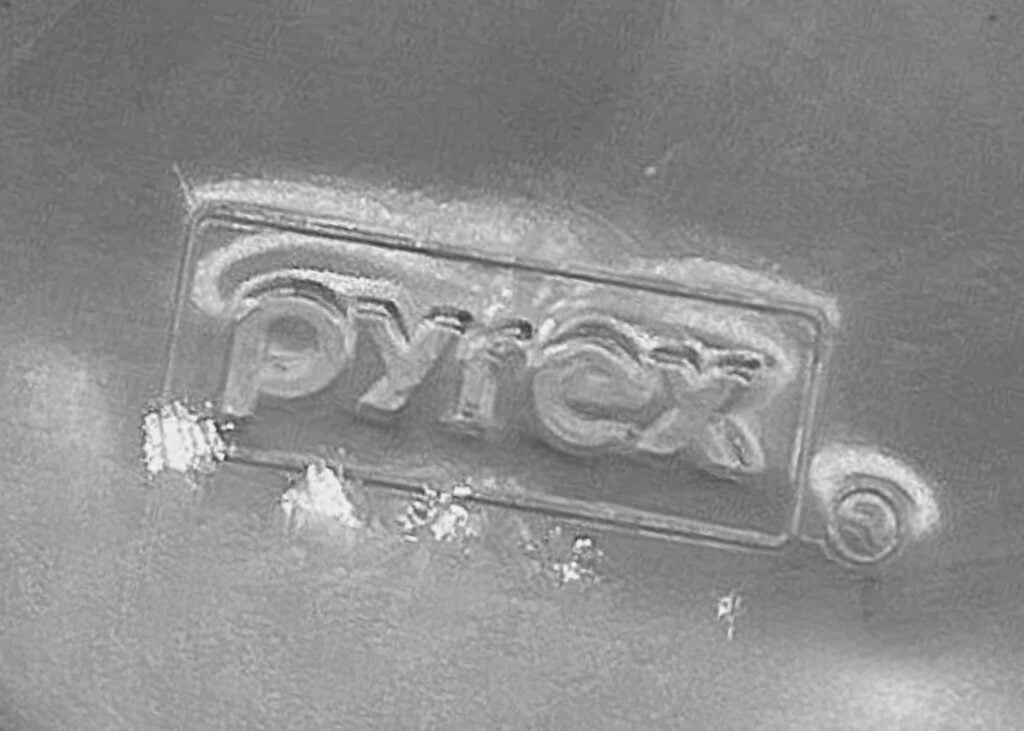
This is where the “old versus new Pyrex” battle begins. The lowercase Pyrex logo did not just pop up out of nowhere. It was copyrighted by Corning back in 1975 and appeared on some products.
Meanwhile, consumer products with the lowercase logo became available starting in 1994. During the 1980s and until the early 1990s, the uppercase PYREX logo remained the norm for kitchenware in the United States. If the item bears lowercase lettering, then it cannot possibly be older than 1994.
1998 to Today: The Instant Brands Era
Corning sold its kitchenware division in 1998 to Borden, now known as World Kitchen in 2000 and Instant Brands in 2021. The new owners switched to soda lime tempered glass, and the lowercase PYREX trademark was used in lieu of the uppercase mark.
Any piece marked with the lowercase PYREX and manufactured in the United States is a recently produced piece. It is neither borosilicate glass nor as highly valued as the vintage pieces.
Quick Pyrex Logo Reference Cheat Sheet
| Decade | Key Mark Feature |
| 1915 to 1924 | Circle with CG monogram, PATENTED MAY 27, 1919 (late) |
| 1925 to 1940s | Circle with T.M. REG. and U.S. PAT. OFF. |
| 1950s | Circle plus MADE IN THE U.S.A. and pattern name |
| 1960s | Circle disappears, straight-line layout |
| 1970s | Metric capacities and NO BROILER warnings appear |
| 1980s to early 1990s | Uppercase PYREX still standard |
| Post-1994 | Lowercase pyrex begins |
| Post-1998 | Lowercase pyrex, soda-lime glass, modern production |
JAJ Pyrex: The British Cousin
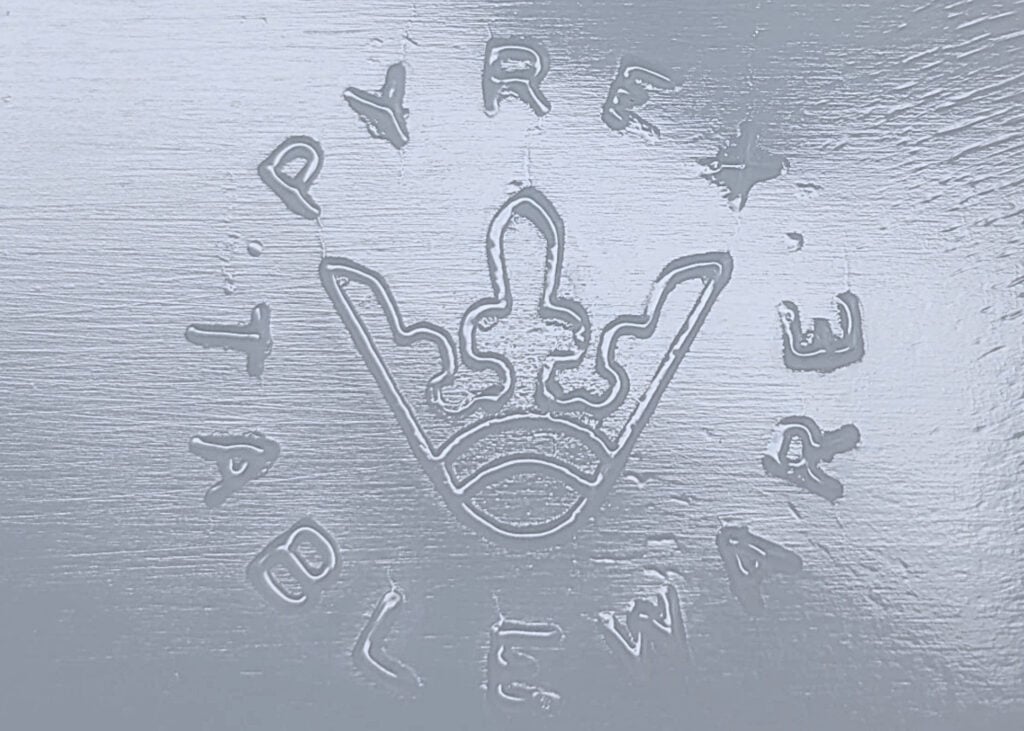
You’ll see some items marked “JAJ PYREX” or “Made in England”. These are made by James A. Jobling & Co., Sunderland, England, who acquired the right to manufacture Pyrex in Britain from Corning in 1921 and manufactured it until the 1970s.
JAJ products usually have a “crown” trademark dating from the early 1950s. They also have different patterns such as “Gaiety” and “Autumn Glory” instead of Butterprint and Gooseberry.
What Does the Bottom Stamp Tell About Value?
Marks only tell part of the story, but they do define the upper limit. Anything stamped with a circular mark prior to the 1960s is considered a vintage item, and anything with a pattern name and 1950s trademarking is generally worth the most. Rarity, color, and condition determine its actual value after that.
The lowercase “pyrex” almost never has any collector value. If you see “rare vintage” for a lowercase marked item, it isn’t worth looking.
Learn more about the vintage Pyrex patterns and their current values here.
Note: This article is intended for informational, educational, and entertainment purposes only. Some images are illustrative and may not represent actual brands, products, or related entities. All trademarks, product names, brand logos, packaging, and other intellectual property referenced remain the exclusive property of their respective owners. Any brand mentions or references are provided solely for descriptive and educational context and do not imply any formal or commercial association.