The average 1917 wheat penny will be worth about $1 or $2. However, some mint marks, grades, and errors can drive the price up into the hundreds, or even thousands. The 1917 Doubled Die Obverse can fetch a five-figure price tag in mint condition.
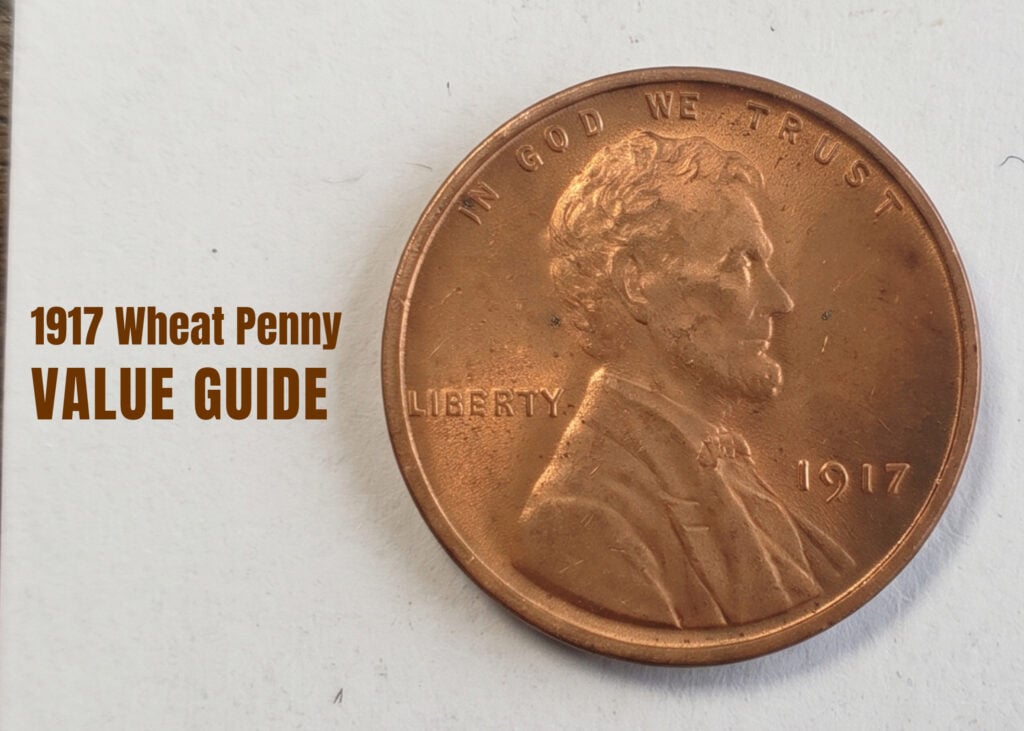
This guide explains how to tell what your 1917 penny is worth, including details on each type of penny and how much it’s worth based on its grade.
About 1917 Lincoln Wheat Cent
The Lincoln Wheat cents were minted from 1909 to 1958. The coin was designed by Victor David Brenner, and it was the first U.S. cent depicting an actual person.
By 1917, America had entered the First World War. All three U.S. mints were busy making pennies on a large scale at this point.
| 1917 Wheat Penny | Specification |
| Composition | 95% Copper, 5% Tin and Zinc |
| Minting Locations | Philadelphia (no mint mark), Denver (D), San Francisco (S) |
| Year of Minting | 1917 |
| Face Value | $0.01 (One Cent) |
| Weight | 3.11 grams |
| Diameter | 19 mm |
| Thickness | 1.55 mm |
| Edge | Plain (smooth) |
| Designer | Victor David Brenner |
| Philadelphia Mintage | 196,429,785 |
| Denver (D) Mintage | 55,120,000 |
| San Francisco (S) Mintage | 32,620,000 |
| Total Mintage | 284,169,785 |
| Proof Coins | None struck (no proofs were made from 1917 to 1935) |
Philadelphia minted almost 200 million pennies during that year. So, 1917 is considered an easy date for collectors, but the quality and varieties make the difference between common and rare pennies.
How to Identify a 1917 Wheat Penny
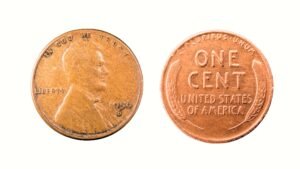
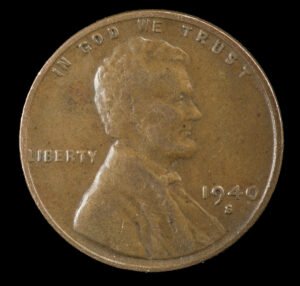
The mint mark sits under the date on the obverse (front). A “D” means Denver, “S” means San Francisco. No letter means it was struck at Philadelphia.
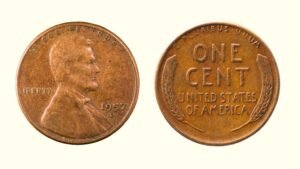
1917 Penny Obverse (Front):
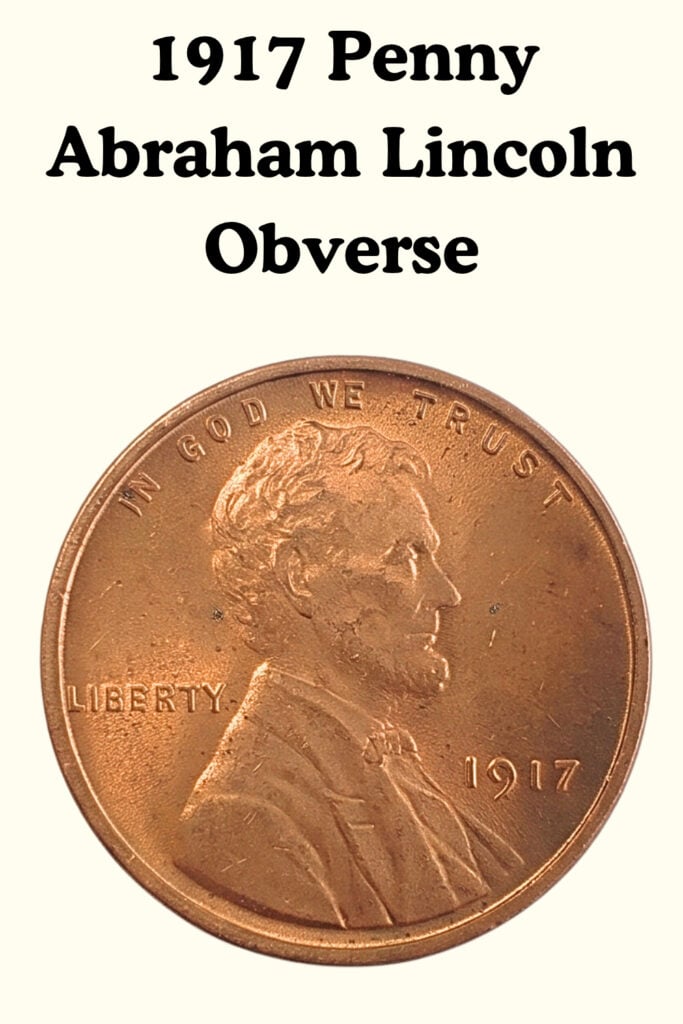
- Portrait of Abraham Lincoln facing right
- “IN GOD WE TRUST” arched above Lincoln’s head
- “LIBERTY” on the portrait’s left
- Date “1917” on the portrait’s right
- Mint mark (D or S) directly below the date. No letter = Philadelphia
1917 Penny Reverse (Back):
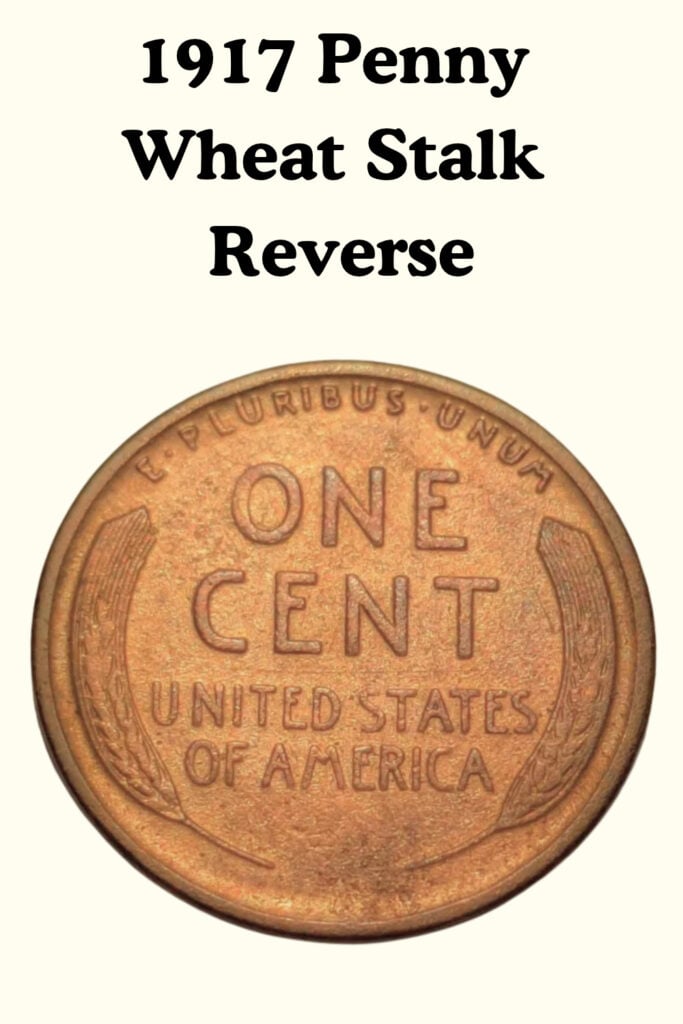
- “ONE CENT” centered in the middle
- “UNITED STATES OF AMERICA” across the upper half
- “E PLURIBUS UNUM” above the denomination
- Two wheat stalks on both sides of the text
Weight and Composition:
Every 1917 penny is 3.11 grams in weight and contains 95% copper and 5% tin and zinc. The size of the coin is 19 millimeters, while the edge is smooth.
If your coin is much lighter than 3.11 grams, you can say that it might be damaged, worn out, or fake.
1917 Wheat Penny Price Guide: How Much It’s Worth
The average value of a 1917 wheat penny ranges from $1 or $2 in completely worn condition to $30 to $1,500 in Mint State top grades, like MS74, while MS66+ examples are extremely rare and can fetch up to five figures.
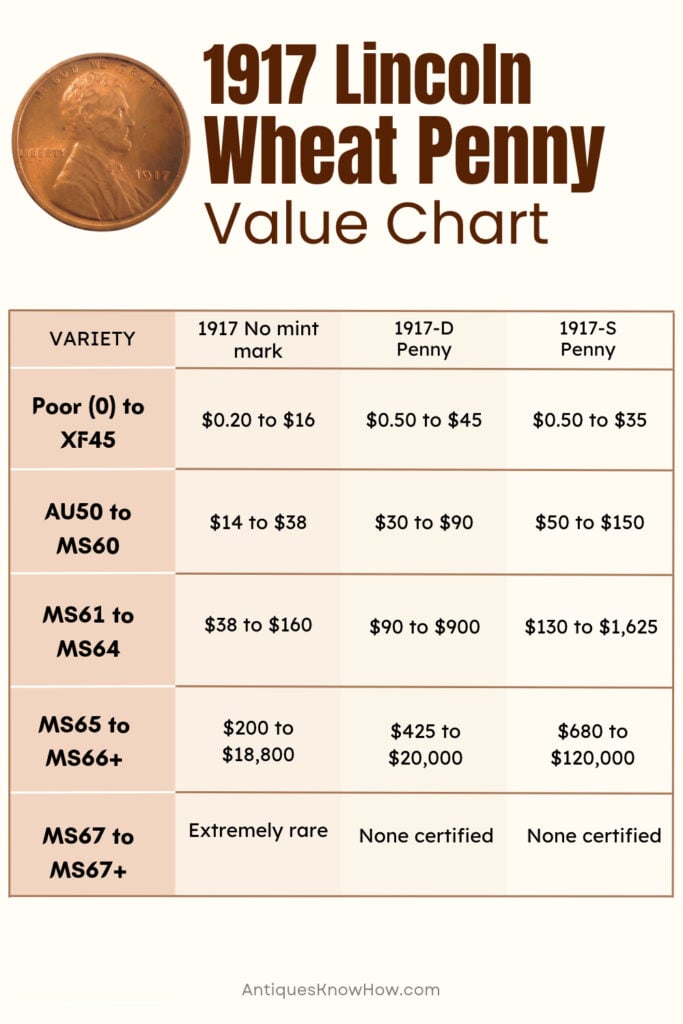
Three factors drive a 1917 penny’s value: the mint mark, the grade (condition), and the color designation. The table below covers all three business strike varieties across five grade tiers.
Coin Grades & Color Designation
The first and most important factor to determine a 1917 cent is its condition. Professionally, the condition of old cents is assessed using the Sheldon scale, a 1-to-70 system.
Grades 1 to 58 cover circulated coins, from Poor to About Uncirculated, while MS60 to MS70 cover Mint State. The most valuable 1917 pennies are the Mint State ones.
Along with grades, the value comes from the penny’s color designation. Copper coins are graded BN, RB, or RD based on how much original red copper luster remains.
- RD (Red): This grade is for coins that have 95% or more of their original luster intact.
- RB (Red-Brown): This grade is for coins with a mix of red and brown toning. These are mid-tier examples.
- BN (Brown): These coins are mostly brown and heavily worn, and fetch the least.
A 1917-S in MS65 BN might sell for around $680, while the same coin in MS65 RD has reached $11,400 at auction. Red examples command the highest premiums because most surviving 1917 cents have toned to brown over 100+ years.
Mint Marks and Mintage
The mint mark appears right below the mint year on the coin’s obverse. The mark changes based on where the coin was minted:
- 1917 No Mint Mark (Philadelphia): The Philadelphia mint made 196,429,785 pennies in 1917, the highest of the three mints. They are the most common 1917 pennies, but past MS65, they become rare. An MS68 RD was auctioned by Heritage Auctions for $38,812.
- 1917 D Penny (Denver): Denver minted 55,120,000 coins, one-third of what Philadelphia produced. The 1917-D coin is always worth more than other coins in any grade. An MS66 RB sold for $3,660 by Stack’s Bowers in June 2026. Denver pennies from that time period tend to be poorly struck due to worn-out dies brought from Philadelphia.
- 1917 S Penny (San Francisco): San Francisco had the lowest mintage at 32,620,000. The 1917-S is considered a semi-key date in the Lincoln cent series. It becomes notably scarce starting at XF40 grade, and red uncirculated examples are genuinely rare. Only about 50 specimens have been certified at MS65 across all color designations.
No proof Lincoln cents were struck in 1917. The Mint discontinued matte proof Lincoln cents after 1916 and did not resume proof production until 1936.
1917 Wheat Penny Errors and Rare Varieties
Error coins are where 1917 pennies get seriously valuable and collectible. A few key varieties are well documented, and they trade for a lot more than regular strikes.
1
1917 Doubled Die Obverse (DDO), FS-101
Typically sells for $10,500 (MS64) to $120,000 (MS67+)
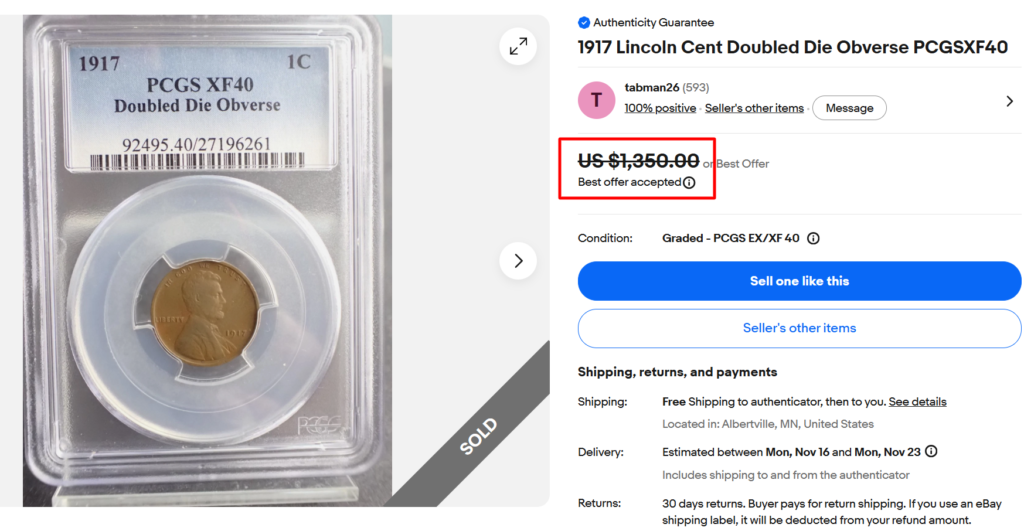
This is the most well-known type from 1917 for the Lincoln cent. The obverse die received two strikes at slightly different angles during the minting process, creating doubling on “IN GOD WE TRUST” and the date.
It is easily observable to the naked eye. There are about 250 pieces known, with less than 20% being uncirculated. A PCGS 1917 Lincoln Cent MS67+ RD example sold for a record price of $120,000.
2
1917-S Penny, Mint State
Typically sells for $100 (MS60 BN) to $36,800+ (MS66 RD)
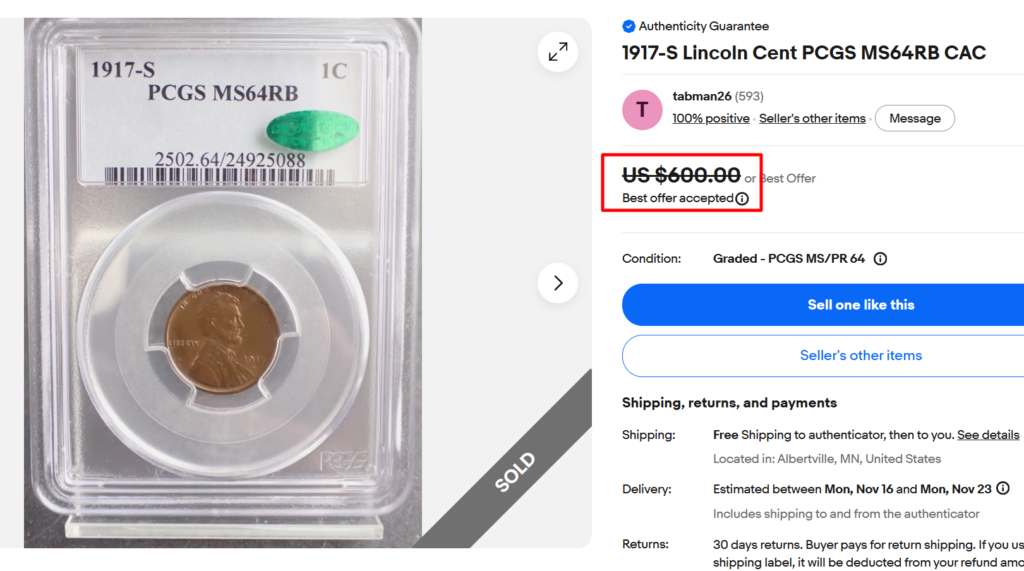
The San Francisco issue is a semi-key coin that becomes scarce starting at XF40. In mint state, red examples are genuinely rare. This is one of the tougher early Lincoln cents to locate in gem grades.
Only about 50 specimens have been certified at MS65 across all designations, which have sold for $3,000 to $25,000+.
3
1917 D Penny, Mint State
Typically sells for $60 (MS60 BN) to $24,000+ (MS66 RD)
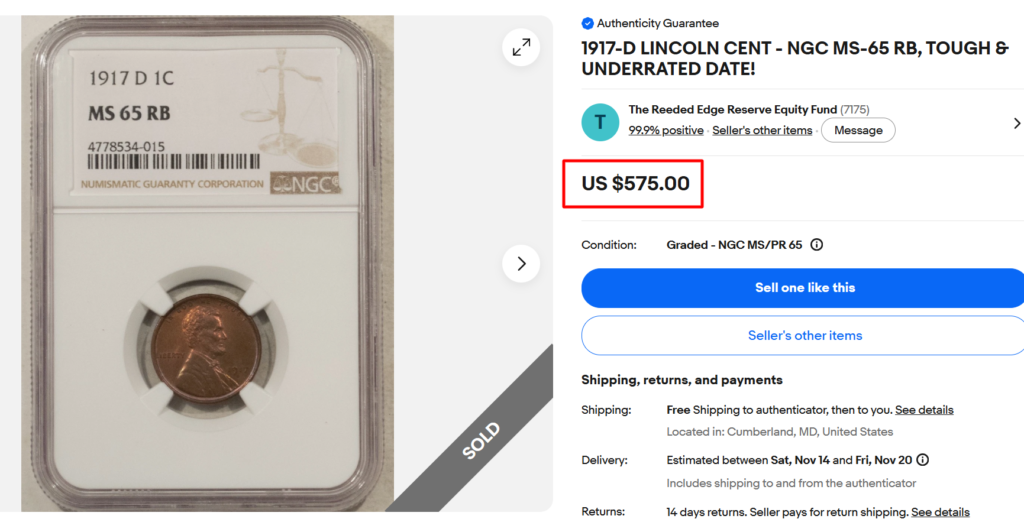
Denver made 55 million cents in 1917, but a lot of them came off poorly struck, as the dies had been made in Philadelphia and then shipped out west, tired. So, a well-struck 1917 D penny in mint state with clear hair detail and good wheat stalks is worth more than a poorly struck one.
The value for an MS65RD 1917 D penny ranges from $1,000 to $3,000, while MS66RD examples can fetch from $7,500 to $24,000.
4
1917 No Mint Mark Penny, Mint State
Typically sells for $18 (MS60 BN) to $38,812+ (MS68 RD)
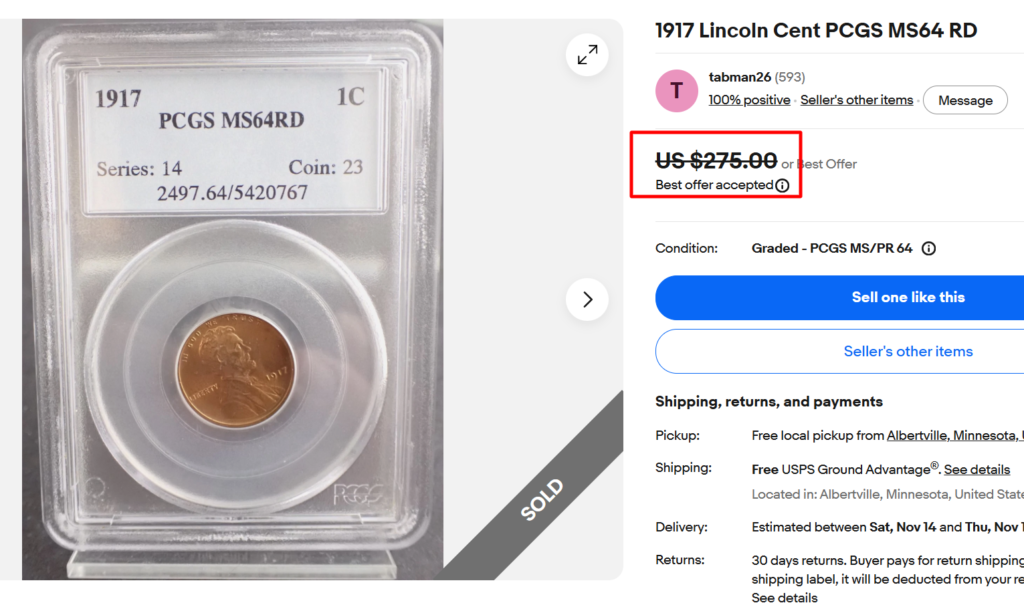
The large mintage of Philadelphia coins makes this variety the easiest to find in circulated grades. However, uncirculated pieces with original red coloration are rare above MS65.
Gem Red coins are quite difficult to come by; the record price for an MS68RD example went up to over $38,500.
5
1917 Penny Off Center Strike
Typically sells for $20 to $300+
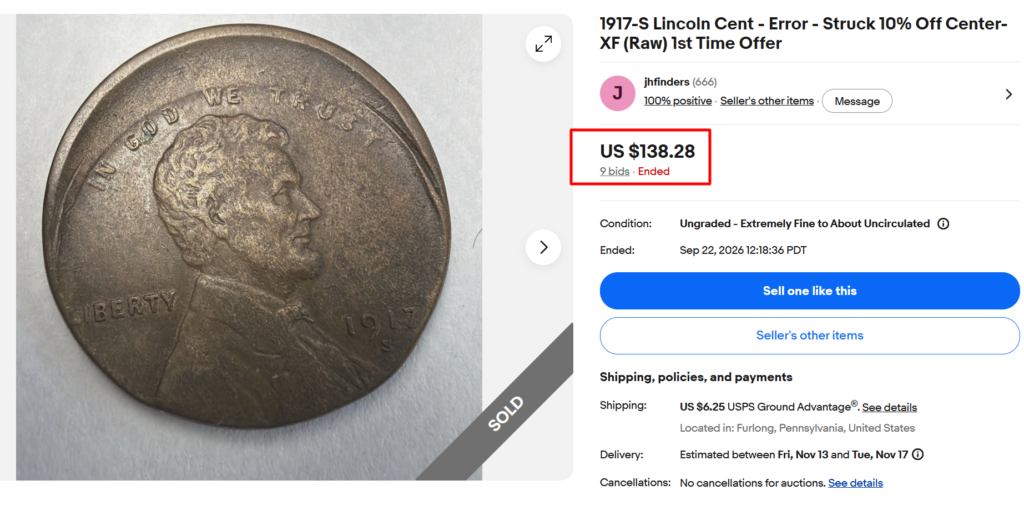
These errors occur when the planchet is not placed in the die correctly before the coin is struck. What results is a coin with an incomplete design.
Its value will depend on the coin’s condition, how off-center the coin was struck, and if the date is legible.
For example, an off-center strike from 5% to 10% of a 1917 penny could sell for $20-$150 based on condition, while 50% off-center or higher with the date legible could fetch $150-$300.
6
1917 Penny Die Break Cud Error
Typically sells for $3 to $100+ depending on severity
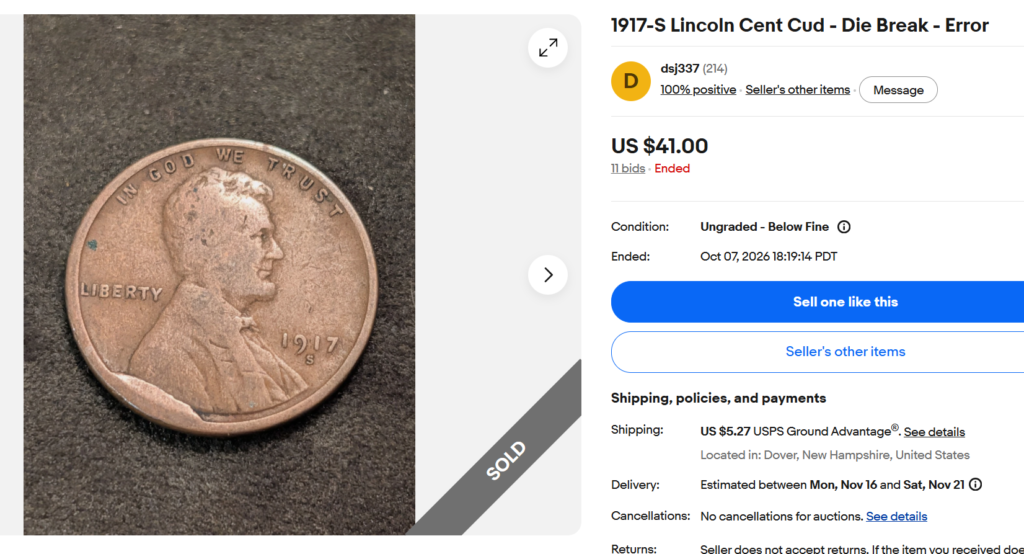
Die cracks appear as thin raised lines on the surface of the coin. Die cuds are bigger raised lumps, mostly around the edge, and are created when a part of the die breaks off.
They are very common in high-mintage years such as 1917, since the dies would wear out quickly due to mass production. The value depends on the cud size, plus the coin’s condition.
7
1917 Penny Clipped Planchet Error
Typically sells for $10 to $75+ depending on clip size and date visibility
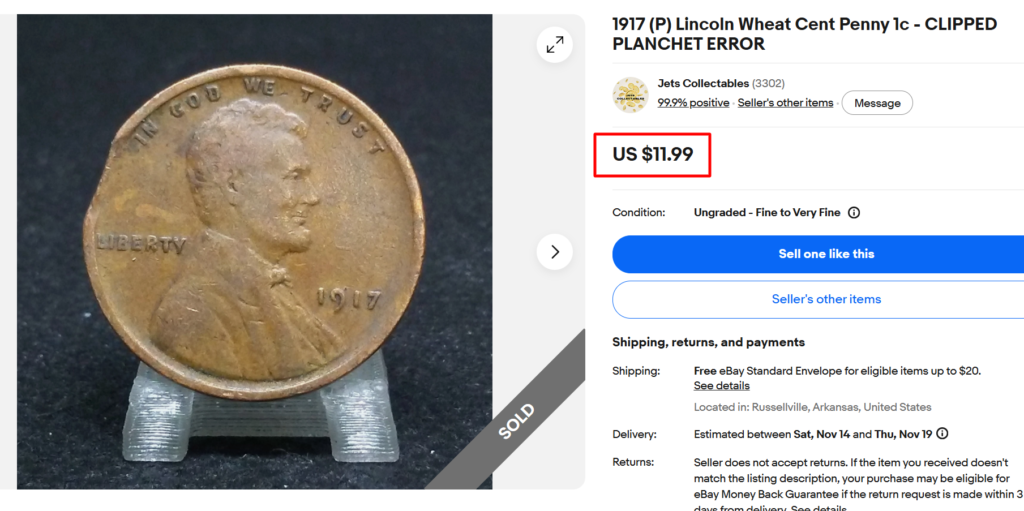
Clipped planchets occur when the copper blank disc is punched incorrectly before striking, resulting in a curved or straight clip along the edge of the coin. Clipped planchets are rare for 1917 pennies. Small clips are worth less than large clips with legible dates.
Note: This article is intended for informational, educational, and entertainment purposes only. Some images are illustrative and may not represent actual brands, products, or related entities. All trademarks, product names, brand logos, packaging, and other intellectual property referenced remain the exclusive property of their respective owners. Any brand mentions or references are provided solely for descriptive and educational context and do not imply any formal or commercial association.