By 1952, the Lincoln Wheat Penny was entering its later era before the Wheat reverse was finally replaced by Frank Gasparro’s Memorial Building reverse in 1959. Yet mintage was high: over 1.7 billion coins.
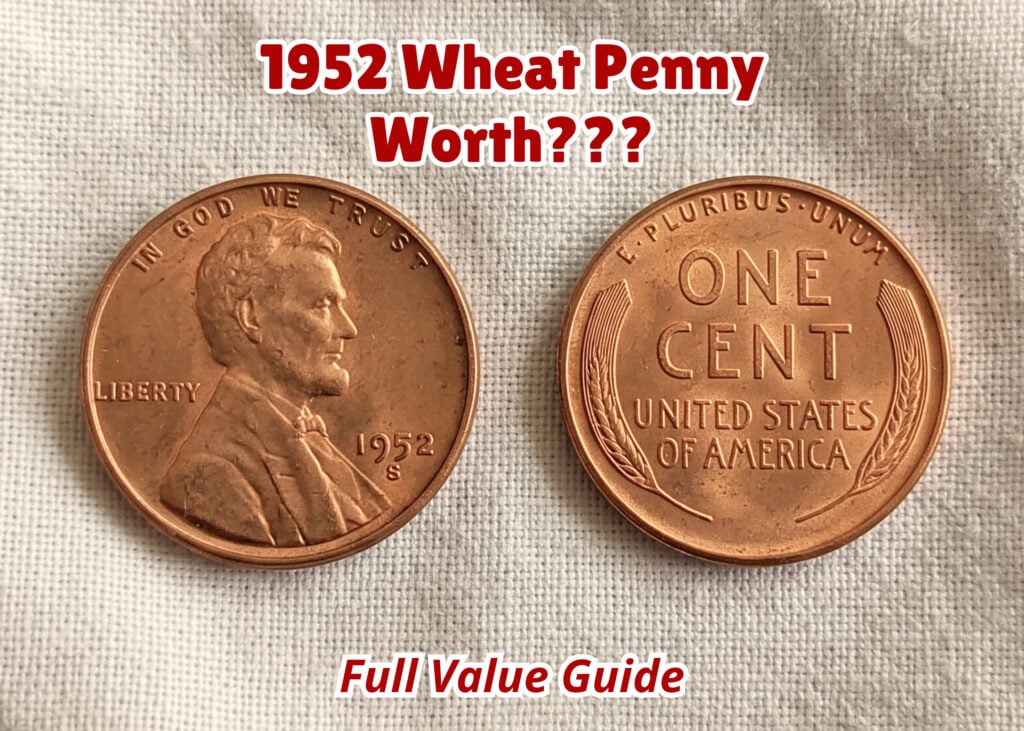
So, most of the 1952 wheat pennies are worth their face value today, while uncirculated graded coins generally go up to a few hundred dollars. But the prices change drastically for rare varieties, like DCAM proofs, and certain errors.
To tell whether your old 1952 cent is worth the money, you need to examine its mint mark variety, condition, proof designation, and minting errors. All of it is covered below.
| 1952 Lincoln Wheat Cent | Specifications |
| Coin Composition | 95% copper, 5% tin and zinc (bronze) |
| Minting Location | Philadelphia, Denver, San Francisco |
| Year of Minting | 1952 |
| Face Value | One cent ($0.01) |
| Weight | 3.11 grams |
| Diameter | 19 mm |
| Thickness | About 1.55 mm |
| Designer | Victor David Brenner |
| Mint Marks | Philadelphia: 186,775,000 D (Denver): 746,130,000 S (San Francisco): 137,800,004 Proofs (Philadelphia): 81,980 |
| Total Mintage | 1,070,786,984 with proofs |
Identification of a Real 1952 Penny: 3 Signs to Check
Start with the date and mint mark, then check the finer details. All you need is a 10x loupe and a digital scale for this.
1952 Penny Obverse Details:
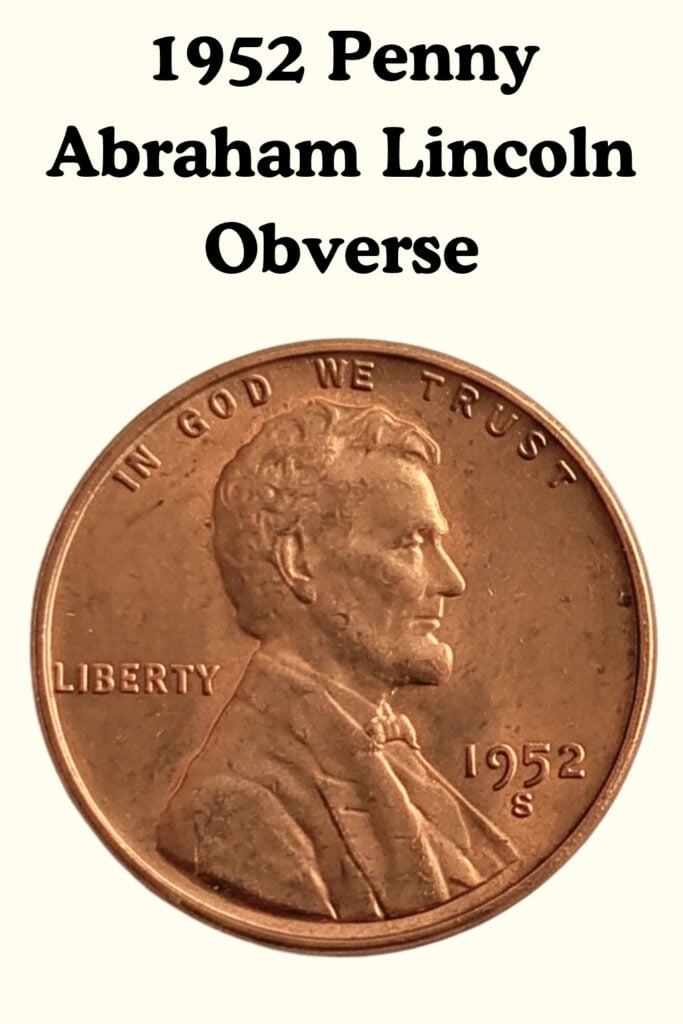
- Portrait: Abraham Lincoln faces right.
- Inscriptions: IN GOD WE TRUST arcs across the top, and LIBERTY sits in the left field behind Lincoln.
- Date and mint mark: The date 1952 sits on the right. The mint mark D or S is directly below the date.
- Designer’s initials: Brenner’s tiny V.D.B. on the edge of Lincoln’s shoulder.
- Short-tailed 5: The 5 in the date has a shortened tail. Lincoln cent expert David W. Lange notes 1952 is the only 1950s date with this feature.
1952 Penny Reverse Details:
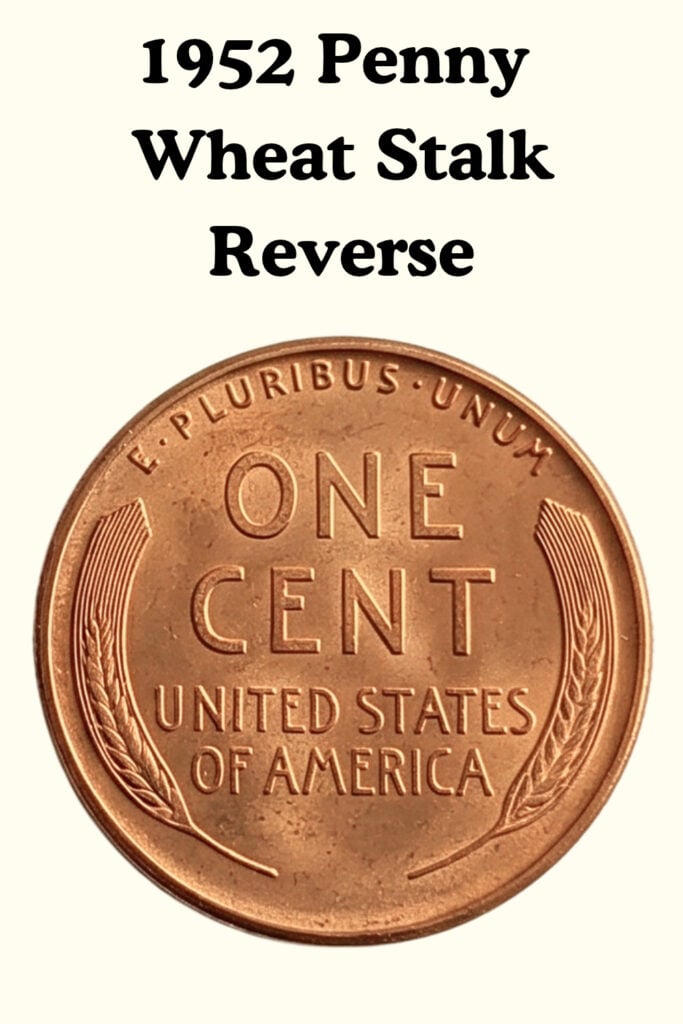
- Central Design: ONE CENT in large letters in the center.
- Wheat ears: Two stalks of wheat curve along the left and right edges.
- Text: UNITED STATES OF AMERICA below the denomination.
- Top motto: E PLURIBUS UNUM runs along the upper rim.
- Wheat lines: Sharp, separated lines in the wheat stalks point to a strong strike and a higher grade.
Weight & Composition
An authentic 1952 penny weighs 3.11 grams and is bronze, composed of 95% copper and 5% tin and zinc. It will not stick to a magnet.
If your coin looks silver, weigh it. Most silver-looking 1952 pennies were silver-plated after they left the mint and have no additional value. But if your coin weighs around 2.5 grams, then it may be struck on a silver dime planchet, which is a valuable error coin.
1952 Lincoln Penny Value Guide: Grades, Proof & Mint Marks
So, is a 1952 penny worth anything? Today, circulated 1952 pennies sell for 5 to 30 cents. It’s the uncirculated coins with full red color, especially at MS67 and above, that bring the premium prices of up to $22,800.
Below are the things that determine what your 1952 Lincoln cent can be worth:
Coin Grades and Color Designation
The condition of old coins is professionally graded on a 1-to 70-scale. Grades 1 to 58 cover circulated coins with moderate wear, while 60 to 70 are Mint State (MS) coins that never circulated.
The value of a 1952 cent increases with the grade.
But for copper coins, the color designation matters almost as much as the number. Graders give every cent one of three labels:
- RD (Red): for the coins with at least 95% of the original orange-red mint color.
- RB (Red-Brown): for the coins with a mix of red and brown toning.
- BN (Brown): for the coins that are fully toned brown.
Mint Marks & Mintage
The mint marks will not be particularly valuable unless the coin is graded in one of the highest grades.
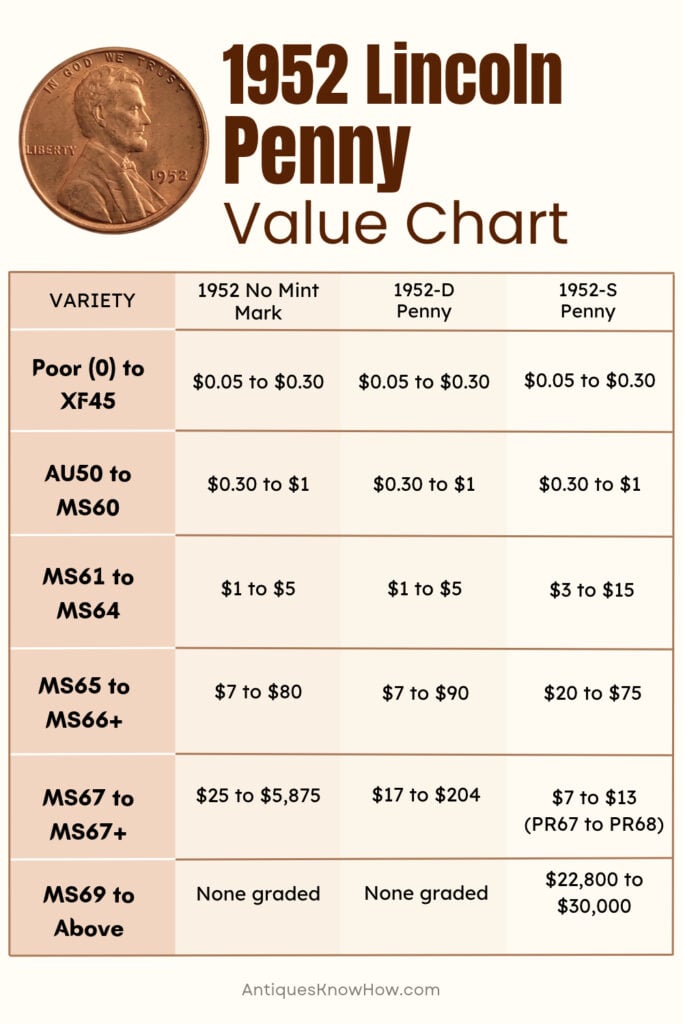
- 1952 No Mint Mark (Philadelphia) – 186,775,000: Philadelphia struck the second-highest number of 1952 cents. Most show spotting or discoloration, so a gem mint in full red tone is a top rarity. For example, a PCGS MS67 Red brought $9,775 in 2007.
- 1952-D (Denver) – 746,130,000: With the highest mintage, the Denver-minted 1952 cents are the most common varieties of the three. You can find these up to MS66 grades for modest prices.
- 1952-S (San Francisco) – 137,800,004: San Francisco made the fewest cents in 1952, but a lot of them exist in good condition. So, prices stay modest until you’re looking at an MS69RD example.
Here is an easy 1952 penny value chart. The prices are for Red (RD) coins, based on the PCGS records and recent auction results.
1952 Proof Penny
Apart from standard coins, Philadelphia also minted 81,980 proof cents for collectors. Proofs have mirrored surfaces and sharp details because they use polished dies and specially prepared blanks.
Proof Red specimens normally bring between $60 and $130 in PR65 to PR67. Cameo specimens are rarer; there are only 150 to 175 proof cents, as per PCGS. DCAM proof pennies are the rarest, and they usually sell for five fives ($28,000 to $65,000) in the highest PF68 grade.
Collectible 1952 Wheat Penny Errors & Rare Varieties
1
1952 D Lincoln Cent, Top Grade
Typically sells for $500 to $1,620; record $3,840 (MS67+)
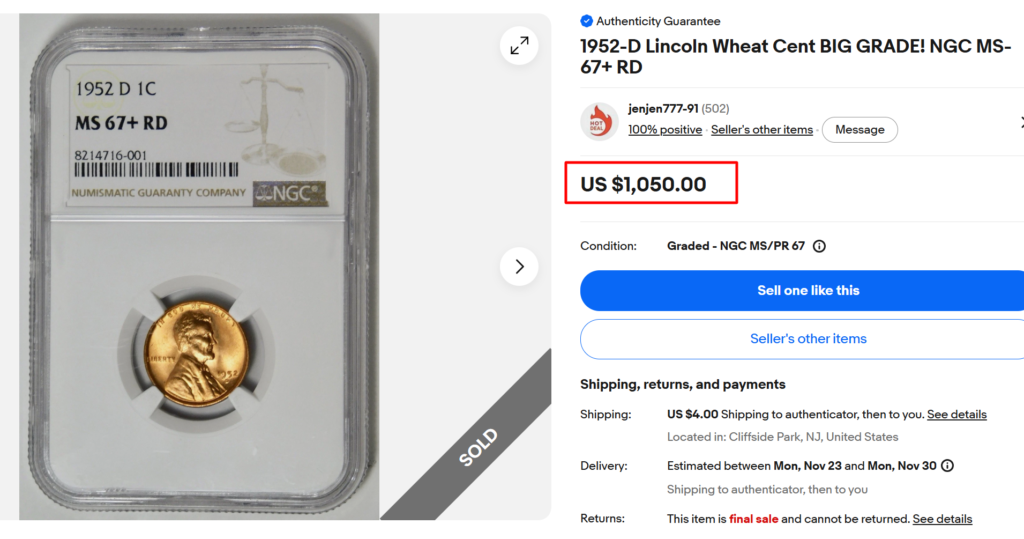
Denver minted more than 746 million cents in 1952, which makes the common 1952-D penny one of the most accessible pennies that year. But very few are found in the MS67+ Red grade.
Prices at this grade swing a lot, though. Recent MS67+ values range from about $500 to $1,620, while the 2023 record reached $3,840.
2
1952 Wheat Penny Proof, Top Grade & Cameo
Typically sells for $28,000 to $65,000 (DCAM, PF68); $150 to $500+ (RD PF68)
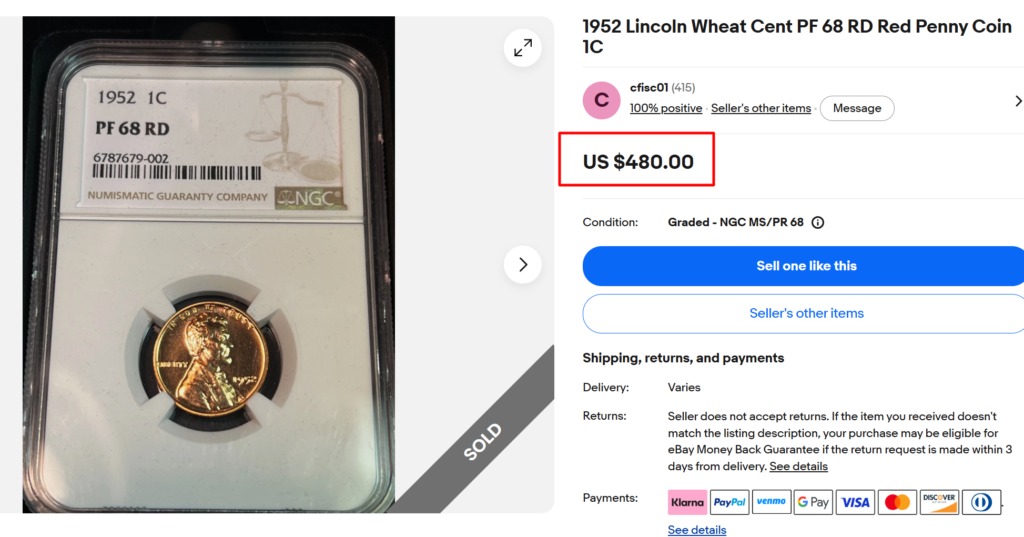
The Philadelphia Mint made about 81,980 cents, but only a few cameo proof cents throughout the 1950s. Deep Cameo (DCAM) is the top contrast grade for a proof coin. On these, the portrait and lettering look frosted white, while the fields stay deep and mirror-like.
PCGS experts think no more than 10 Deep Cameo 1952 cents may exist; one PR68 RD DCAM example sold for a record price of $64,625 on Legend Rare Coin Auctions.
3
1952-S Wheat Penny in Top Grade, Red
Typically sells for $100 to $1,000 (MS67 to MS76+)
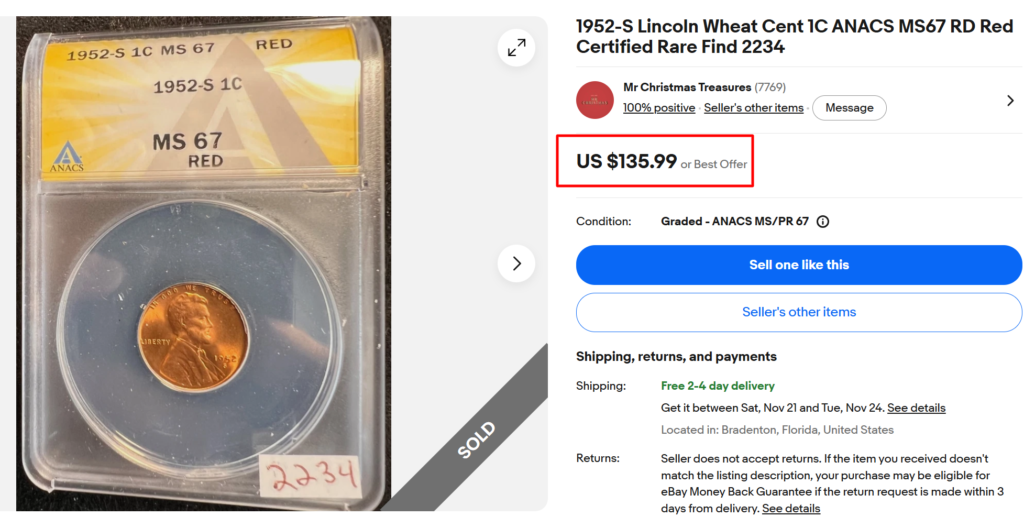
San Francisco minted almost 138 million cents in 1952, but PCGS has only certified one example as MS68 Red that realized a record price of $22,800.00 at Heritage Auctions.
This single piece is the finest known of the date. The 1952-S penny usually grades no higher than MS66 or MS67, so an extra grade point makes all the difference here. MS67+ examples usually fetch up to $1,000.
4
1952 No Mint Mark Penny, Top Grade
Typically sells for 4,000 to $7,500 (MS67+); $20 to $120 (MS66+)
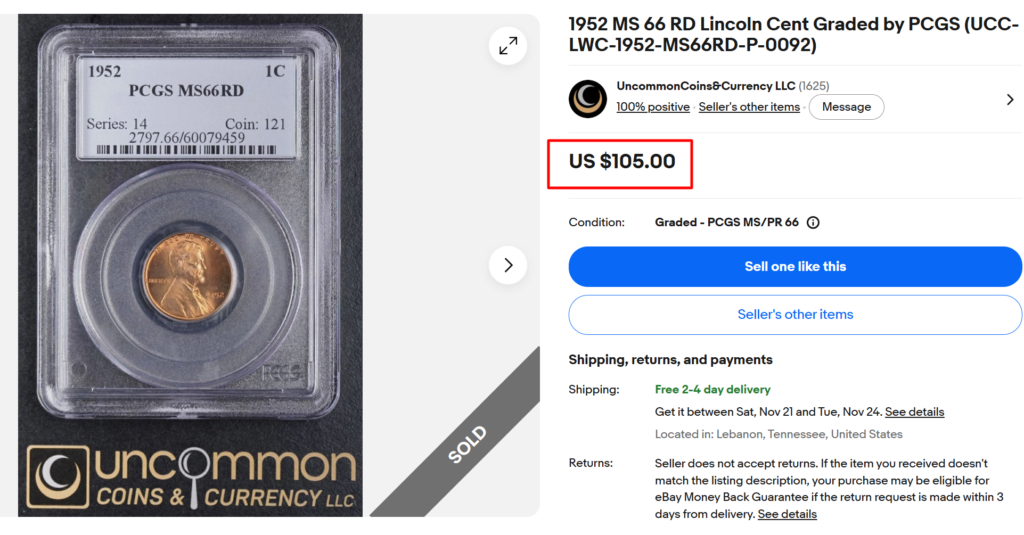
In 1952, cents from the Philadelphia mint were normally well-struck. But the rarity comes from their preservation. Most coins acquired spots and discoloration over the years, so mint red examples, especially in top grades like MS67 or higher, are very rare now.
In fact, even PCGS has certified fewer than 10 at MS67+ Red grade, which sold from $4,300 to $6,600.
5
1952-D/S Over Mint Mark (FS-511)
Typically sells for $264 to $529 (PCGS MS65 to MS66 Red)
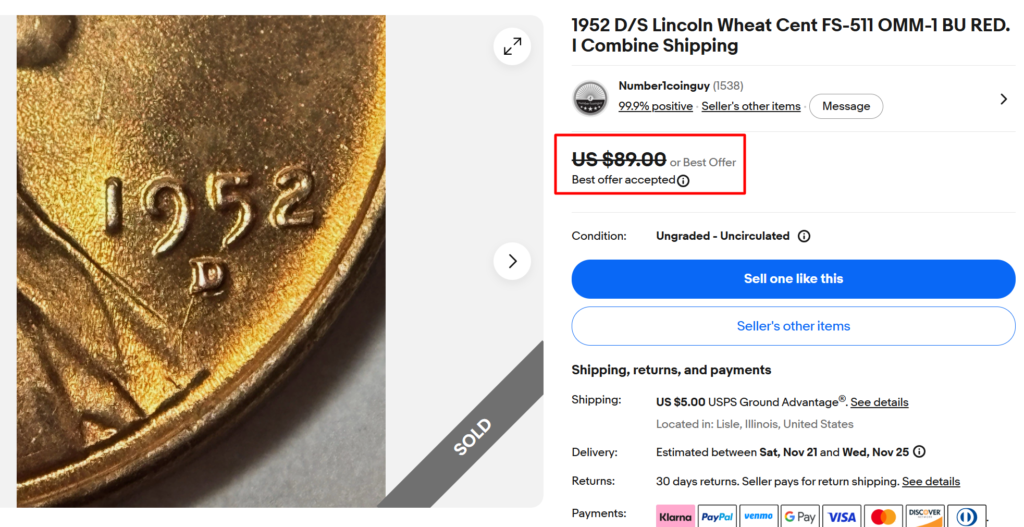
An Over Mint Mark (OMM) occurs when the die is struck with one letter and then corrected using another. In this 1952 penny variety, the bottom curve of the S appears slightly below and to the right of the D.
You’ll need a loupe to spot this feature. Some experts also believe that the hidden letter is not really an S.
6
1952 Penny Off-Center Strike
Typically sells for $50 (20% off-center) to $350 (65%+)
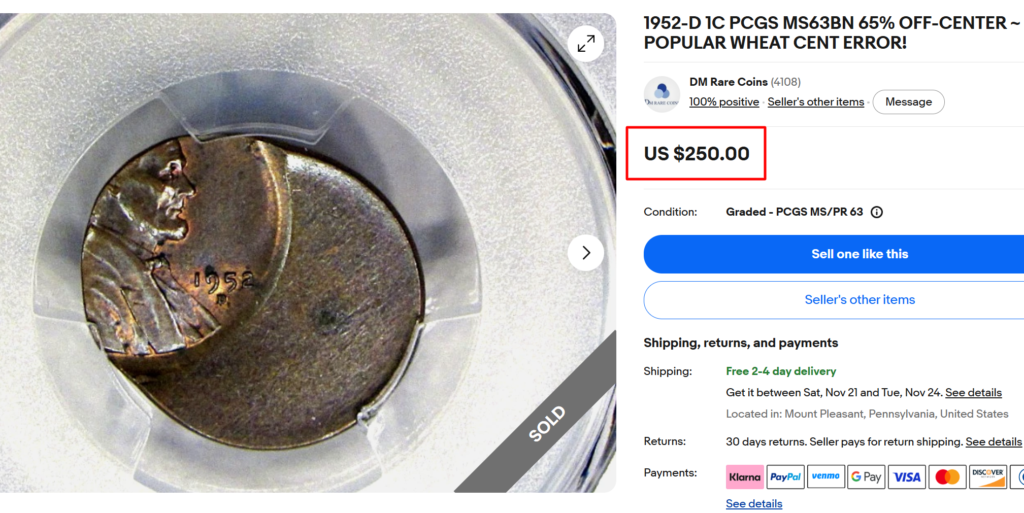
An off-center error occurs due to the improper placement of the coin blank between the dies. The result is an incomplete (off-center) design.
For collectors, coins 30%-60% off-center are most prized, especially those that show the complete year designation on their obverse sides. A missing date drops the value since the year is difficult to identify.
7
1952 Penny Proof Reverse Planchet Flaw
Typically sells for $5 to $25
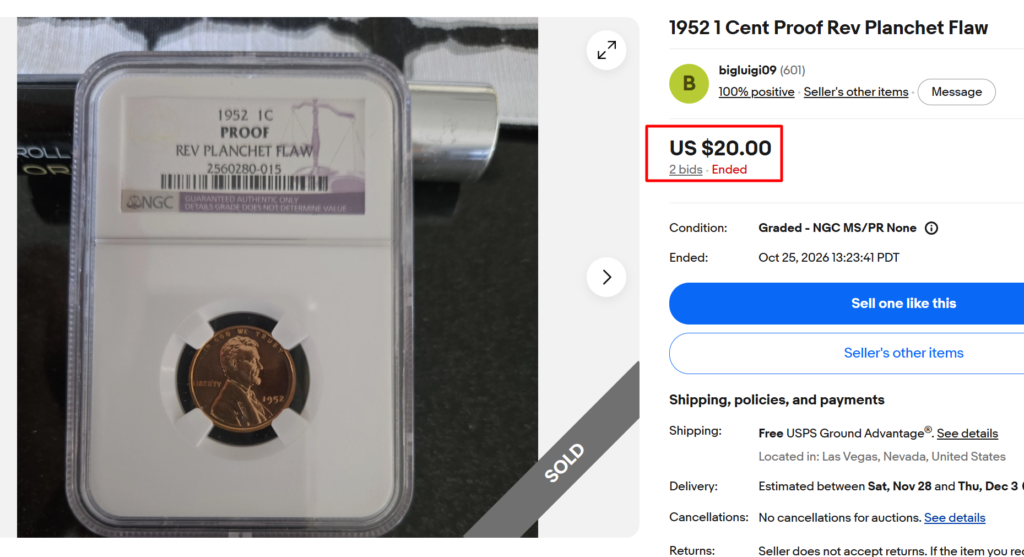
This is a low-value variety. It’s a planchet flaw, which means the planchet or black has a defect. It can be a small void, crack, or lamination error (the metal didn’t stick properly to the backing). On circulated coins, this error can be difficult to read, but it’s easily visible on proof examples.
However, collectors see these as wear or blemishes rather than a notable mint error, so flawed 1952 cents are worth less.
Note: This article is intended for informational, educational, and entertainment purposes only. Some images are illustrative and may not represent actual brands, products, or related entities. All trademarks, product names, brand logos, packaging, and other intellectual property referenced remain the exclusive property of their respective owners. Any brand mentions or references are provided solely for descriptive and educational context and do not imply any formal or commercial association.