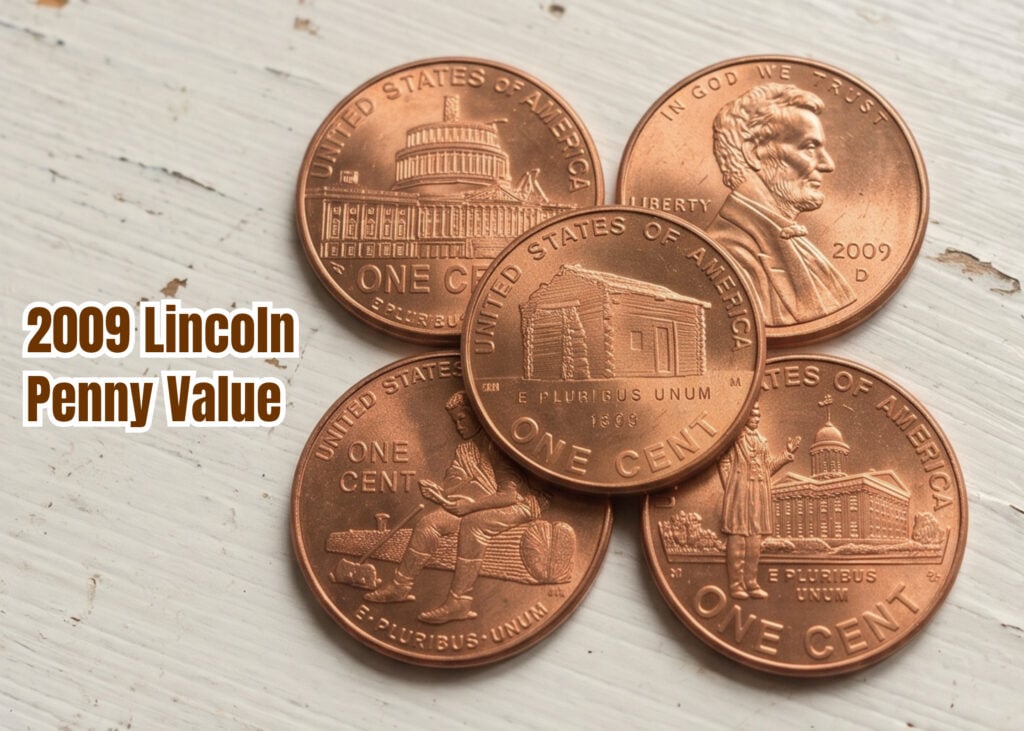
Turn over a 2009 penny, and you will see either a log cabin, a young man studying on a log, or an incomplete dome of the Capitol. It’s not a mistake. In 2009, the Mint issued four reverse designs for the Lincoln pennies; all of them are still found in pocket change.
Most are only worth one cent. However, some high-grade specimens, copper satin finish coins, and certain doubled die varieties are worth money, and this guide will help you identify them.
History of the 2009 Lincoln Bicentennial Penny
The year 2009 was the bicentennial anniversary of Abraham Lincoln’s birth and the centennial anniversary of his portrait appearing on the cent. To celebrate both, Congress ordered four reverse designs representing each stage of Lincoln’s life.
These designs were issued separately; the log cabin design came out on February 12 (Lincoln’s birthday), Formative Years on May 14, Professional Life on August 13, and Presidency on November 12.
The Presidency reverse design became the rarest of all. The Denver mint produced 198 million and Philadelphia 129.6 million Presidency cents, which is less than half the number produced by any other design. By 2010, the Union Shield reverse design replaced all four.
| 2009 Lincoln Cent | Specifications |
|---|---|
| Coin Composition | 97.5% zinc, 2.5% copper (circulation) 95% copper, 5% tin & zinc (Satin & proof) |
| Minting Location | Philadelphia, Denver, San Francisco (proofs only) |
| Year of Minting | 2009 |
| Face Value | One cent ($0.01) |
| Weight | 2.5 grams (zinc); 3.11 grams (copper) |
| Diameter | 19.05 mm |
| Thickness | 1.52 mm |
| Designer | Obverse: Victor David Brenner Reverse: Richard Masters, Charles Vickers, Joel Iskowitz, Susan Gamble |
| Mint Marks | (Philadelphia): 1,106,000,000 D (Denver): 1,248,000,000 S (proofs): 2,995,615 per design |
| Total Mintage | About 2.35 billion circulation, plus satin and proof issues |
Identification of the 2009 Penny
All 2009 pennies have the same obverse. So, for identification, you need to consider three aspects – the reverse, the mintmark, and the alloy used.
2009 Penny Obverse:
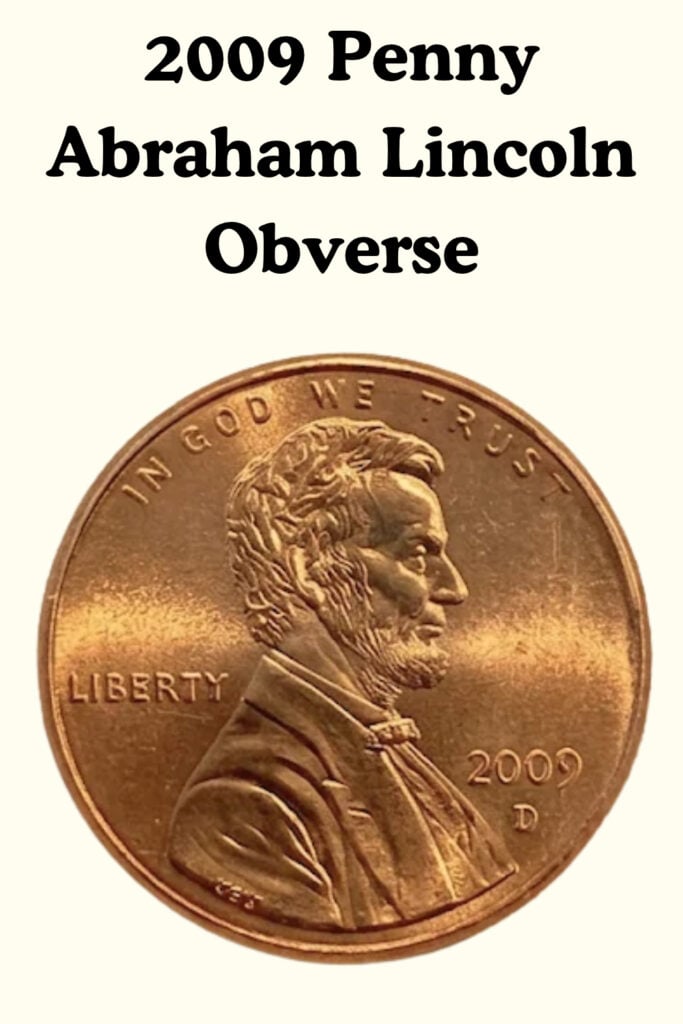
- Portrait of Lincoln facing right, the same likeness used since 1909.
- Inscriptions “IN GOD WE TRUST” across the top, and “LIBERTY” to the left of Lincoln’s face.
- Date “2009” and mint mark on the right (no letter means Philadelphia).
- Designer’s initials “VDB” at the base of the bust. Check here, along with LIBERTY and the date, for obverse doubling.
2009 Penny Reverse:
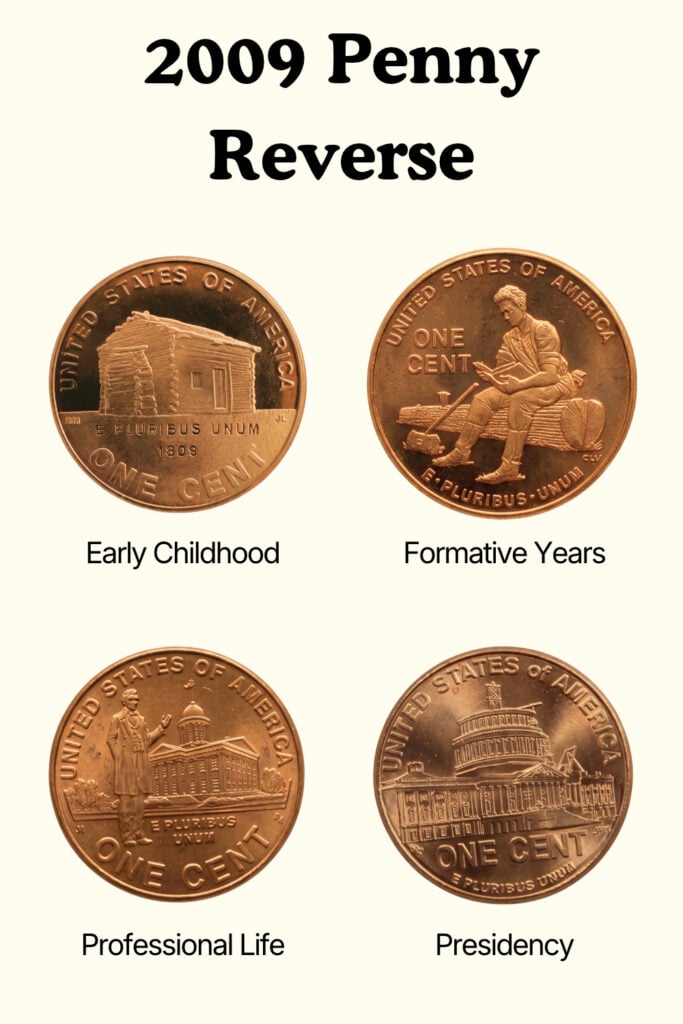
The reverse is what separates different 2009 penny varieties. All four designs have E PLURIBUS UNUM, ONE CENT, and UNITED STATES OF AMERICA, but the central design separates them.
Variety guides use the abbreviations LP1 through LP4.
- LP1, Birth and Early Childhood (log cabin): A one-room log cabin like the Kentucky log cabin where Lincoln lived as a child. Designed by Richard Masters.
- LP2, Formative Years (man sitting on a log): Young Lincoln reading a book while resting from his work of splitting rails. Designed by Charles Vickers.
- LP3, Professional Years (standing man): Young Abraham Lincoln as a lawyer and legislator, standing in front of the Illinois State Capitol Building in Springfield. Designed by Joel Iskowitz.
- LP4, Presidency (building the Capitol): Half-built dome of the U.S. Capitol, which Lincoln ordered to be completed during the Civil War. Designed by Susan Gamble.
Weight and Composition
The circulating pennies from 2009 are copper-coated zinc weighing 2.5 grams. However, the collectible 2009 pennies made for mint sets and proof sets used the 1909 composition of 95% copper with tin and zinc and weigh around 3.11 grams.
Quick Tip: Weigh any 2009 or 2009-D penny using a digital scale. If the reading is close to 3.1 grams, you may have either the satin-finish mint set coin or an incorrect planchet error.
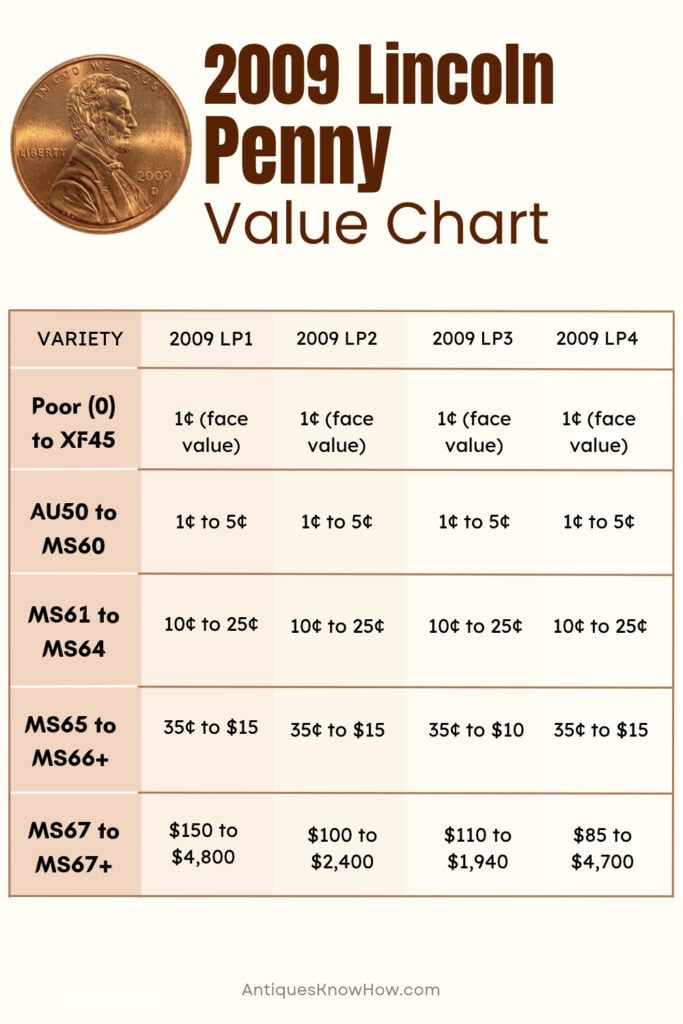
2009 Lincoln Penny Value Chart by Grade
Value of 2009 Pennies by Grade
Most 2009 Lincoln pennies in circulation are worth their face value. The values start going up only when the coin has reached high grades in the Mint State category with full red color.
Coin Grades and Color Designation
Coins are graded with the 70-point Sheldon scale. For a zinc cent, circulated grades from Poor to About Uncirculated add nothing, because billions of these coins exist.
Color matters just as much as the number. Cents get labeled
- RD (Red, with 95% or more original color)
- RB (Red-Brown, with original luster as well as brown toning)
- BN (Brown, with 90% or more toning).
Zinc cents spot and darken easily, and a brown coin loses nearly all its premium. So check the coin under a lamp before paying for grading. You want an even red color and no spots or marks on Lincoln’s cheek.
Mint Marks & Mintage
Philadelphia and Denver struck the coins for circulation, while San Francisco only made the proof 2009 pennies.
2009 No Mint Mark (Philadelphia) Penny
Philadelphia 2009 cents have no mint mark. There are 284.4 million LP1, 376 million LP2, 316 million LP3, and 129.6 million LP4 pennies made by the mint. Even the lowest number, LP4, is very large, so value depends on grading.
2009-D Penny
Denver minted 350.4 million LP1, 363.6 million LP2, 336 million LP3, and 198 million LP4 pennies. In common grades, a 2009-D penny has the same value as the 2009-P penny.
2009 Satin Finish Penny (P and D)
The 2009 Uncirculated Mint Set contained satin finish copper copies of all eight P and D coins, with 784,614 pieces of each. These go for around $70 in MS69 RD.
2009-S Proof Penny
The San Francisco mint made 2,995,615 proofs of each design from the original copper alloy. Check for the S under the date and mirror-like fields surrounding frosted designs. Since these are usually sold in proof sets, loose examples are common.
2009 Lincoln Penny Errors & Varieties
With four new designs in one year, production on new dies increased, and errors occurred. Collectors have identified over 120 doubled dies for 2009.
A doubled die is one that received an impression slightly off-center, resulting in doubled details on each coin struck. They generally add only a few dollars, such as the doubled windows on LP3 and LP4 coins.
The ones below are worth seeking out, and most are from the Formative Years design.
1
FS-802 Doubled Die Reverse
Typically sells for $800 to $1,000+ (MS67 RD)
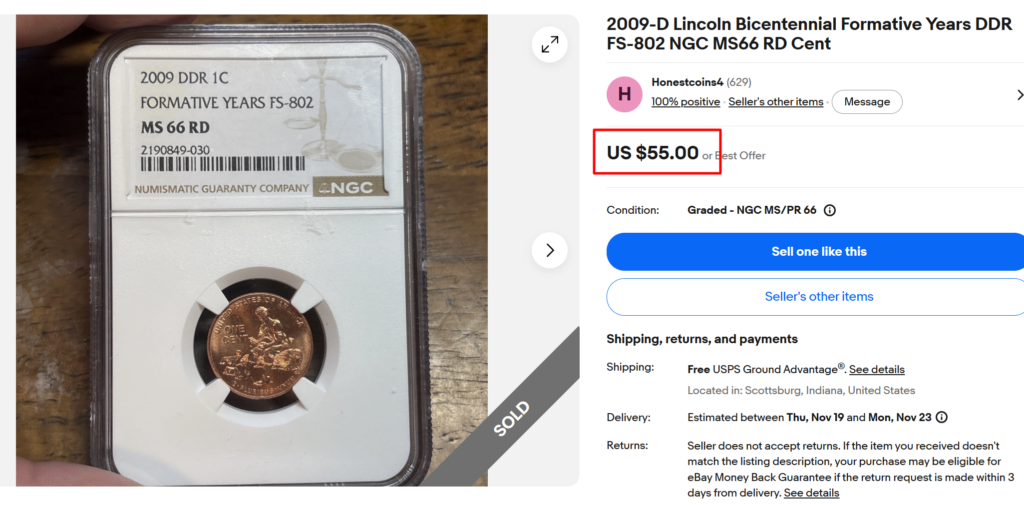
| Design & Mint | LP2 Formative Years, Philadelphia |
| Where to Look | Between thumb and index finger; book pages |
| Attribution | FS-802, WDDR-002 |
This is one of the finest examples of Formative Years varieties. Spot the partial extra index finger and middle finger between Lincoln’s thumb and index finger.
There is also a second impression of the book’s top edge that slices diagonally across the pages. Because PCGS grades it numerically, graded specimens sell better.
2
FS-803 Doubled Die Reverse (Strong Extra Index Finger)
Typically sells for $50 to $120+ (MS65)
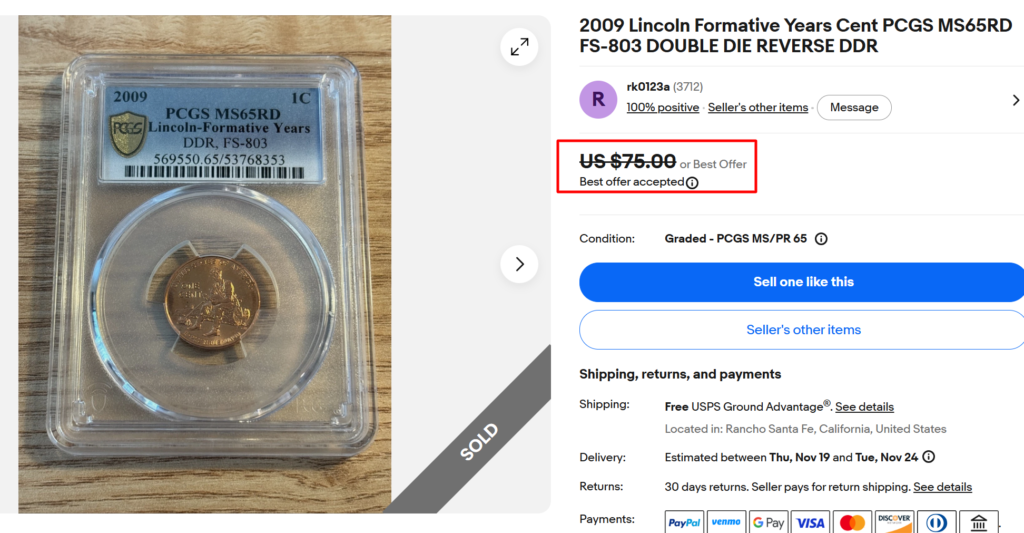
| Design & Mint | LP2 Formative Years, Philadelphia |
| Where to Look | Between thumb and index finger |
| Attribution | FS-803, WDDR-001 |
In this 2009 Formative Years penny variety, you’ll see an additional finger right between the thumb and index finger; it is easily visible even through a simple loupe. It can be confused with the FS-804 type, which also has an additional finger, but in a partial form.
3
FS-805 Doubled Die Reverse (Finger Below the Book)
Typically sells for $50 to $120 (MS66 RD)
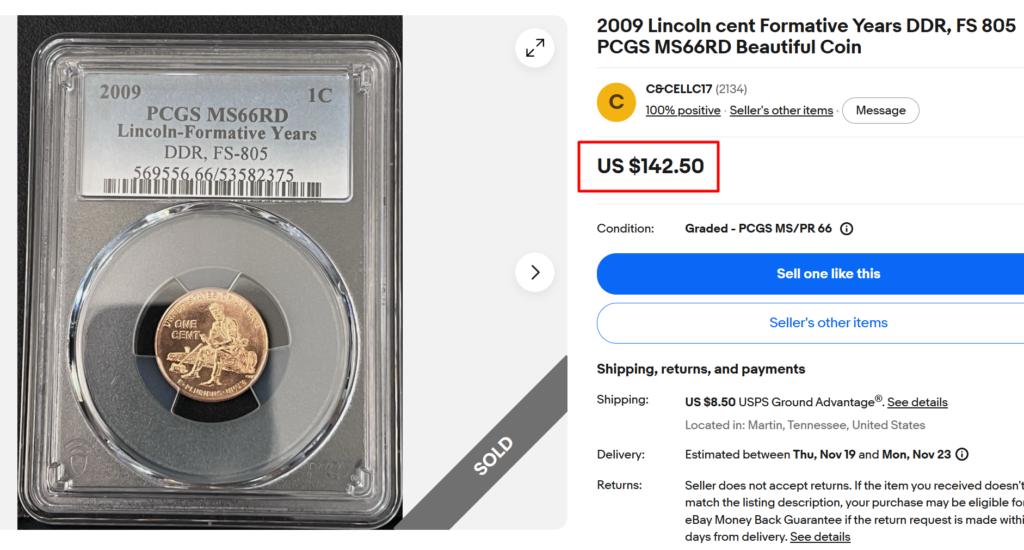
| Design & Mint | LP2 Formative Years, Philadelphia |
| Where to Look | Below the book; edge of the book spine |
| Attribution | FS-805, WDDR-025 |
The FS-805 shows a moderate to strong extra index finger underneath the bottom of the book rather than doubling between the fingers. The tip of the extra thumb is visible near the spine of the book.
Many have been graded by PCGS; thus, the condition takes precedence over rarity.
4
2009 Satin Finish Copper Cents
Typically sells for $30 to $70 (MS68 to MS69)
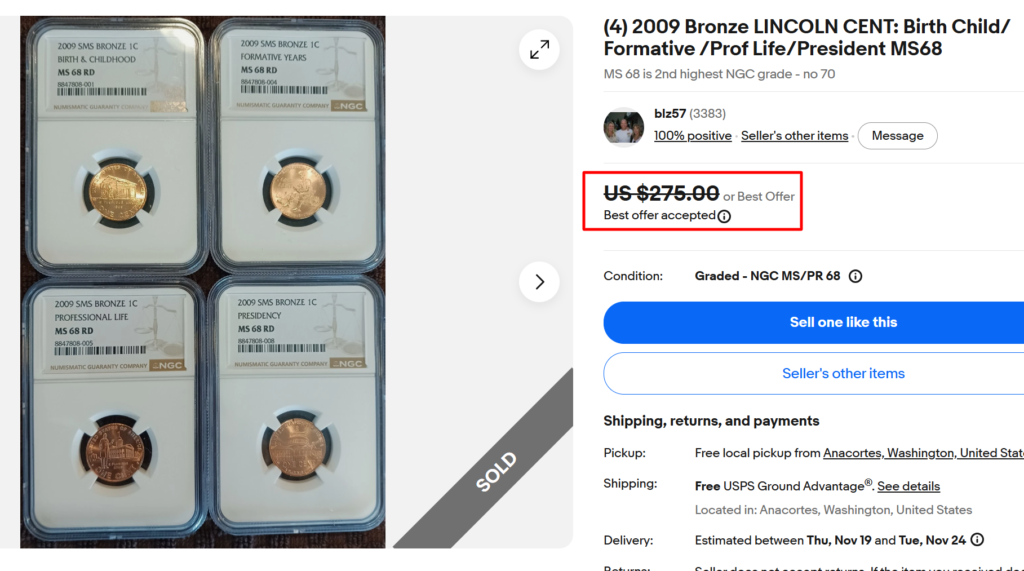
| Design & Mint | All four designs, Philadelphia and Denver |
| How to Spot | Weighs 3.11 grams; satin surface |
| Mintage | 784,614 per design, per mint |
This isn’t an error, but it is the lowest-mintage 2009 cent. The Mint struck 784,614 of each design at each mint in 95% copper for the Uncirculated Mint Set. Loose coins are common, since the sets are often broken. A weight of 3.11 grams will confirm them.
5
2009 S Professional Life Penny Proof
Typically sells for $39 to $250 (PR70)
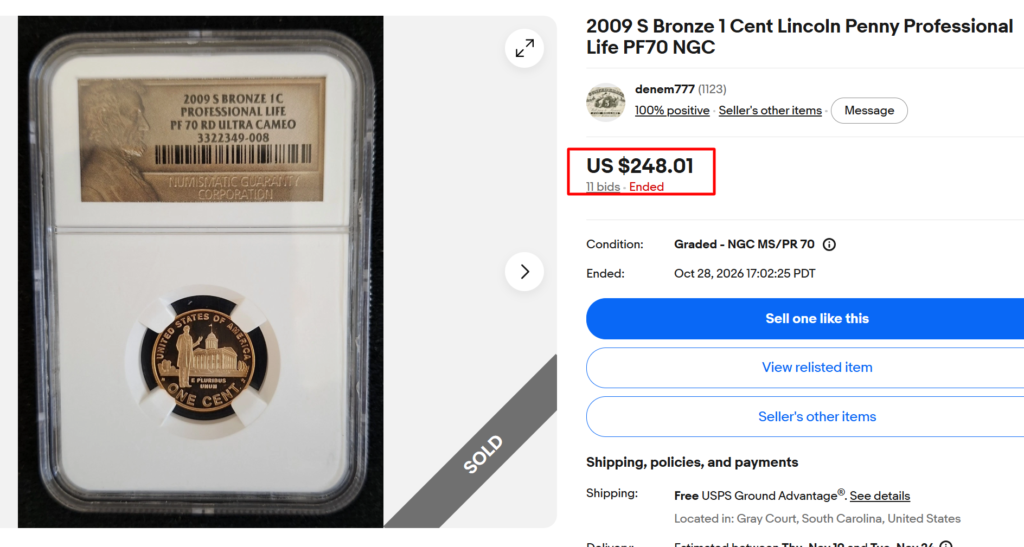
| Design & Mint | LP3 Professional Life, San Francisco (S mint mark) |
| Grade | NGC PF70 RD Ultra Cameo |
| Composition | 95% copper, 5% tin and zinc, 3.11 grams |
The example combines the Professional Life reverse and the S mintmark on the original 1909 bronze composition. The NGC PF70 Ultra Cameo designation indicates no visible defects under magnification, along with abundant frost on the devices and mirror-like fields. Top values are in PF69 and PF70 grades.
Note: This article is intended for informational, educational, and entertainment purposes only. Some images are illustrative and may not represent actual brands, products, or related entities. All trademarks, product names, brand logos, packaging, and other intellectual property referenced remain the exclusive property of their respective owners. Any brand mentions or references are provided solely for descriptive and educational context and do not imply any formal or commercial association.