Pyrex has been trusted by Americans for its heat- and cold-resistant qualities for over a hundred years. Once a household staple passed down through generations, vintage Pyrex is now popular among modern collectors for its durability and unique patterns.
In this guide, we will uncover some rare vintage dishes that have rarely appeared on the market, learn how to identify them, and what makes them so rare. Let’s explore!
A Glimpse of History
Pyrex is a brand launched by Corning Glass Works in 1915, and today has become ubiquitous and the most desirable collectible in the American kitchen. At first, the company made Borosilicate glass, which was resilient. Later, it began manufacturing opaque tempered soda-lime glass with colorful designs.
The craze for Pyrex dishes began in the 1940s, when the brand launched unique, colorful patterns capturing popular trends and cultural aesthetics of a specific era.
How to Identify Genuine Vintage Pyrex Dishes?
Backed with a hundred-year reputation, Pyrex dishes appear in every American kitchen. But not every dish is really Pyrex; some could be modern reproductions. Here are some easy steps to distinguish authentic vintage Pyrex from seconds.
1. Check the Backstamp & Logo
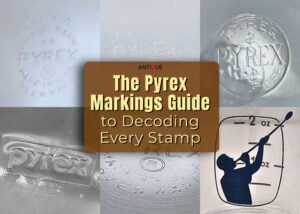
The backstamp, usually found on the back of the dish, is one of the easiest ways to spot a genuine vintage Pyrex dish. It shows the logo as well as additional details, like the model number, warnings, and capacity, in some pieces.
The logo style and presence or absence of these extra marks can help you identify and date a Pyrex dish:
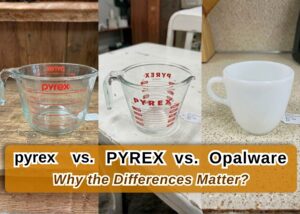
- 1915 – 1940s: “PYREX” in Serif + CG Monogram on clear borosilicate ovenware. You may also find “T.M. REG.” and “U.S. PAT. OFF.” or a patent date. Some later pieces show “PYREX” + “CORNING.”
- Mid 1940s – Early 1950s: First opal/colourware with “PYREX” (caps) + “T.M. REG.” / “U.S. PAT. OFF.”
- 1950s – Mid‑1960s: “PYREX” / “CORNING” / MADE IN U.S.A. + plus model numbers (401, 402, 440, etc.) and capacity markers.
- Late 1960s–1980s: These pieces show warmings. You’ll see “PYREX” / “CORNING” + warnings, like “NO BROILER” or “NO STOVETOP.”
- Late 1990s–present: Lower “Pyrex,” often printed rather than molded.
2. Check the Physical Clues
Authentic Pyrex dishes actually feel different. Here’s how:
- Weight and Thickness Test: Vintage Pyrex dishes made of borosilicate or soda-lime opal glass are heavy and have thick rims. But modern soda-lime dishes are thin and smooth.
- Color Clues: The original borosilicate Pyrex shows a slight bluish or greenish tint. Also, the colors on vintage soda-lime opal glass rarely fade, unless you wash them in the dishwasher.
- Surface Quality: Vintage dishes will not have any mold lines on the decoration, although subtle swirl marks might appear.
- Decoration and Paint: Genuine screen printed patterns (post 1956), including but not limited to “Pink Daisy,” “Snowflake,” “Butterprint,” exhibit clean edges, even coverage, with a finish that will not flake under normal conditions.
3. Verify the Pattern & Shape
The shape of a vintage Pyrex dish is another reliable identification clue. How? Well, the brand released certain patterns in specific shapes or types, and they didn’t exist before a particular period.
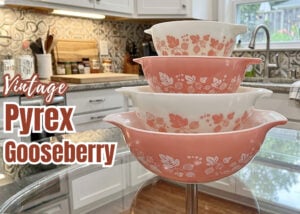
For example, the black-and-yellow Gooseberry pattern was only released on Cinderella bowls, and not on any other shape. So, if you find a casserole with this pattern, it could be a fake.
So, make sure to refer to Pyrex’s official catalogues or pattern guides to tally the design, dish shape, and production period to authenticate your piece.
Rare Vintage Pyrex Dishes that Appeal to Modern Collectors
Let’s take a look at some of the highly collectible Pyrex dishes that have actually sold for hundreds to thousands of dollars!
1. Atomic Eye 2.5-Quart Bowl
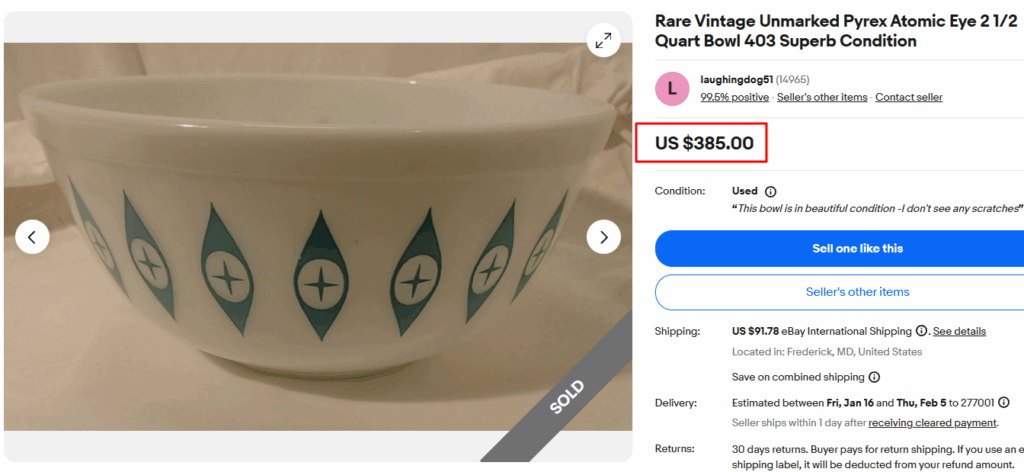
Officially called “Hot ‘N’ Cold,” the “Atomic Eyes” pattern features a repeating, stylized, elongated-oval geometric shape with a star/plus resembling a starburst or an eye. It’s one of the first patterns to be released in chip-and-dip form.
The example shown is a 2.5-qt mixing bowl from the chip-and-dip set, a promotional item with limited production. If you can find a complete set along with the 401 dip bowl, the value would be even higher.
| Average Value | $200 to $550 (Full Sets) |
| Dish Type | 2-qt Space Saver Casserole Dish 575B |
| Pattern & Color | Atomic Starburst |
| Manufacturing Era | 1960 |
| Collectibility | Very Rare |
2. Atomic Starburst Casserole (575 B) with Lid & Warmer
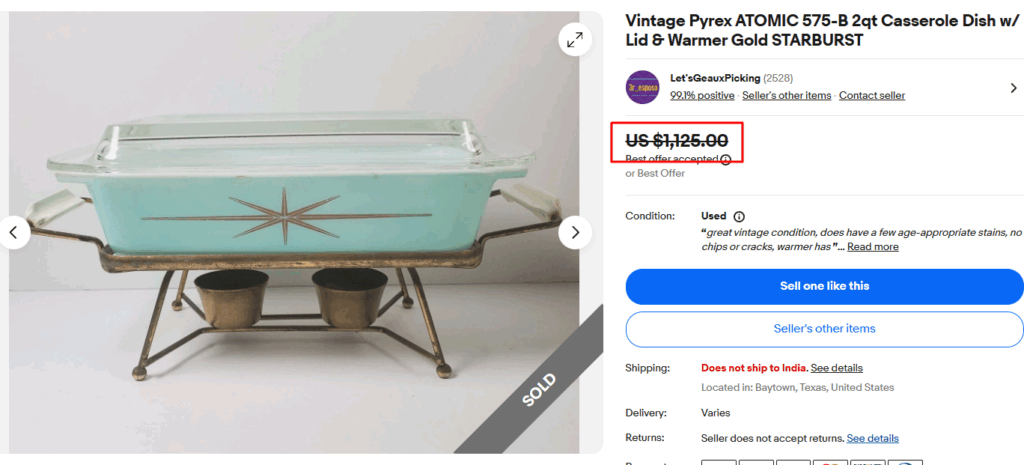
This 575 B space-saver casserole dish is highly sought after for its rare “Atomic Starburst” pattern, a gold eight-point star on a turquoise milk opal glass. This piece usually comes with a glass lid and a metal warmer; a complete set can be extremely valuable!
| Average Value | $800 to $1,500 (Full set) |
| Dish Type | 2-qt Space Saver Casserole Dish 575B |
| Pattern & Color | Atomic Starburst |
| Manufacturing Era | 1960 |
| Collectibility | Very Rare |
3. Black on White/Yellow Gooseberry Cinderella Bowls
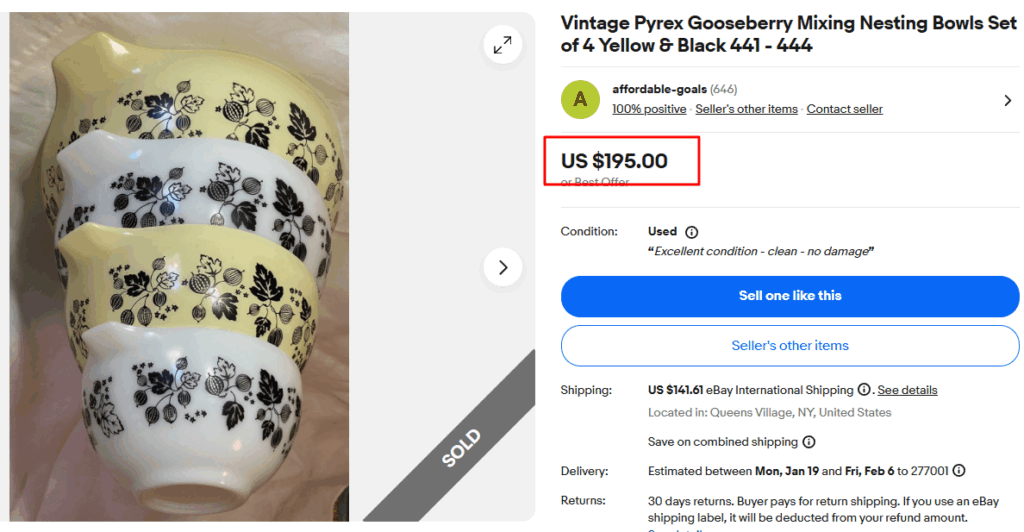
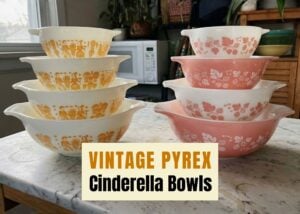
This Pyrex Cinderella bowl set sold for almost $200! The reason? It displays a rare variation of the popular “Gooseberry” pattern: a black swag of gooseberries, flowers, and leaves on a white-and-yellow surface.
The Gooseberry pattern was among the first released on opal glass. Besides, this unique Gooseberry variant was released only on Cinderella Bowl sets and discontinued in 1962, making it collectible.
| Average Value | $150 to $400 (based on set size) |
| Dish Type | 1.5-qt Cinderella Mixing Bowl #442 |
| Pattern & Color | Black Gooseberries, flowers, & leaves on White |
| Manufacturing Era | 1957 – 1962 |
| Collectibility | Very Rare |
4. Amish Butterprint Pumpkin Orange Cinderella Bowls (440 Series)
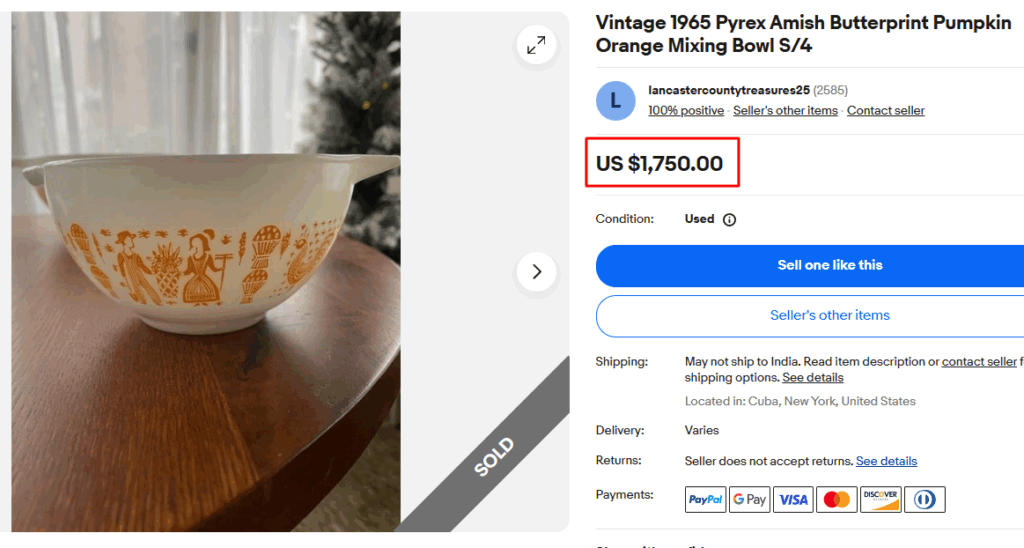
The high value of this pumpkin-orange “Amish Butterprint” Cinderella bowl is due to its promotional status and scarcity, compared to the blue version. The combination of a popular pattern on a short-lived color makes this set extremely rare.
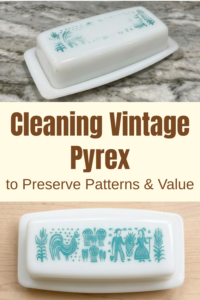
“Butterprint” features farm motifs, like an Amish couple holding crops, chickens, sheaves of wheat, and corn. Also called ‘Amish’ or ‘Farmer and Wife,’ this was one of Pyrex’s first printed patterns on opalware.
| Average Value | $500 to $1,800 (Full Sets) |
| Dish Type | Cinderella Bowls (444, 443, 442, 441) |
| Pattern & Color | Pumpkin Orange Amish Butterprint |
| Manufacturing Era | 1957 to 1968 |
| Collectibility | Rare & Super Collectible |
5. Pink Stems Oval Casserole with Glass Lid
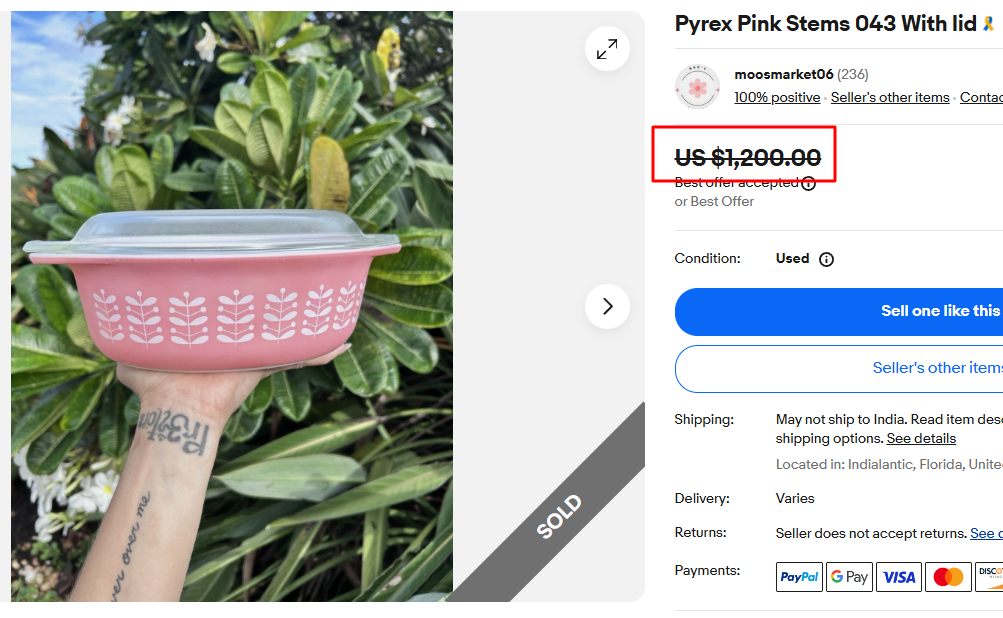
This lidded casserole dish features the rare “Pink Stem” pattern – stylized white leaves and stems on pink opal glass, leading to an exceptionally high value. This #043 casserole is likely a limited-release or stamp-program item, making it super scarce and valuable.
| Average Value | $500 to $1,500 (based on condition) |
| Dish Type | 043 1.5 Quarts Oval Casserole with Lid |
| Pattern & Color | Pink Stem, White Stems on Pink |
| Manufacturing Era | 1962 |
| Collectibility | Extremely Rare |
6. Turquoise on White Hex Sign Casserole without Lid
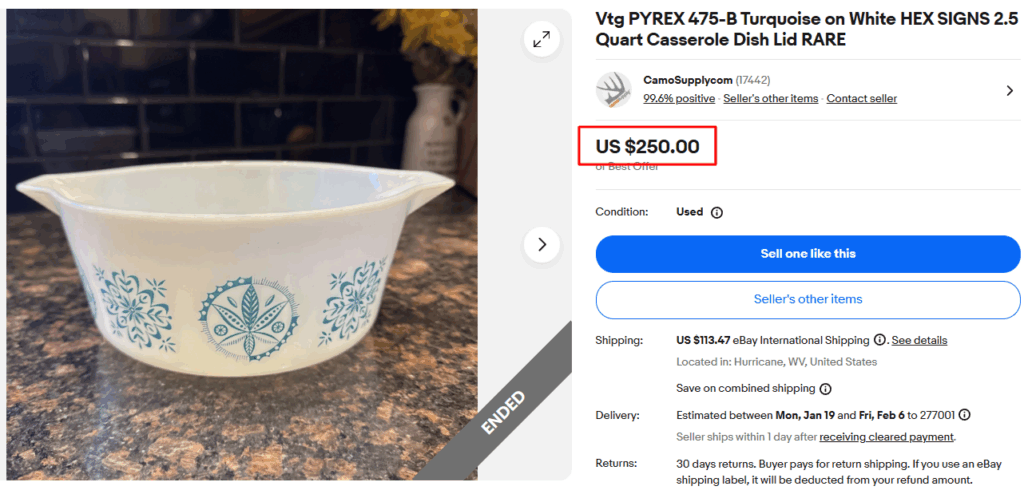
Initially released in tan gold, the “Hex Sign” is a promotional Pyrex pattern without an official name. It shows Pennsylvania Dutch-inspired gold-leaf pattern inside a circle, alternating with a square-flower motif.
This casserole dish features the rare, limited turquoise-on-white variant of this pattern, which gives it a steep price tag. A lidded dish or a full set or pair can be worth even more!
| Average Value | $180 to $350 |
| Dish Type | Casserole Dish, 475-B 2.5-Quart |
| Pattern & Color | Turquoise Hex Sign & Florals on White |
| Manufacturing Era | 1960 |
| Collectibility | Rare |
7. Blue Dianthus Casserole Dish
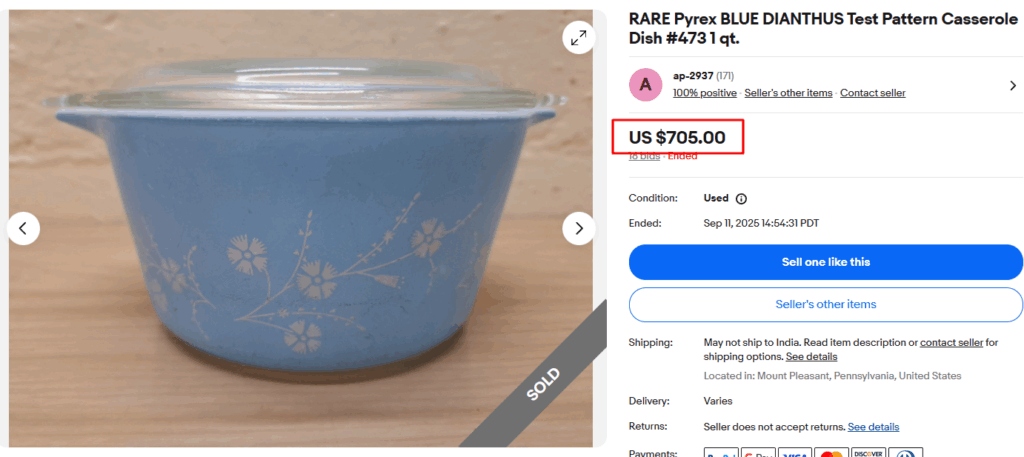
Produced as a ‘sales test’ pattern, Blue Dianthus never entered full mass production, which makes this lidded Casserole worth a fortune! It is less documented, but you can spot it by the delicate design of white Dianthus flowers and foliage on a blue background.
| Average Value | $500 to $800+ (as per completeness) |
| Dish Type | Casserole Dish, #473 1-qt |
| Pattern & Color | White Dianthus Flowers & Foliage on Blue |
| Manufacturing Era | 1963 |
| Collectibility | Extremely Rare |
8. Hot Air Balloon Chip and Dip Cinderella Bowls
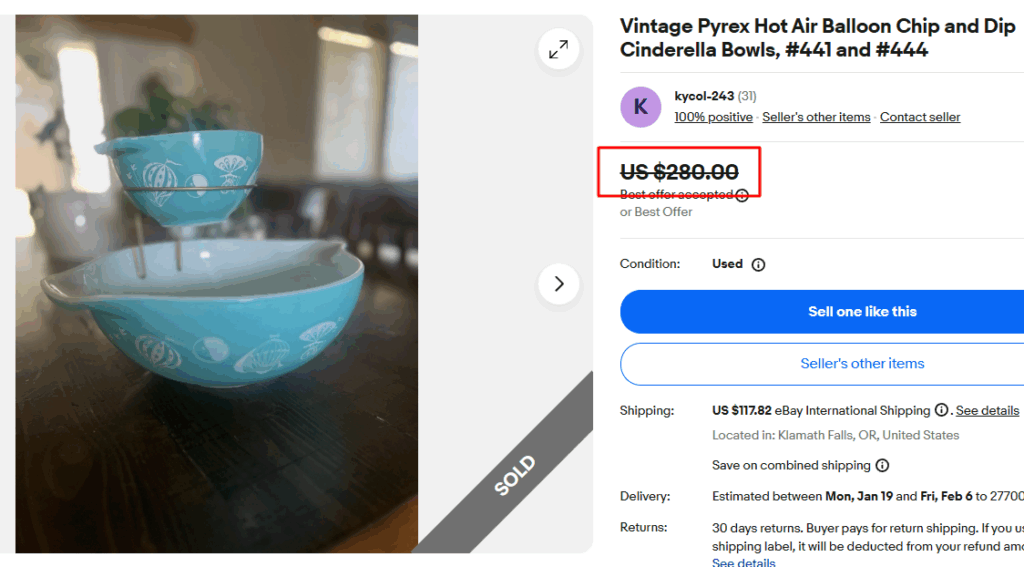
Another promotional item with a whimsical design! The chip-and-dip Cinderella set includes a 4-quart Cinderella mixing bowl, a similar 1-pint dip bowl, and a metal bracket to hold the smaller bowl.
This complete set features the “Hot Air Balloon” pattern, featuring hot air balloons, a crescent moon, and flying bicycles across the bowl. Based on the condition, pattern, and completeness, these sets can sell for $50 to $500.
| Average Value | $150 to $500 |
| Dish Type | Chip& Dip Cinderella Bows (444 & 441) |
| Pattern & Color | “Hot Air Balloons” Bicycle, & Crescent Moon on Blue |
| Manufacturing Era | 1958 |
| Collectibility | Highly Collectible |
9. Zodiac Casserole With a Lid and Candle Warmer
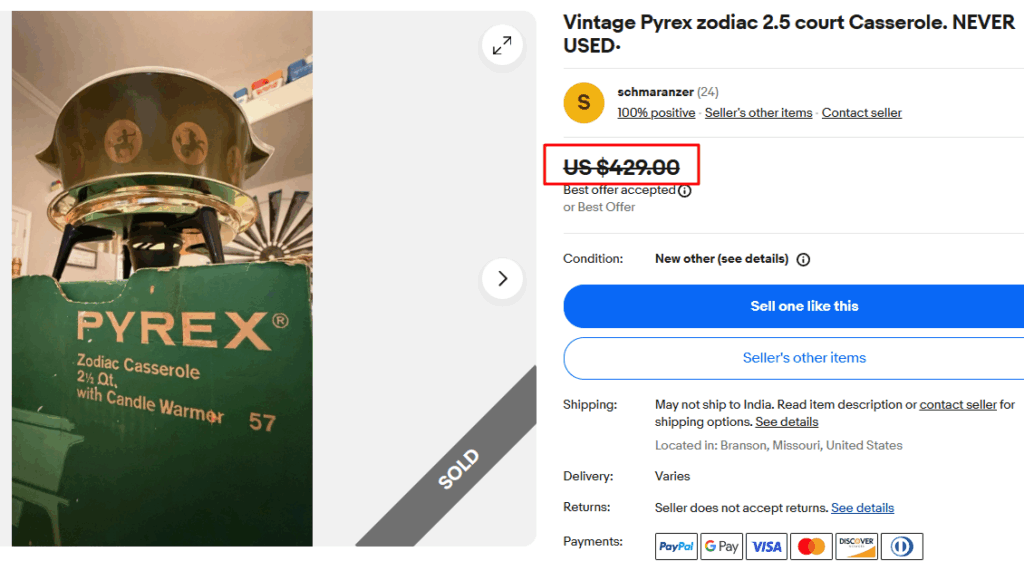
This 2.5-quart casserole dish features Pyrex’s one of the rarest patterns, “Zodiac” – 12 gold astrological signs on a forest-green opal. It’s believed that this pattern was designed with mid-century modern collectors in mind.
This piece was likely a holiday promotional produced for a limited time, making it super collectible. A full set with a glass lid with a gold starburst design and a four-metal cradle warmer can be worth up to $500!
| Average Value | $100 to $500 (complete set) |
| Dish Type | Casserole Dish with a Lid & Warmer |
| Pattern & Color | Gold Zodiac Signs on Green Base |
| Manufacturing Era | 1961 |
| Collectibility | Very Rare |
10. UFO Atomic Casserole with Warmer
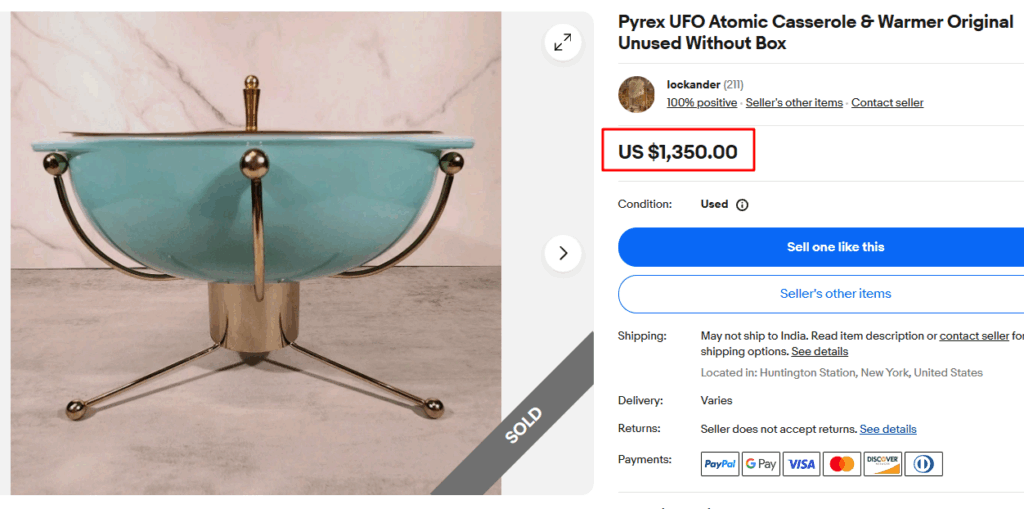
Notable for its domed shape, the UFO atomic casserole set from Pyrex includes a matching metal lid and a six-armed, brass-plated warmer in a mid-century modern space-age design. Collectors also call it ‘Sputnik’ or ‘Super Deluxe.’
Although the set lacks a specific pattern, it’s highly collectible for its unique design and limited one-year production run.
| Average Value | $500 to $1,400 (full set with all items) |
| Dish Type | Casserole Dish with Lid & Warmer Set |
| Pattern & Color | Turquoise Bowl with Brass Lid & Warmer (No pattern) |
| Manufacturing Era | 1956 |
| Collectibility | Extremely Rare |
11. “Golden Acorn” Round Casserole Dish
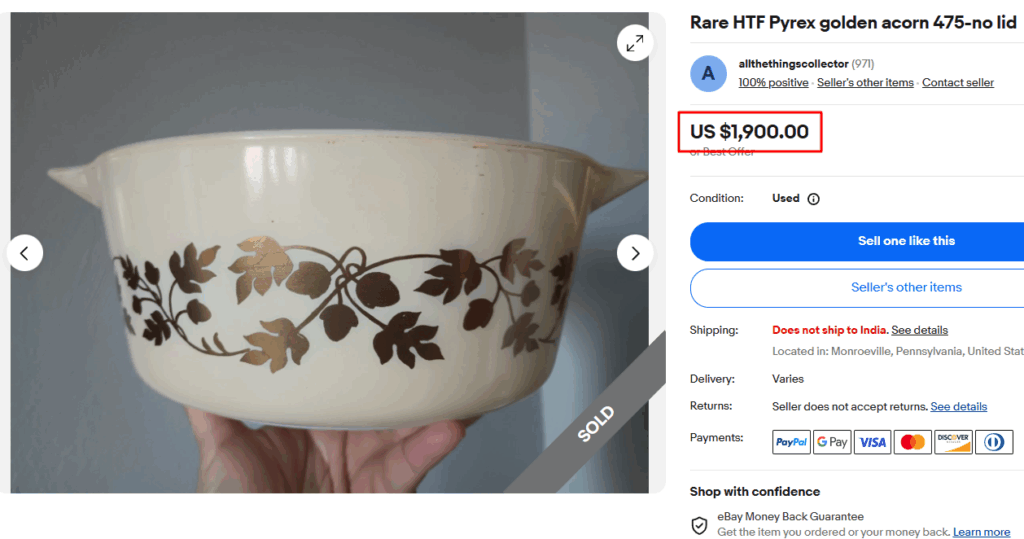
Also known as ‘Gold Acorn on Ivory’ and ‘Golden Touch,’ the “Golden Acorn” pattern from Pyrex features bold gold acorns and oak leaves on a cream or ivory background.
Although the pattern had a four-year run, this 2.5-quart (475), round casserole dish with this pattern is one of the market test pieces, produced in low numbers. Others are #473 and #474. Only a few pieces are known to exist, making it super valuable.
| Average Value | $500 to $2,000 (complete set) |
| Dish Type | Round Casserole Dish |
| Pattern & Color | Golden Acorn/ Gold on Ivory |
| Manufacturing Era | 1960 to 1963 |
| Collectibility | Lidded Pieces are Very Scarce |
12. “Constellation” Divider Serving Dish with Lid and Twin Candle Warmer
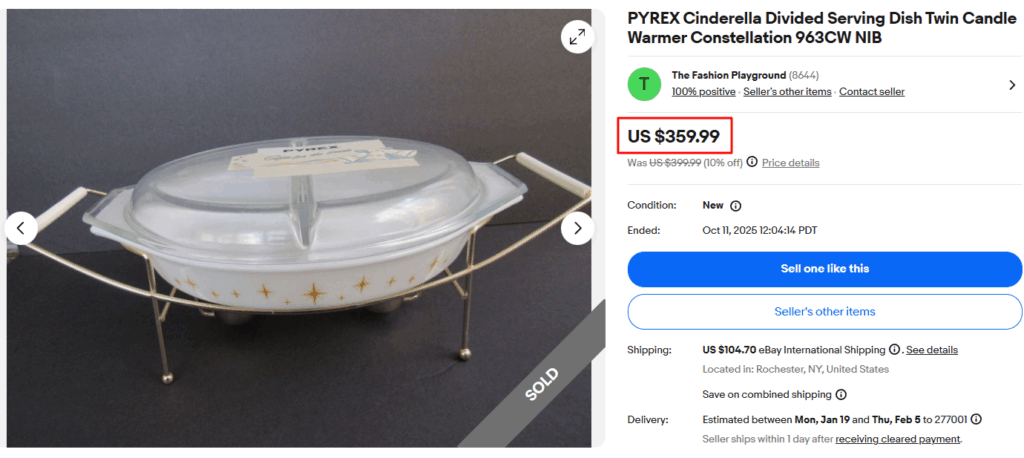
Constellation is one of the brand’s most desirable patterns, featuring yellow stars of different sizes on a white opal background. This example shows a unique, divided Cinderella serving dish with a clear glass lid and a two-candle warmer!
Finding a complete set with warmer and lids in this pattern is quite rare these days, which is why they sell for a high price.
| Average Value | $150 to $400 (full set with warmer) |
| Dish Type | Oval Divider Serving Dish (1.5 Quart 963CW) with Warmer |
| Pattern & Color | Yellow Stars on White Background |
| Manufacturing Era | 1959 |
| Collectibility | Extremely Rare |
13. Musical Staff Casserole Dish with Lid
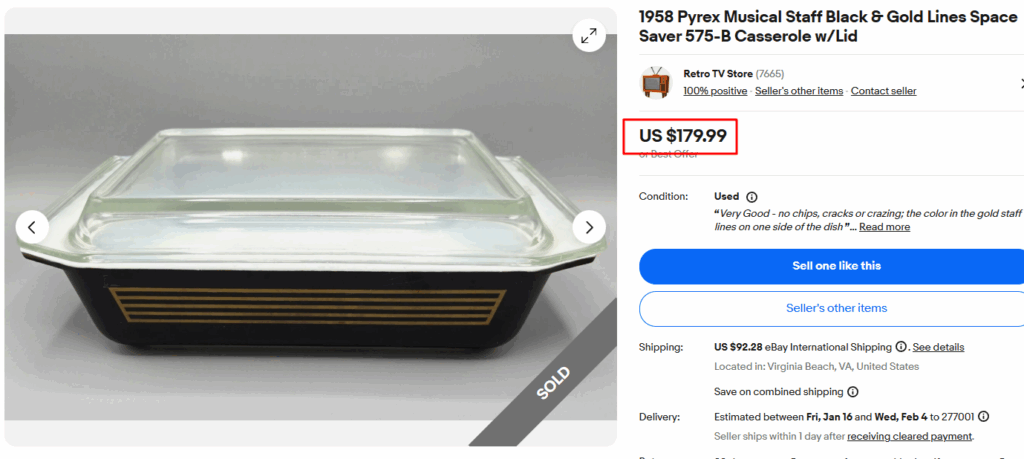
Originally sold as a part of a Cinderella buffet set, this rectangular “Musical Staff” 2-quart casserole dish was a limited edition, designed exclusively for efficient storage. Since it’s not a standard piece, it’s rare and valuable.
This piece features a golden musical staff design on a black exterior, a white interior, and a matching glass lid.
| Average Value | $150 to $280 |
| Dish Type | Rectangular Casserole (575 B, 2-qt) |
| Pattern & Color | Gold Musical Staff on Black |
| Manufacturing Era | 1958 |
| Collectibility | Moderately Rare |
14. Blue New Holland Oval Casserole With Lid and Trivet
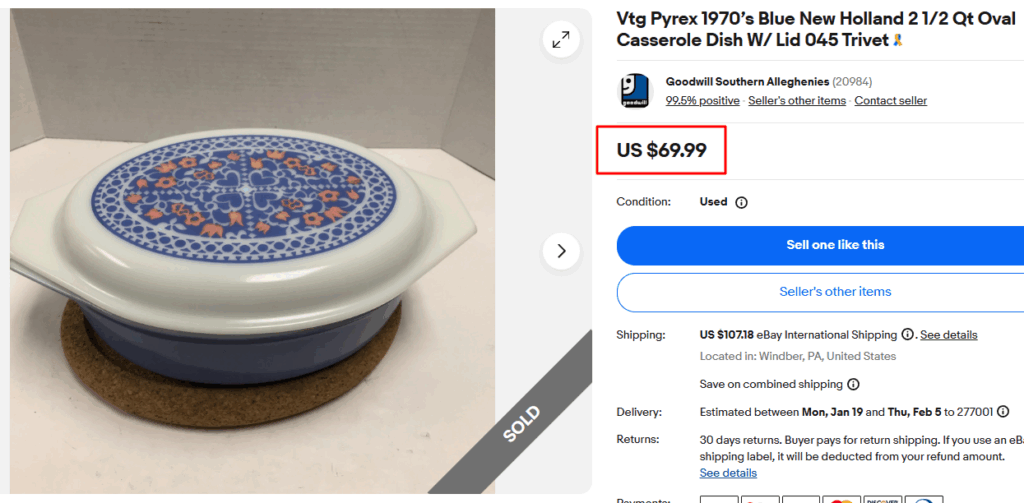
The brand’s New Holland casseroles show white opal lids adorned with a central medallion-like design featuring hearts, leaves, and flowers in blue and red. The dish itself has a solid blue base. Since it’s newer than other standard patterns, it’s moderately valuable.
| Average Value | $35 to $100 |
| Dish Type | Casserole (2.5-qt) with Lid & Trivet |
| Pattern & Color | Solid Blue Base & Printed White Lid |
| Manufacturing Era | 1973 |
| Collectibility | Moderately Rare |
15. “Barcode” Casserole Dishes with Lids
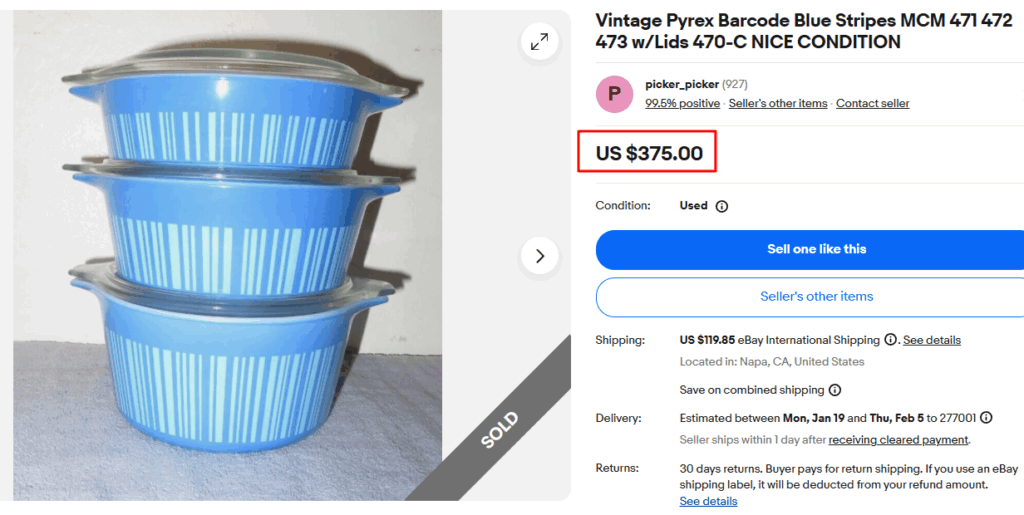
This is a set of three round casserole dishes featuring the short-lived promotional “Barcode” pattern. They are part of the ‘470’ series with sizes 471 (1 pint), 472 (1.5 pints), and 473 (1 quart).
The pattern is simple, light blue vertical stripes on a dark blue base. Lids are clear, and the dishes come with Cinderella-style handles!
| Average Value | $250 to $550 |
| Dish Type | Casserole Dishes with Lids |
| Pattern & Color | Barcode, Light Blue Stripes on Dark Blue |
| Manufacturing Era | 1966 |
| Collectibility | Highly Sought-After |
What Makes a Pyrex Dish Valuable?
So, now you know some of the rarest vintage Pyrex dishes that can elevate your collection. Here’s what makes a normal Pyrex dish valuable.
Rarity
The rarer a dish, the more valuable and collectible it is. For Pyrex, the rarity largely depends on production volume, duration, and distribution.
For example, Pyrex dishes with limited promotional patterns, such as “Barcode,” “Lucky in Love,” etc., are valuable among collectors. Sets in these patterns were either released as special sets, in low numbers, or had a short run.
Similarly, test and sales sample patterns or shapes/items that never reached the production line are considered rare.
Condition & Completeness
The overall value of a Pyrex dish also comes from its condition. Pieces in mint, near mint, and excellent condition are valued at premium rates, while those in poor condition, with chips, cracks, and other damage, are priced in the low-cost range.
Apart from this, the completeness of a set is another significant value multiplier. While individual pieces typically sell for $5 to $15, full sets of bowls, casseroles, etc., can fetch double or triple the price.
Pattern and Shape Desirability
Even if a pattern isn’t rare, it can command a high value for its popularity. Some of Pyrex’s beloved patterns include “Butterprint,” “Snowflake,” “Pink Daisy,” “Early American,” and “Gooseberry.”
This attribute also applies to dish shape. Collectors go crazy and pay more for some of the functionally appealing shapes like Cinderella bowls, space savers, lidded casseroles, and more.
Note: This article is intended for informational, educational, and entertainment purposes only. Some images are illustrative and may not represent actual brands, products, or related entities. All trademarks, product names, brand logos, packaging, and other intellectual property referenced remain the exclusive property of their respective owners. Any brand mentions or references are provided solely for descriptive and educational context and do not imply any formal or commercial association.