Antiques Know How Research
Fostoria American Pieces Value
Our Antiques Know How team’s review of hundreds of eBay sales shows that Fostoria “American” pattern (Line #2056) pieces sell from $30–$600+, with rare colored pieces reaching $150+. Most collectible items include Crushed Fruit Jar, amber cookie jar, amber handkerchief box, punch bowl sets, square cake stands, amethyst vases, & cobalt divided dishes. Spot originals by 3-mold seams, fire-polished finish, sharp cubes, heavy body, and flat ground base.
Antiques Know How
What Is Fostoria “American”?
Fostoria Glass Company is one of the most famous glass companies in America. The Fostoria Glass Company introduced its “American” pattern (Line #2056) in 1915 to compete with the “Early American” style.
The pattern features a unique three-dimensional cube design, which soon became one of the most beloved patterns. Fostoria introduced this design in various shapes (around 400 pieces in total) and colors until the 1980s.
Fostoria American is highly collectible today due to its durability and variety, including rare colored pieces and serving pieces!
Valuable Fostoria American Glass Pieces to Find!
Listed below are some of the most valuable and collectible Fostoria pieces in its iconic American pattern!
1. Round Pedestal Cake Stand (with Rum Well)

| Average Value | $80–$175 |
| Production Period | circa 1916–1982 |
| Status | Discontinued |
| Collectibility | Moderate to High |
This round “salver” cake stand is the classic version of the Fostoria American pedestal. This form was introduced in 1916, just one year after the American pattern’s debut, and it remained in production for most of the pattern’s history.
Standing about 7 inches tall, it features a 10-inch “salver” or plate surface with a “rum well” in the center and a pedestal base. Round stands are quite common and fetch a moderate value in pristine condition.
2. Crushed Fruit Jar

| Average Value | $250 – $400 |
| Production Period | 1915 – 1925 |
| Status | Discontinued / Rare |
| Collectibility | High (Early Production) |
| Collector Notes | “Hollow” top handle design |
This is one of the rarest and most valuable Fostoria American pattern pieces. Why? The “Crushed” Fruit Jar was only made between 1915 and 1925, giving it a very short production window of about a decade.
These jars are about 10 inches tall and come with a domed lid topped by a round ball finial, all featuring the full American pattern cube design.
Its original purpose was to hold crushed fruit for cocktails and desserts, giving it its nickname. Due to its scarcity, especially if intact, this jar can fetch up to $1,000 today!
3. Lidded Pedestal “Wedding Cake” Box
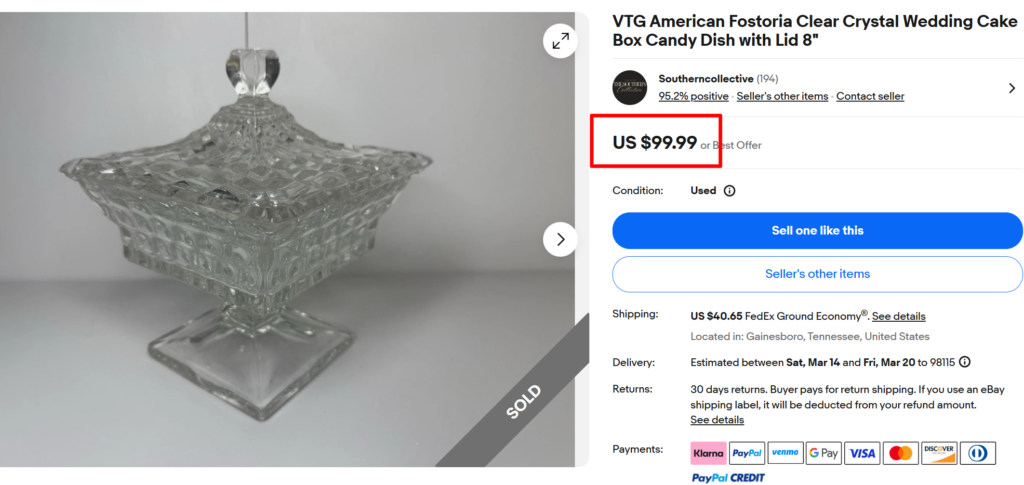
| Average Value | $80 – $250 |
| Production Period | 1930s – 1960s |
| Status | Discontinued |
| Collectibility | High |
Often referred to as a “Wedding Cake Box” or a high-foot compote, this piece is essentially a small, lidded jar elevated on a tall, square pedestal. It was used for candies, nuts, or as a decorative “statement” piece for formal tablescapes.
Such tall pieces with fitted lids are prone to damage, so finding one in pristine condition is rare!
4. Punch Bowl Set

| Average Value | $175–$400 (complete set) |
| Production Period | 1915 – 1982/86 |
| Status | Discontinued |
| Collectibility | High |
The Fostoria American punch bowl set is one of the most collectible pieces in the entire line. The full set consists of a large footed bowl, a stand or pedestal base, and a set of punch cups, usually 12 in a full service.
The bowl itself is large and heavy, featuring the full American cube pattern, and it stacks impressively on its tall pedestal stand.
Full sets like these can easily fetch $150 to a few hundred dollars, in “mint” condition.
5. Amber Cookie Jar

| Average Value | $150 – $300 |
| Production Period | 1920s to 1960s (Amber) |
| Status | Discontinued |
| Collectibility | Highly Collectible |
Amber (often called “Topaz”) is a warm, honey-toned glass that Fostoria produced for a short time. This cookie jar in Topaz features the cube pattern across the entire body and a matching lidded top with a faceted knob.
Fostoria produced colored American pieces in limited runs, and amber was offered during specific periods in the 1920s and beyond. So, this amber cookie jar is rarer than the clear ones.
6. Square Bell Pedestal Cake Stand (with Rum Well)

| Average Value | $175 – $350 |
| Production Period | 1920s – 1950s |
| Status | Rare Shape |
| Collectibility | High |
One of Fostoria’s two iconic cake stand shapes in the American pattern, this one is the Square Salver, introduced in the early 1920s.
These stands generally measure about 10 inches square and 7 inches tall, with a distinctive bell-shaped pedestal. The standout feature is the small rum well in the center of the surface (for brandy or rum as a sauce for cakes and puddings)!
Square Salvers are usually harder to find (and heavier, too) than the round version, making them slightly more valuable.
7. Amethyst Square-Footed Vase
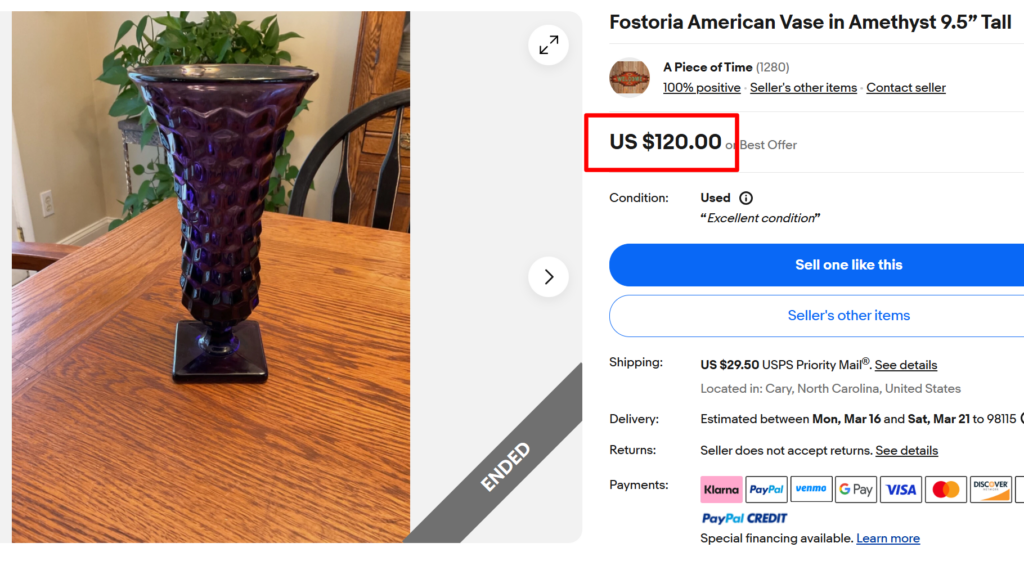
| Average Value | $100 – $250 |
| Production Period | 1924–1944 and 1946–1974 |
| Status | Discontinued |
| Collectibility | High (rare color) |
Amethyst Fostoria American pieces are among the rarest finds in the entire line. This Amethyst example is a 9.5-inch-tall trumpet-shaped vase featuring the full cube design, with a squared, footed base typical of the American pattern.
The production of Amethyst glass needed precise chemical additives, making these runs shorter and more expensive than standard crystal runs.
8. Cobalt Blue Divided Serving Dish (With Tray)

| Average Value | $60 – $90 |
| Production Period | Late 1920s (Limited) |
| Status | Rare Color |
| Collectibility | High (with metal tray) |
Cobalt blue is another rare color in Fostoria’s line of colored American glassware. This specific blue 5-section divided tray design itself was also produced for a limited time in regular crystal, making a cobalt example doubly unusual.
Many divided dishes usually came with a decorated metal tray or holder with heart-shaped cut-outs and side handles. The presence of the original trays can boost these dishes’ value.
9. Amber Handkerchief Box

| Average Value | $450 – $600 |
| Production Period | 1915 – 1942 (mainly 1925 – 1926) |
| Status | Extremely Rare |
| Collectibility | Elite |
While the Handkerchief Box was made in clear glass for years, Fostoria produced a limited run of colored boxes as a part of its 1925 Boudoir Sets. The shape was officially called the “Confection and Cover” in Fostoria’s catalogs.
This specific amber variant is a perfect example of how color transforms the value of an American pattern piece. “Early Blue” (Azure) shade is another particularly rare variant in this line.
10. Marmalade Jar

| Average Value | $40 – $75 (common) |
| Production Period | 1930s – 1943 (as Jam Jar) |
| Status | Discontinued |
| Collectibility | Moderate |
| Collector Notes | Cut-outs in the lids for a spoon |
The Marmalade Jar has an interesting history in the American line. It was first introduced in 1915 as the “Pickle Jar” but was discontinued in 1925. Then, it was reintroduced as “Jam Jar” in the mid-1930s and produced through 1943.
The form features a tall cylindrical jar with the full cube pattern and a rounded dome lid. Also, these were originally sold with a metal spoon, first chromium and later silver-plated. The lids have a cut-out for spoons.
While lidded marmalade jars alone sell for $25 to $60, one with its original metal spoon can be worth slightly more.
11. Cranberry Tom and Jerry Bowl

| Average Value | $100 – $180 |
| Production Period | 1920s – 1950s |
| Status | Rare Color |
| Collectibility | High |
This 12-inch footed centerpiece features one of the most stunning color variations ever produced by Fostoria. The Cranberry (or Pink-Red) tone is often associated with the holiday “Tom and Jerry” punch sets used during the mid-century era.
The cranberry and deep rose tones in this pattern were not part of the regular catalog runs, making surviving examples especially desirable.
12. Round Butter Dish and Cover

| Average Value | $30 – $75 |
| Production Period | 1915 – 1982 |
| Status | Discontinued |
| Collectibility | Moderate to High |
Clear round butter dishes are one of the longest-running items in the American line. The two-piece set features a butter plate with a pointy, scalloped edge and a tall, domed lid with a glass knob finial.
This piece was produced for nearly six decades, making it readily available and common. But earlier pre-1940s examples of manganese glass (which shows a faint lavender tint under UV light) are particularly popular among collectors.
Quick Note: When collecting these, make sure the lids fit snugly; loose lids may indicate a mismatched set and reduce value.
How to Spot Real Fostoria American Glass?
Fostoria’s “American” pattern is undoubtedly the most imitated glassware design in U.S. history. Jeannette Glass, Indiana Glass, and Fenton all have similar-looking cube designs. You can spot the real Fostoria pieces using the following features:
- Labels: Fostoria rarely marked its pieces with etched or molded stamps. They rather used glued-on paper labels or shield-shaped foil, which often washed off. So, labels aren’t reliable for authentication, but if they’re intact, they can boost the value.
- Three Mold Lines: Real Fostoria American was made using a three-part mold. If you look closely at the base or sides of a piece, you’ll see three vertical seams. Many look-alikes, like those by Indiana Glass, often have only two.
- Fire-Polished Surface: Fostoria was known for its “fire-polishing” process, returning the piece to the furnace to smooth out any rough edges. The result was a silky texture, unique to its glassware. Other imitations, like Indiana’s Whitehall, were not fire-polished, so they have a rougher, more matte feel.
- Cube Details: The cubes on genuine Fostoria American glass are sharp and well-defined (like real ice cubes), with flat tops. Replicas often have slightly rounded or “mushy” cubes that lack the crisp, geometric brilliance of the original.
- Weight & Clarity: Fostoria used high-quality lead crystal (especially in early years) for its glassware, which is super clear! Also, it’s surprisingly heavy. So, if a “clear” piece looks cloudy or slightly green and feels lighter for its size, it could be a lower-quality replica.
Note: This article is intended for informational, educational, and entertainment purposes only. Some images are illustrative and may not represent actual brands, products, or related entities. All trademarks, product names, brand logos, packaging, and other intellectual property referenced remain the exclusive property of their respective owners. Any brand mentions or references are provided solely for descriptive and educational context and do not imply any formal or commercial association.