Antiques Know How Research
Old Egg Beaters Value
Our detailed analysis of several recent eBay and market sales at Antiques Know-How suggests that vintage egg beaters generally sell for $15 to $300, with rare complete examples reaching up to $800 to $1,000+ more. The most valuable beaters are King glass jar pieces, Hill cast iron rotary (1901), Flyswatter mesh-style, early Dover Stamping Co. Boston variants, scissor-geared (1893), and uranium (vaseline) A&J crank models. Key factors that drive value are makers, brand markings, patent dates, original accessories, unusual mechanisms, and condition.
Antiques Know How
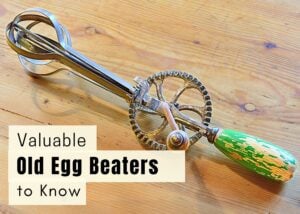
Do you remember those bulky, rusty metal egg mixers with crank handles? Those were a common kitchen accessory back in the day. Today, these tools lie unnoticed in estate sales or kitchen drawers.
But would you leave your old egg beater to gather dust if you knew it could actually be worth a few hundred dollars today? That is what I want to tell you.
In this guide, I will show you examples of vintage egg beaters that are high-value collectibles today and teach you how to determine if your egg mixer is valuable.
9 Valuable Egg Beaters Worth Finding Today
Below are some rare egg beater collectibles of different types and several brands that can be worth a small (or big) fortune today.
1. King Patented Egg Beater with Glass Jar
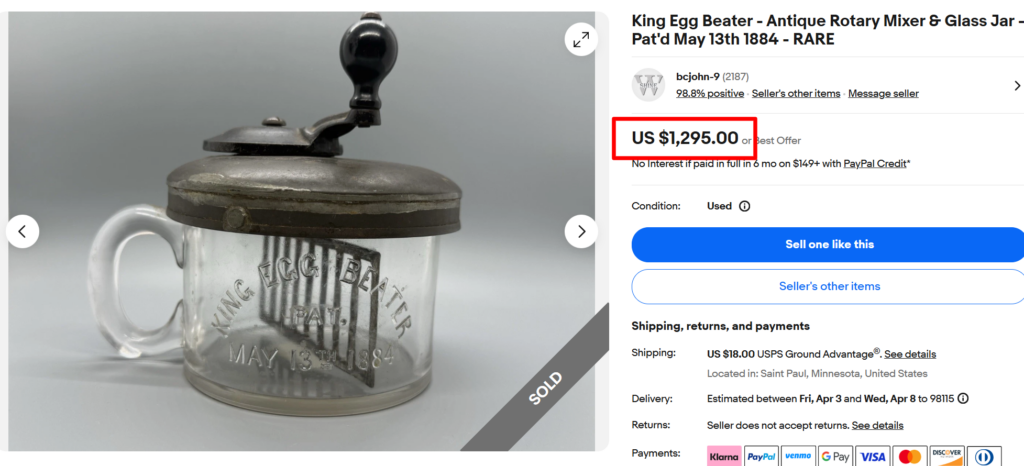
| Average Value | $800 – $1,500+ |
| Production Period | 1884 |
| Key Features | Cast iron/pewter mechanism, embossed glass mug-form jar |
| Collectibility | Very High |
| Collector Notes | “KING EGG BEATER PAT MAY 13TH 1884” embossed on glass |
The King Egg Beater is one of the rarest and most sought-after American egg beaters. This model was patented in 1884 and has a custom-fitted glass jar with embossed markings. The cast-iron mechanism rests on a metal lid that fits on the jar.
The high value comes from two factors: age and completeness. Most examples found today have either a broken jar or a missing mechanism, making complete surviving examples like this extremely rare and valuable.
A version with light amethyst-colored glass, caused by sun exposure to manganese-dioxide glass, is known to exist and is even more desirable.
2. The Hill Cast Iron Rotary Egg Beater
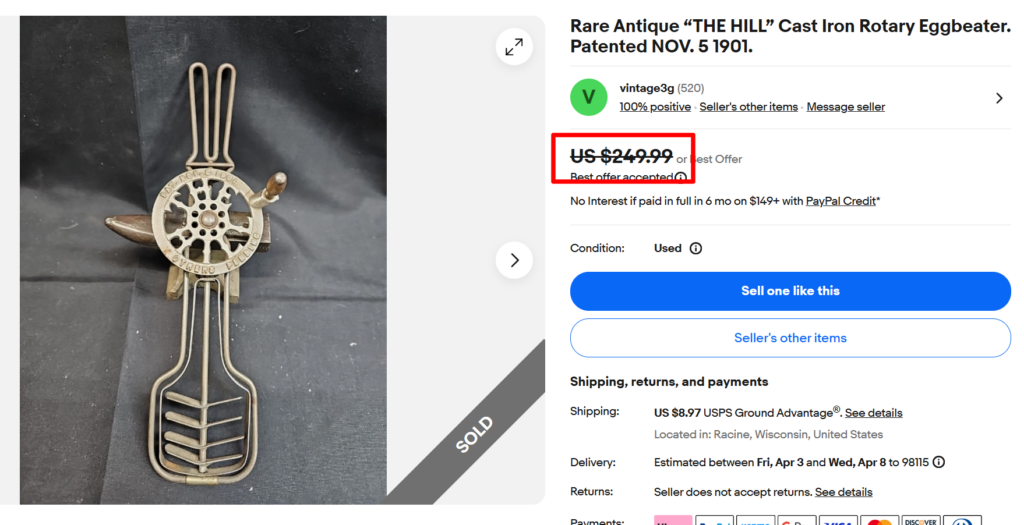
| Average Value | $150 – $250+ |
| Production Period | Patented 1901 |
| Key Features | Spoked cast-iron wheel, flat horizontal beater wires |
| Collectibility | High |
| Collector Notes | Check the patent embossing on the wheel. |
“The Hill” is a mechanical masterpiece patented in 1901. Unlike standard loop-style dashers on Dover-type beaters, this one uses a unique vertical gear system and a specialized wire frame. Its distinct industrial look and rare “paddle” style blades make it a standout piece.
Also, this is a single-patent egg beater with the patent date “Pat/Nov/5/1901” embossed directly on the drive wheel, making it easy to identify. As a rare design, this beater can sell for $200 to $300 or more in good condition.
3. Antique Flyswatter Egg Mixer
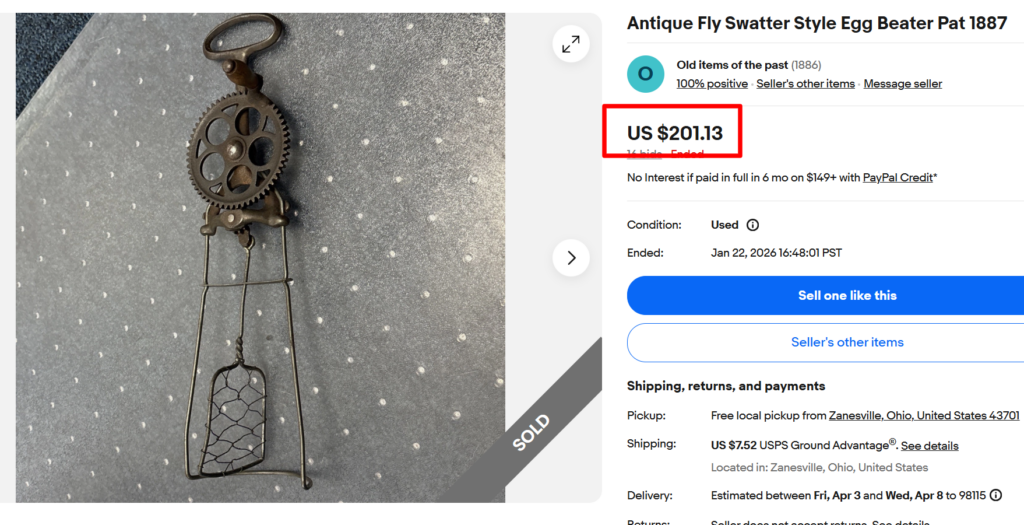
| Average Value | $150 – $250 |
| Production Period | Late 1880s |
| Key Features | Large open gear wheel, flat mesh-screen beater |
| Collectibility | High |
| Collector Notes | Check the “Patent/Oct/25/1887” mark on the metal stripe. |
This unusual 1887 patent is nicknamed the “Fly Swatter” because of its flat, mesh-like beating surface. The large spoked drive gear, ring handle at the top, and the unusual rectangular mesh beater make it one of the rarest designs you’ll see.
Because these wire mesh beaters are easily damaged or rusted through over time, intact examples with minimal rust and damage can be worth over $200.
4. Dover Egg Beater (Dover Stamping Co., Boston)
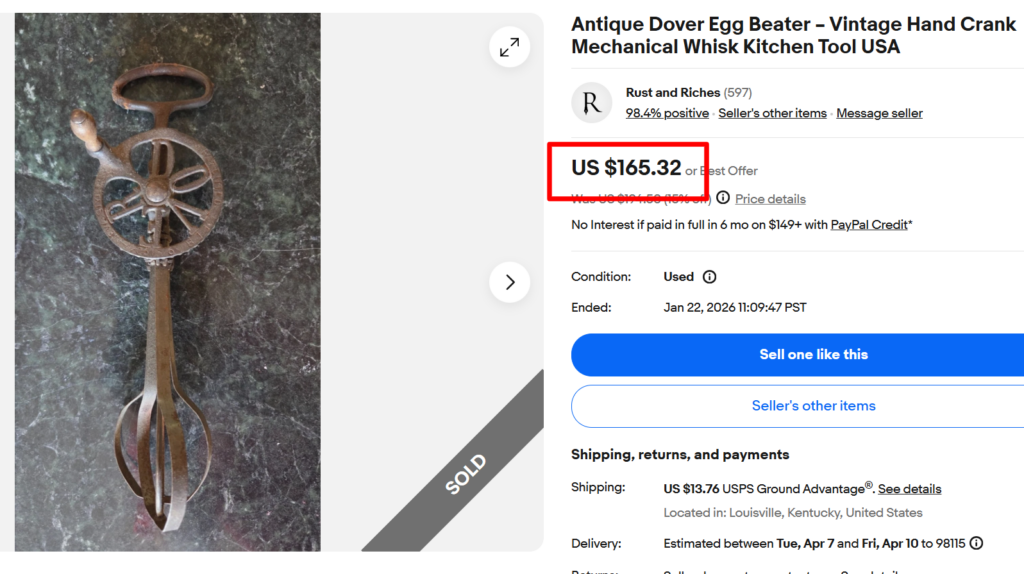
| Average Value | $15 – $165+ (high for rare variants) |
| Production Period | 1870s – early 1900s |
| Key Features | Cast iron frame, spoked wheel, stamped patent dates |
| Collectibility | Moderate to High |
| Collector Notes | Check for patent date and “Boston” stamp |
The Dover Stamping Company of Boston produced one of the first widely successful rotary egg beaters, patented May 31, 1870. The design was so popular that many other makers named their beaters “Dover-style.”
You can spot the originals, marked “Dover Egg Beater” and stamped with a patent date on the drive wheel. These examples are the most desirable of all standard Dover-style beaters.
The value lies in the rarity of the variant. Basic examples from the 1890s–1900s are worth $15–$50. Rarer versions, including unusual dasher shapes, early single-patent examples from the 1870s, or commercial clamp-on hotel-size beaters, can reach $100–$200+.
5. Jaquette Bros Cast Iron 3 Scissor-Style Beater
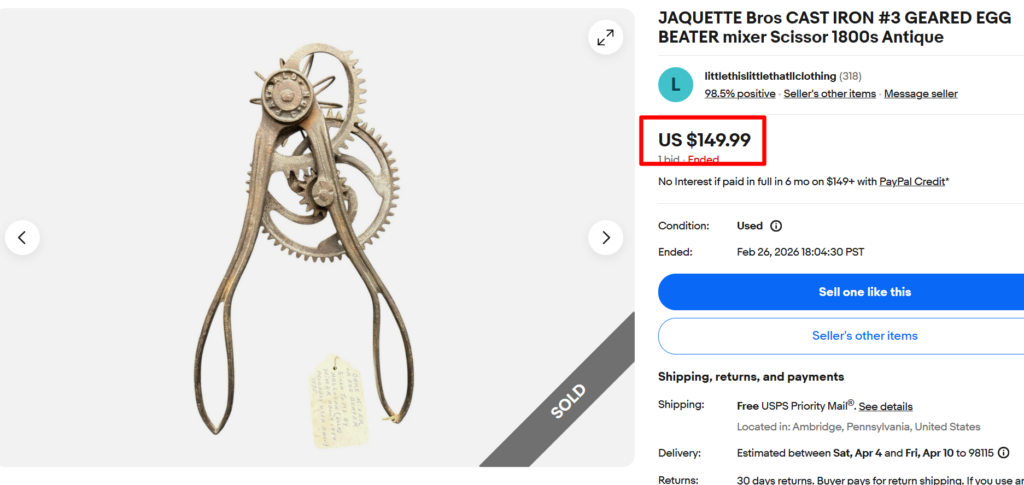
| Average Value | $100 – $200 |
| Production Period | Patented Nov. 28, 1893 |
| Key Features | Scissor-style handles, three interlocking cast iron gears |
| Collectibility | High |
| Collector Notes | “JACQUETTE/PHILA. PA.” embossed on handles |
This “Scissor” style mixer by Jaquette Bros is a rare 19th-century collectible. Harry Jaquette of Philadelphia patented this beater on November 28, 1893. It operates like a pair of scissors.
It features an exposed triple-gear system with a unique skeletal frame and “pliers” style handles that make it one of the most visually striking antique egg beaters. The beater came in at least four sizes, numbered 1 through 3 (and possibly larger).
The #1 (smallest) and the largest size are the hardest to find. The #3, like this one shown here, is the most common variant of all.
6. Silvers Co. Cast Iron Egg Beater Glass Mixer
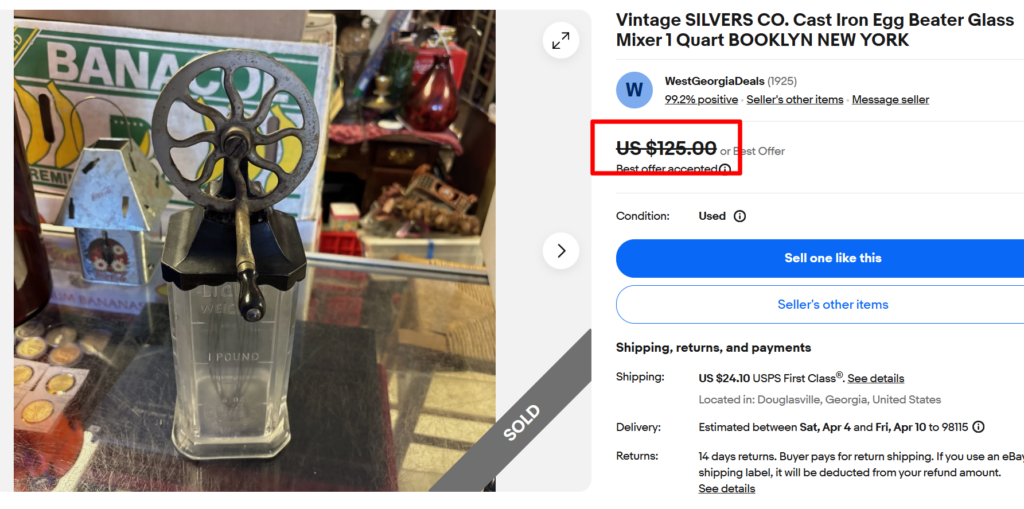
| Average Value | $80 – $175 |
| Production Period | c. 1900 – 1918 |
| Key Features | Square measuring jar, ornate cast iron wheel |
| Collectibility | High |
| Collector Notes | Brooklyn Bridge embossed on the glass. |
Produced in Brooklyn, NY, the Silvers Co. mixer is highly desired for its structured, square glass base. The cast iron top features an elegant “spoke” design on the drive wheel.
These units were often sold as “one-quart” mixers. Each jar is embossed on each side with different measurements: liquid weights, quart/pint markings, cup measurements, and pound-flour markings.
You’ll also find the “SILVERS TRADE MARK BROOKLYN” embossing inside a circle on the base. The No. 3 model is the most common version in this type; the rarer “No. 1” size is harder to find and commands a higher price.
7. Uranium Glass Crank Handle Beater
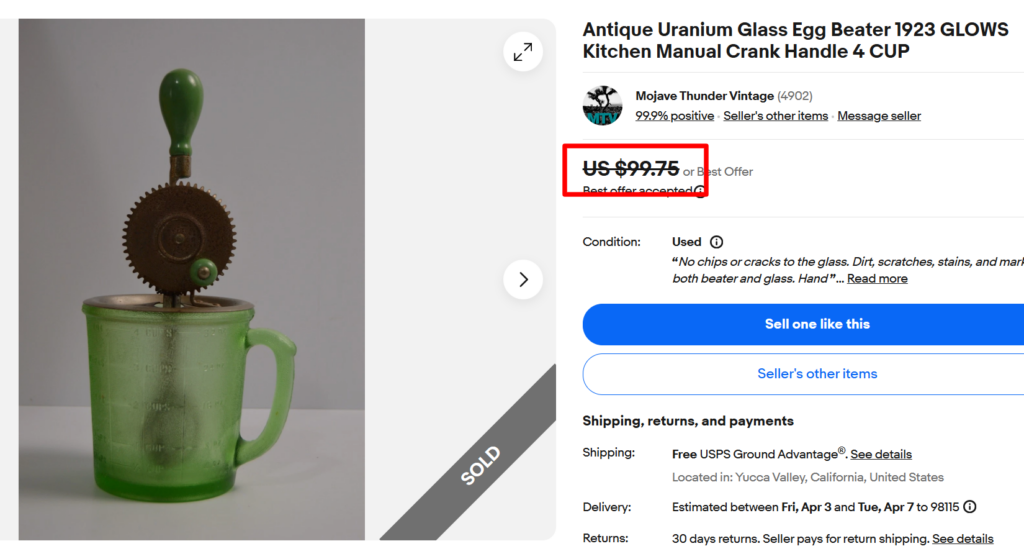
| Average Value | $50 – $120 |
| Production Period | 1923 – 1930s |
| Key Features | Uranium (vaseline) glass jar, A&J metal beater mechanism |
| Collectibility | Moderate to High |
| Collector Notes | Check the “PAT. OCT. 9 1923” stamp on wheel. |
This is an example of the most popular Depression-era hand mixers produced by A&J (Aluminum & Johnson). Its base is made of Vaseline or Uranium glass, which glows bright green under a UV light, while the beater has a green handle.
The glass jar is embossed with measurements in ounces, cups, and pints. The 4-cup (1 quart) version is more common; the 2-cup version is harder to find and can be more valuable.
Check the “PAT. OCT. 9 1923” stamp along with the A&J diamond logo on the beater mechanism for authenticity.
8. Hold-Lyon Co. Improved Dover Egg Beater (Hopper)
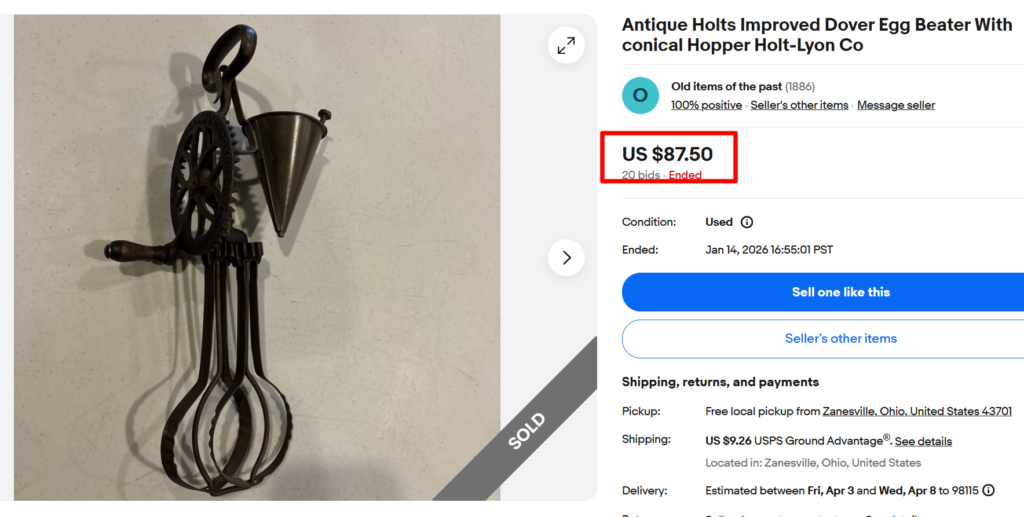
| Average Value | $80 – $100 |
| Production Period | 1890s – 1910s |
| Key Features | Side-mounted funnel, Dover mechanism |
| Collectibility | Moderate |
| Collector Notes | Original Hopper is crucial for high value. |
Holt-Lyon Company of Tarrytown patented an improved Dover-style beater in 1899 and 1900. They added a clever conical tin funnel (or “hopper”) to this Dover-style beater. This allowed the cook to drip oil or other liquids into the mix slowly.
The funnel accessory is the key value driver here. Without it, a Holt-Lyon beater is a standard Dover beater, which is collectible but not exceptional.
9. Blue Whirl Egg Beater (Red Handle)
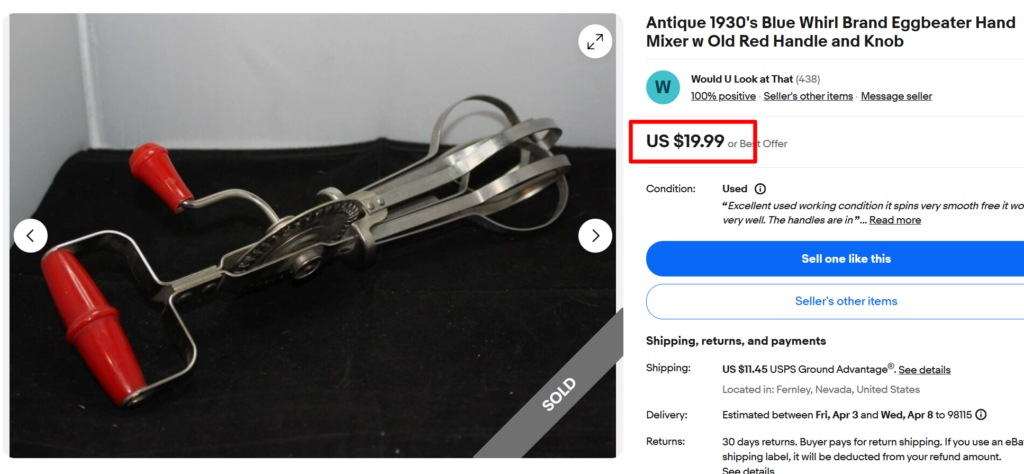
| Average Value | $20 – $40 |
| Production Period | 1930s – 1950s |
| Key Features | Red plastic handles; stainless steel body |
| Collectibility | Low to Moderate |
| Collector Notes | Rare handle colors can boost value. |
Blue Whirl beaters are vintage classics known for their Stainless steel construction, smooth action, and colorful aesthetics. The value of these beaters lies in the vibrant color variants.
For example, the original red-handled versions, whether painted wood or Bakelite, are among the most desirable. While these beaters are worth significantly less than earlier cast-iron beaters, they’re still moderately collectible.
You can spot these by the brand name “Blue Whirl” etched or engraved on the steel mechanism.
How to Tell If an Egg Beater Is Worth Anything?
As you can see above, the price range for a vintage egg beater varies from $10 to $350, with some rare ones going as high as over $1000. If you want to find out whether your old egg beater is valuable or not, then you must check the following:
Brand, Markings & Patent Dates
The first thing to check on any old egg beater is whether it has a name or patent date stamped somewhere on it. Look at the drive wheel (the large gear you crank), the handle, and any flat surfaces on the frame.
Below are some common markings to look for:
- A brand name like “DOVER,” “HOLT’S,” “JACQUETTE,” or “SILVERS.”
- A patent date like “PAT’D MAY 31 1870.”
- A city of origin like “BOSTON” or “BROOKLYN, N.Y.”
Patent dates are particularly useful because they give you an accurate date for when the design was registered. But remember, the patent dates may not necessarily tell you when a specific beater was made.
Unmarked beaters can also be valuable if the design is unusual, but identified examples are almost always more desirable.
Construction & Handle Material & Color
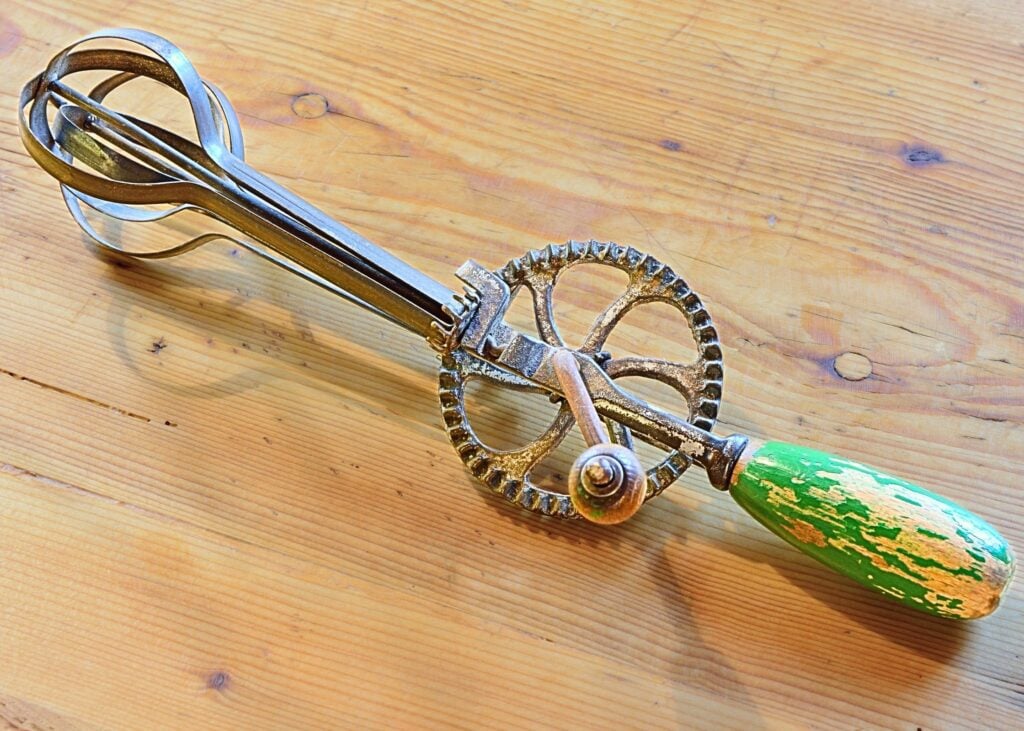
Both the overall construction material and the handle material are crucial to value. Cast-iron egg beaters from the 1800s through the early 1900s are generally more collectible than those made of pressed tin or stamped steel made in later years.
The weight, detail, gears, and method of handle attachment can say a lot about their age and quality.
Handle color and material matter a lot, especially for mid-century beaters. Red or green Bakelite handles, original painted wood, and colored ceramic handles all add collector appeal and value, with red being particularly sought after.
And the handle should be original. A replaced handle (even if it looks similar) reduces value. So, always check if the handle matches the patina and wear level of the rest of the beater.
Unusual Mechanism
Standard “side-wheel” beaters are common. To find real value, look for “oddities” in how the tool actually moves. The more complex or strange the mechanism, the higher the desirability and value.
- Turbine & Spiral Models: Instead of a side crank, these use a “push-down” spring or a top-mounted turbine. They look more like modern whisks but feature heavy antique gears.
- Clamp-Mounted Beaters: These heavy-duty mixers were designed to be mounted on the side of the table or bowl. Their size and heavy-duty design make them hard to find.
- Glass-Jar Models: Some beaters were made to fit perfectly onto a specific glass jar or measuring cup. The value here is in the “complete set,” as the glass was often broken over the decades.
- Center-Drive Gears: Most beaters have a gear on the side, but “center-drive” models have the main wheel positioned directly over the blades. These were considered a premium, smooth-running design in the late 1800s.
- Scissor-Action Grips: These look like a pair of pliers or scissors. Squeezing the handles together spins the blades. Because they were difficult to use for long periods, they weren’t produced for very long.
Condition & Completeness
A valuable egg beater is one that’s functional and original. This means that the gear mechanism should be operational (even if stiff), and the original handles should be present.
Surface rust and patina are expected, but pitting and/or broken gears are not. Cleaned and/or repainted beaters are generally less valuable than original ones with signs of use.
Completeness is also critical for the high-value pieces, with the condition of additional elements playing a huge part. A Holt-Lyon beater without its funnel won’t be as valuable. Likewise, a King Egg Beater with a chipped or cracked glass jar loses most of its value.
Note: This article is intended for informational, educational, and entertainment purposes only. Some images are illustrative and may not represent actual brands, products, or related entities. All trademarks, product names, brand logos, packaging, and other intellectual property referenced remain the exclusive property of their respective owners. Any brand mentions or references are provided solely for descriptive and educational context and do not imply any formal or commercial association.