Antiques Know How Research
Vintage Figural Brooches Value
The Antiques Know How team’s in‑depth review of several eBay sales and auctions shows that most vintage figural brooches sell for under $50 at thrift stores, while signed pieces from big brands can range from about $80–$3,000+. Some valuable pieces include Trifari’s Jelly Belly animals, Schiapparelli bear, Coro fruit‑basket and Quivering Camellia Duettes, Schreiner lobster, Boucher Bird of Paradise, Bakelite Scottie dog, Carnegie mermaid, Trifari Tree of Life, and Eisenberg Ice Christmas tree designs. The value depends on the maker and markings, production era (1930s–1940s), materials, rarity of design and motif, and condition.
Antiques Know How
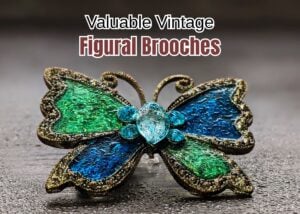
Old brooches shaped like animals, flowers, trees, or bugs appear to be common, but certain figural brooches hold high collector value today, especially if they come from a renowned brand like Trifari or Coro.
This list covers valuable vintage figural brooches worth knowing, the kind shaped like bugs, flowers, animals, or whimsical novelties, from notable brands, and what they’re actually selling for today.
Why Figural Brooches Became Collectible?
The peak of popularity of figurine brooches was achieved in the era from the 1930s to the 1960s, when the American costume jewelry industry went from imitating fine jewelry designs to creating an original style.
Some of the achievements of American jewelry designers like Alfred Philippe (Trifari), Gene Verri (Coro), and Ruth Kamke (Eisenberg and Hattie Carnegie) were incorporating techniques typical for fine jewelry into crafting pieces from base metal and rhinestones, as well as using precious materials like sterling silver and Lucite due to metal rations from 1942 to 1946.
Now these pieces are well recorded in jewelry reference books. Certain figural subjects (bugs, birds, dancers, flowers) have an individuality that is impossible to achieve with purely abstract modern jewelry.
What Makes a Figural Brooch Valuable?
Although highly popular, not every old figural brooch is worth a lot of money. The five key factors that determine if one is valuable or not are:
- Designer or Maker: A signed Trifari “Crown” or Eisenberg Original mark adds a zero to the price tag. Trifari even advertised “If it isn’t signed, it isn’t Trifari.” Unsigned pieces from the same era can be lovely but rarely break $50, while a signed Alfred Philippe figural can hit $1,500 or more.
- Material: Sterling silver pieces from 1942–46 are especially prized because wartime metal rationing forced companies to use sterling instead of pot metal. Bakelite and Catalin pieces in cobalt blue, red, or marbled colors can sell for two to five times the price of common butterscotch.
- Design and Era: 1930s-1940s figurals (Jelly Bellies, Duettes, fur clips) are the Holy Grail pieces. Items with mechanical aspects (tremblers, hanging diamonds), as well as patriotic or war-themed items, will fetch higher prices as well.
- Rarity and Production Period: Short production runs drive prices up fast. Coro’s “Carmen Miranda” Camellia line was made for a single year, 1939. One Duette in that series sold for over $1,800. Eisenberg’s mermaid by Ruth Kamke is so rare that reproductions appeared in the 1990s.
- Motif Popularity: Some figural shapes attract more collectors than others. Bugs and insects are some of the hottest motifs right now, especially in Jelly Belly form. Mermaids, fairies, and other fantasy figures are rare and sought-after. Sea creatures like lobsters, seahorses, and starfish are also valuable.
- Condition: Missing rhinestones, broken clasps, lost enamel, and damaged Lucite all hurt the value sharply. A Jelly Belly with a cracked Lucite belly drops 50% or more. Original sets with matching earrings or boxes sell for far more than orphaned brooches.
11 Valuable Vintage Figural Brooches to Look For
1
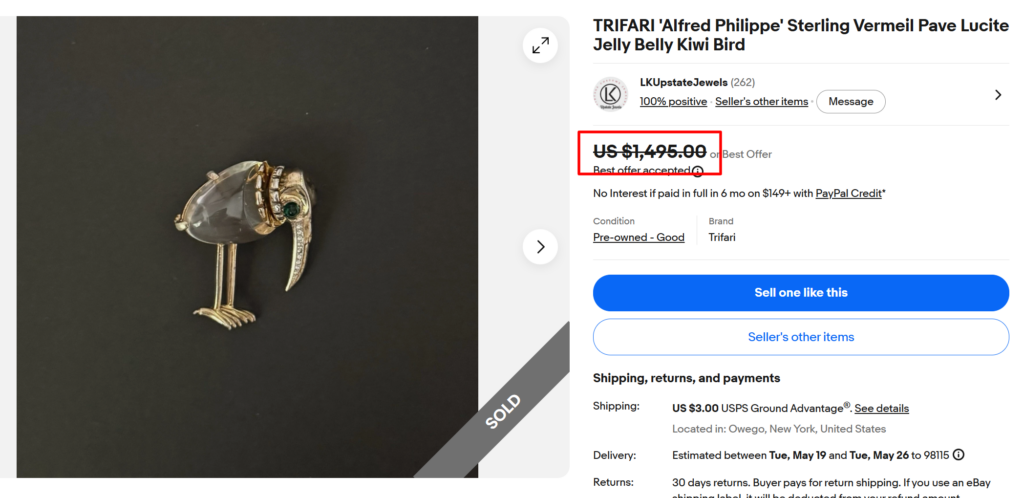
Trifari Lucite Jelly Belly Kiwi Brooch
Typically sells for $800 to $1,500
| Production Period | 1940s |
| Brand | Trifari (Alfred Philippe) |
| Key Features | Sterling vermeil, large Lucite body, pavé beak |
| Collector Notes | Among the rarer Jelly Belly forms |
The Kiwi Bird is one of the harder-to-find Jelly Belly designs from Alfred Philippe’s 1940s run at Trifari. Unlike the fly and frog, which both got patent numbers and appear in multiple costume jewelry reference books, the kiwi is a rare find.
The body is a single large Lucite cabochon set into sterling vermeil, with a pavé rhinestone beak, an emerald cabochon eye, and sculpted legs.
The “TRIFARI” mark and “STERLING” stamp confirm wartime-era production. When complete and clean, this Jelly Belly piece can sell in the four-figure range.
2
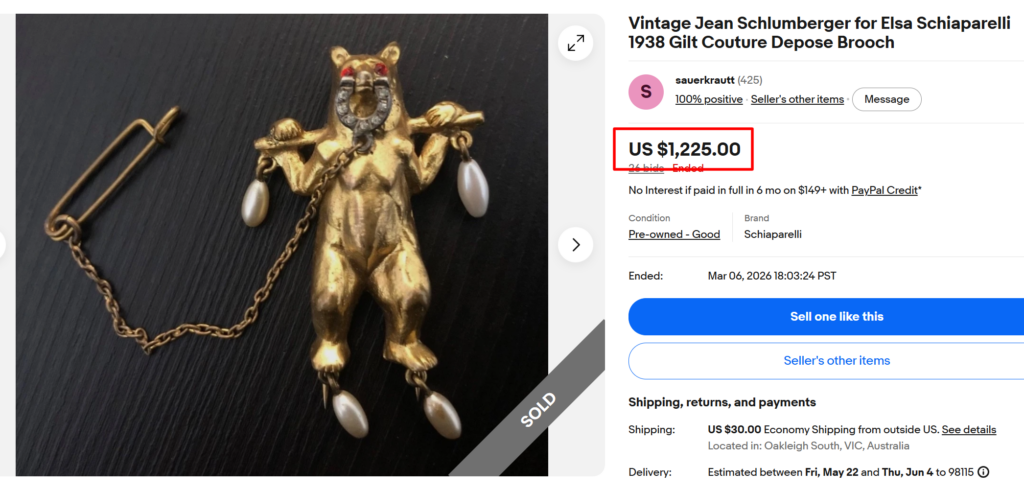
Schiaparelli Haute Couture Bear Brooch
Typically sells for $1,000 to $1,500
| Production Period | 1938 |
| Brand | Schiaparelli (Schlumberger) |
| Key Features | Gilt couture, pearl drops, ruby eyes |
| Collector Notes | Marked “Depose” |
Elsa Schiaparelli commissioned Jean Schlumberger to design buttons and brooches for her starting in 1936. By 1938, he was creating Surrealist figural pieces for her Circus and Pagan collections. Soon after, Schlumberger moved away from Paris and opened his own company in New York before finally joining Tiffany & Co.
This bear brooch, dated to this period, was made using gilt couture metal for the figure, along with a horseshoe of rhinestones on its neck, ruby paste eyes, and pearl drops suspended from the paws. The “Depose” mark on the back indicates registered French couture jewelry from this era.
Some early Schlumberger pieces from Schiaparelli days are rare and well-recorded, and can easily fetch $1,000 to $3,000 today.
3
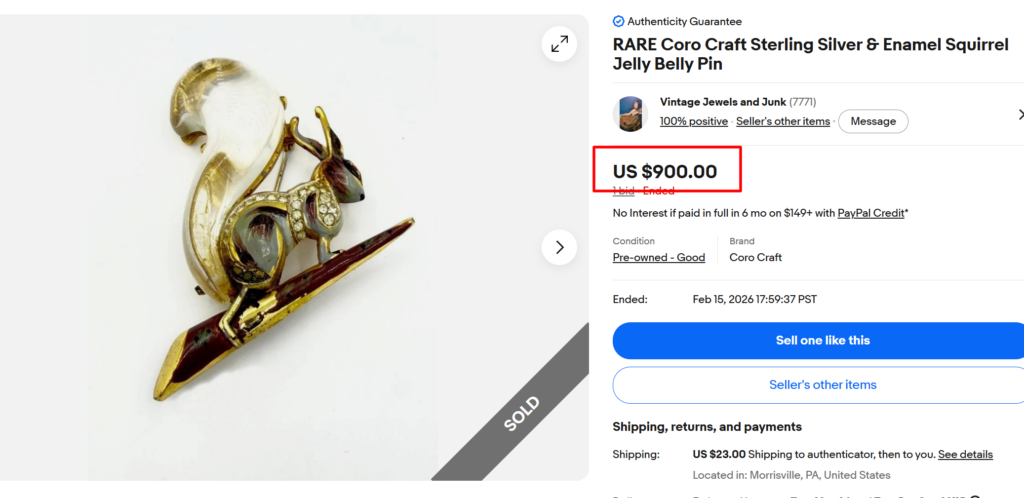
CoroCraft Sterling Jelly Belly Squirrel Brooch
Typically sells for $500 to $950
| Production Period | 1940s |
| Brand | Coro Craft |
| Key Features | Lucite tail, enamel body, rhinestone collar |
| Collector Notes | Rare figural form |
The Coro Craft squirrel uses Lucite for the curled tail instead of the belly, which makes it one of the more unusual Jelly Belly designs. The body is sterling silver with hand-painted brown enamel, a pavé rhinestone collar, and an enameled branch perch underneath.
Coro Craft was Coro’s higher-end line, marked “Coro Craft Sterling” on the back. Like the Trifari Jelly Bellies, these wartime sterling pieces are documented in reference books and sit firmly in the four-figure range when complete.
The squirrel form is rarer than Coro’s fish, or flower Jelly Bellies, and clean examples with intact enamel and Lucite can sell for $700 to $1,000 or more.
4
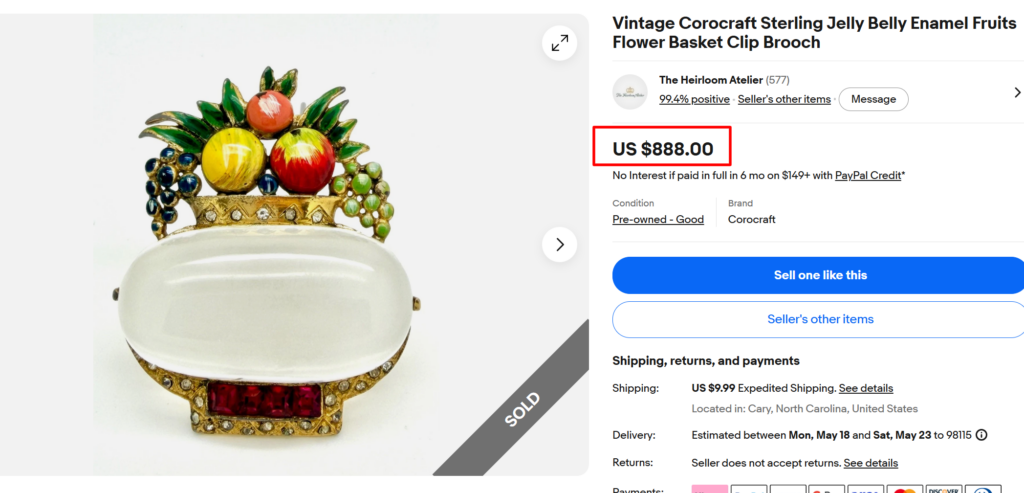
Corocraft Jelly Belly Enamel Fruit Basket Brooch
Typically sells for $500 to $900
| Production Period | 1940s |
| Brand | Corocraft |
| Key Features | Lucite belly, enamel fruit, red baguettes |
| Collector Notes | Fur clip back conversion |
Coro’s Corocraft sterling line picked up the Jelly Belly concept from Trifari and ran with it in their own direction. The fruit basket version uses a large Lucite cabochon as the basket itself, with hand-painted enamel apples, lemons, grapes, and leaves spilling out the top.
The base is gold-washed sterling silver with rhinestone accents and a row of channel-set red baguettes at the bottom. Many examples were made as fur clips that could double as brooches.
Production happened during the wartime sterling era (1942–46), which is one reason these now sell strongly. Pristine examples have reached $800-$900 with intact enamel.
5
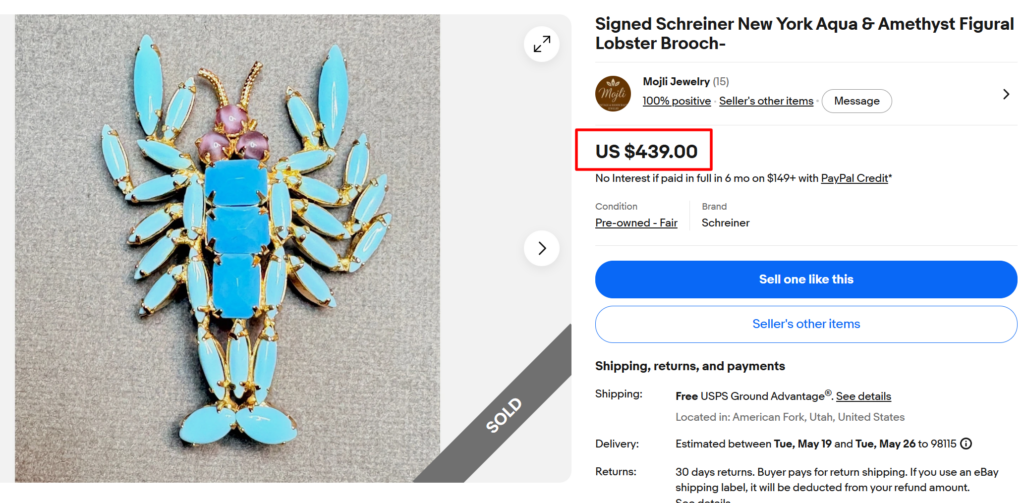
Schreiner New York Lobster Brooch
Typically sells for $300 to $600
| Production Period | 1950s |
| Brand | Schreiner New York |
| Key Features | Aqua art glass, amethyst cabochon head |
| Collector Notes | Senn in Bonwit Teller “see-our-sea” ad |
Henry Schreiner founded his New York company in 1932 and worked with fashion houses including Christian Dior, Norman Norell, and Pauline Trigère.
The lobster is part of a “sea-creature” series featured in a Bonwit Teller department store ad with the tagline “Bonwit’s Bouillabaisse, see-our-sea jewelry,” alongside Schreiner’s seahorse and starfish pins. You can spot it by the brand’s signature inverted stones (set point-up) and dog-tooth prongs across the body.
Schreiner sea creatures are documented in the Tanenbaum and Townsend reference book Schreiner: Masters of Twentieth-Century Costume Jewelry.
Lobsters are scarcer than Schreiner’s crab and butterfly designs, which makes them a top-tier figural for collectors.
6
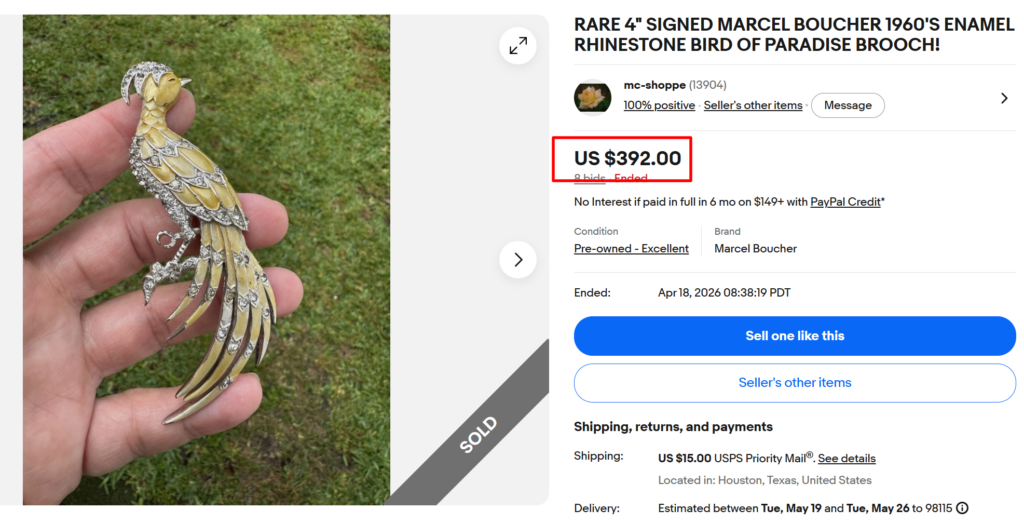
Marcel Boucher Bird of Paradise Brooch
Typically sells for $200 to $700
| Production Period | 1940s to 1960s |
| Brand | Marcel Boucher |
| Key Features | Pavé rhinestones, enamel, cabochon stones |
| Collector Notes | Numbered design (e.g., 7759P, 1042P) |
Marcel Boucher worked as a model maker at Cartier in 1923 before creating his own costume jewelry line in 1937. He designed the famous Bird of Paradise piece in different styles, each carrying a unique inventory number with his signature.
His 1940s designs incorporated pearlized enamel in shades of garnet, orange, and purple, along with pavé rhinestone wings mounted on rhodium-plated base metal. His designs from the 1950s and 1960s included cabochon gemstones and guilloche enamel.
The early designs by Marcel Boucher (late 1930s and 1940s) fetch the highest value, and some can even cost several thousand dollars. The early designs have the “MB in a Phrygian cap” hallmark.
7
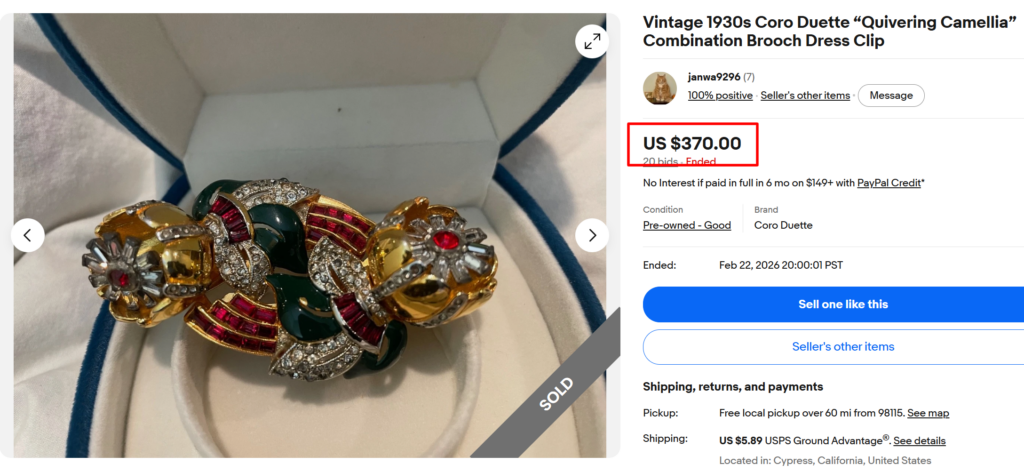
Coro Quivering Camellia Duette Brooch
Typically sells for $250 to $600
| Production Period | 1938 to 1940 |
| Brand | Coro (Gene Verri) |
| Key Features | Two flowers on tremblers, splits into clips |
| Collector Notes | Trace the patent number on the back |
Coro’s Duette mechanism, patented in 1931, lets two dress clips snap together to form a single brooch. The Quivering Camellia design from Gene Verri put two flowers on tiny springs so the rhinestone centers tremble when the wearer moves.
It comes up in costume jewelry reference books, including Brunialti’s American Costume Jewelry: Art & Industry. The most desirable versions have intact enamel and all rhinestones, since damaged enamel cuts the price by half.
8
Bakelite Carved Scottie Dog Brooch
Typically sells for $50 to $300
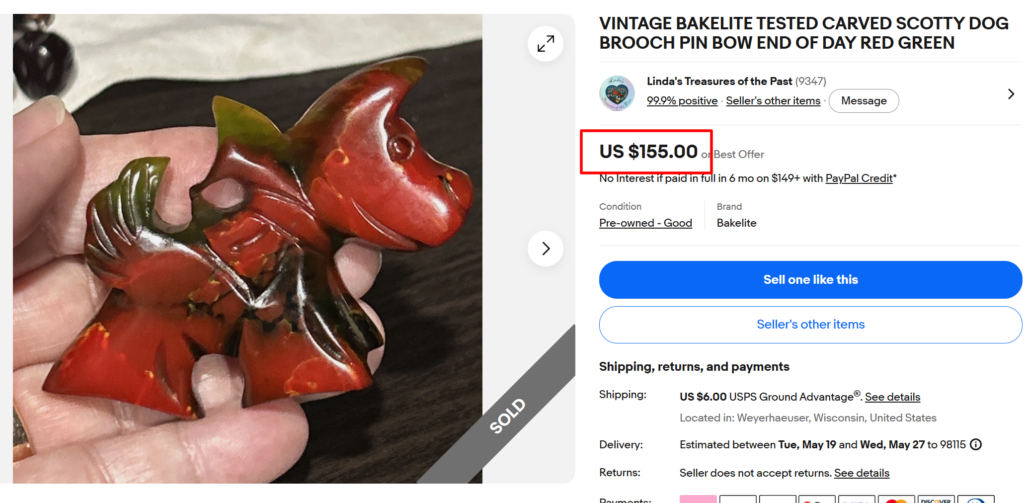
| Production Period | 1930s to 1940s |
| Brand | Unsigned (various makers) |
| Key Features | Carved and painted plastic |
| Collector Notes | Check for genuine bakelite. |
The Scottie dog was a 1930s icon, partly because of President Roosevelt’s dog Fala and Dorothy’s Toto in The Wizard of Oz. Bakelite carvers made hundreds of variations, with hand-carved details, painted features, and embedded pin backs.
Cherry red and butterscotch are the most common colors. Coloured Catalin pieces (a form of Bakelite), pieces with nodding or moving heads, and rare colors like cobalt blue can sell for over $300.
Collector’s Tip: Test for genuine Bakelite using Simichrome polish (which turns yellow) or the hot water method (Bakelite gives off a distinctive phenol smell). Reproductions made of newer plastic won’t pass either test.
9
Hattie Carnegie Mermaid Brooch
Typically sells for $100 to $250
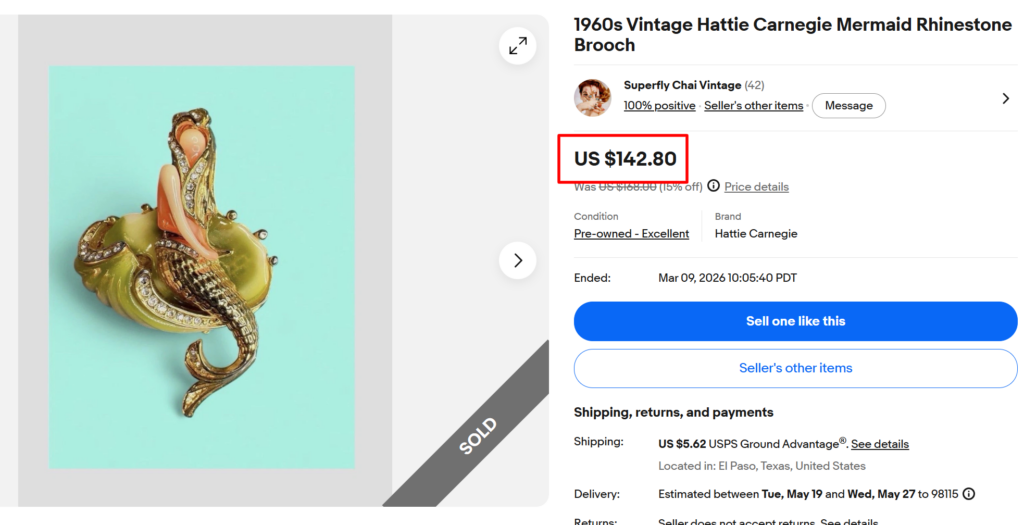
| Production Period | 1960s |
| Brand | Hattie Carnegie |
| Key Features | Enamel tail, painted resin face, pavé rhinestones |
| Collector Notes | Part of the fantasy figural line |
The ’60s Hattie Carnegie mermaid is part of the “fantastical figurals” collection, along with the well-known lion-in-the-grass and Asian Princess pieces. The body uses painted resin or composition for the face and torso, with green enamel tail scales and pavé rhinestone accents.
These post-1956 Carnegie pieces came from manufacturers other than Fallon & Kappel after Hattie’s death, so they don’t carry the same premium as the early “HC in diamond” pieces. These Mermaids usually sell for $140 to $200 for pristine pieces. Those with a clear signature, undamaged enamel, and complete rhinestones sell the best.
10
Crown Trifari Tree of Life Brooch
Typically sells for $45 to $600
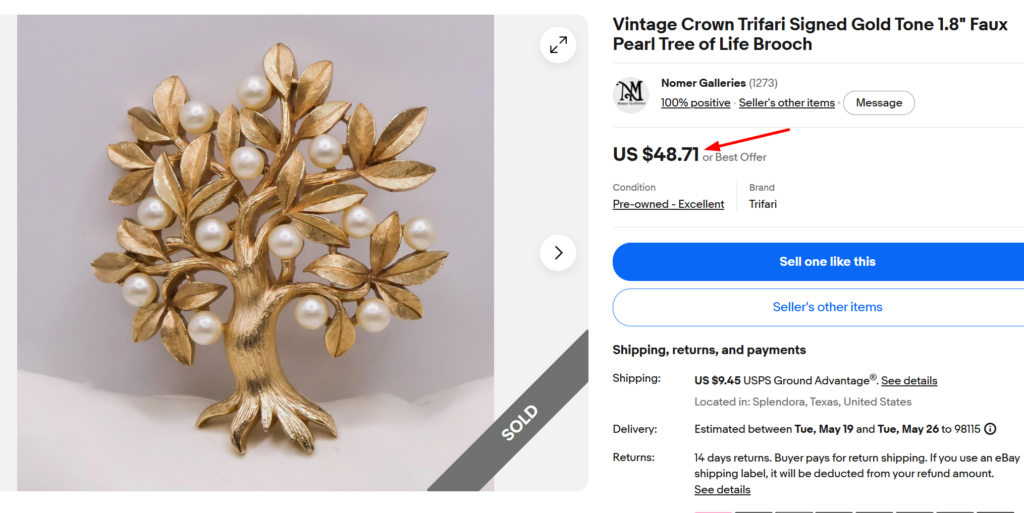
| Production Period | 1950 (and later variants) |
| Brand | Crown Trifari (Alfred Philippe) |
| Key Features | Textured leaves, faux pearl “fruit” |
| Collector Notes | Part of the Clair de Lune line |
Alfred Philippe designed the original Tree of Life for Trifari’s Clair de Lune line, patented in 1950. The earliest versions have opalescent crescent-shaped elements, like leaves and fruits. Large trees can sell for several hundred dollars today.
The smaller gold-tone faux pearl version (about 1.8 inches) is the more affordable, selling for $45 to $80. accessible variant. It carries the Crown Trifari mark and features textured gold leaves with round faux pearls suggesting fruit.
The Tree of Life motif ran across Philippe’s career at Trifari, and full-size sterling or rhinestone versions can hit $1,500 to $2,600 at auction.
11
Eisenberg Ice Christmas Tree Pin
Typically sells for $75 to $560
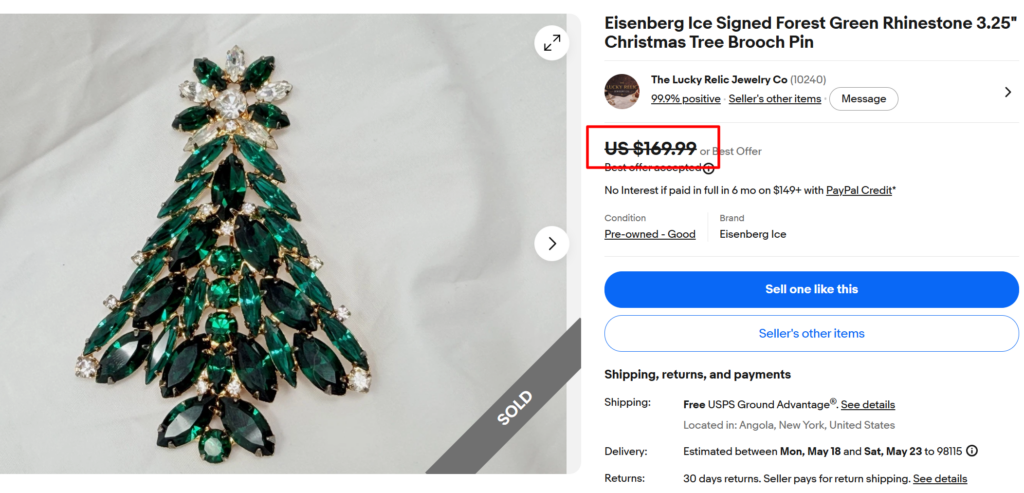
| Production Period | 1970s onward |
| Brand | Eisenberg Ice |
| Key Features | Multicolor rhinestones, antiqued gold |
| Collector Notes | Published in collector reference books |
Christmas tree pins are their own collecting category, with hundreds of documented designs in several reference books. Eisenberg Ice trees are among the most collected, with jewel-tone rhinestones set in antiqued gold-tone metal.
One of the rarest designs of crystal trees, which can sell for $560. Most common Eisenberg Ice trees sell in the $75 to $150 range, but specific “book pieces” (designs documented in the Trowbridge guide) bring premium prices.
Pre-2000 Eisenberg pieces also tend to outprice newer production.
Note: This article is intended for informational, educational, and entertainment purposes only. Some images are illustrative and may not represent actual brands, products, or related entities. All trademarks, product names, brand logos, packaging, and other intellectual property referenced remain the exclusive property of their respective owners. Any brand mentions or references are provided solely for descriptive and educational context and do not imply any formal or commercial association.