Corning divided its opal ware into two categories. Standard patterns were in production for at least two years. Then, there were Pyrex promo patterns – one-time gifts released for Mother’s Day, weddings, and Christmas.
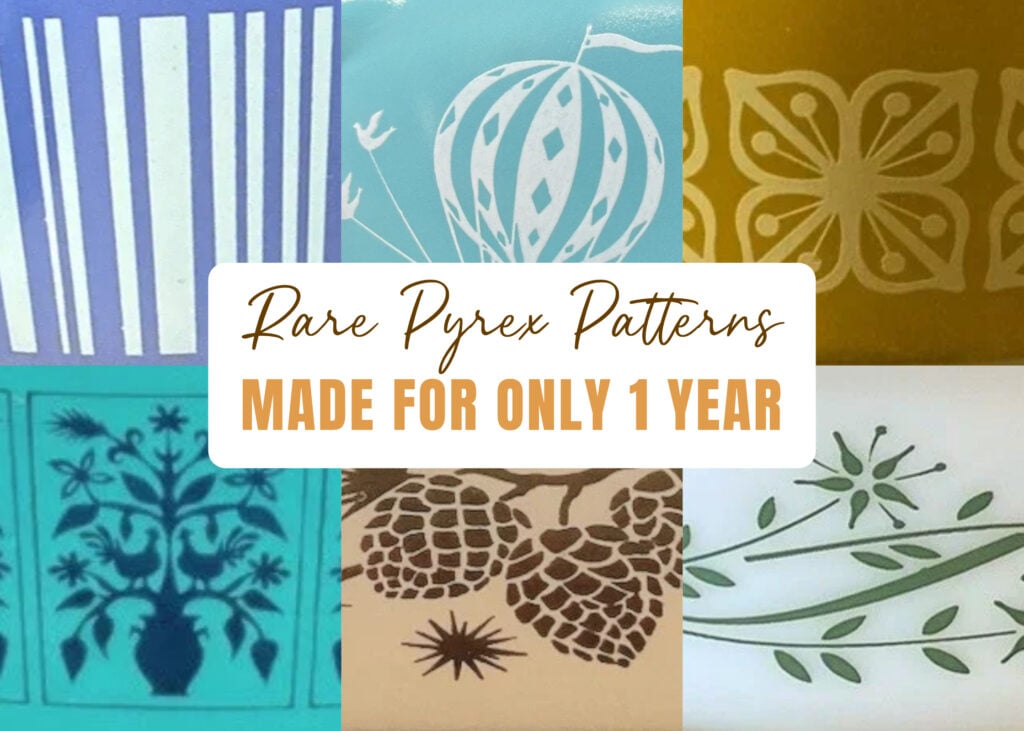
Corning created almost 135 promo patterns by 1983, and told the stores to pull unsold promos once the season ended. That’s why so few survive. Most of the promos were made on existing forms, like the Cinderella series. And most promos lacked names, which is why you’ll find different names for one.
Below are 14 Pyrex patterns that lived for just a year, with the shapes they came on and what they sell for now.
Rare Vintage Pyrex Patterns That Lived for Just One Year
1
Lucky in Love (1959)
Typically sells for $2,600 to $6,000 (recorded auction sales)
| Manufacturing Years | 1959 |
| Shapes | 1-quart round casserole (473) |
| Key Features | Green grass, four-leaf clovers, and pink hearts on white opal glass |
| Collectors’ Notes | The 2018 reissue is clear glass, not opal. The Corning Museum of Glass example has no hearts. |
Every Pyrex collector knows this pattern by name. And it’s an auction-only piece; you’ll hardly ever find it in online sales.
The design shows green grass, four-leaf clovers, and pink hearts on the lower half of a 1-quart round opal casserole. This piece came from Corning’s Charleroi plant in 1959, possibly as a prototype. Genuine pieces sell for thousands at auctions.
2
Black Tulip (1956 to 1957)
Typically sells for $40 to $120
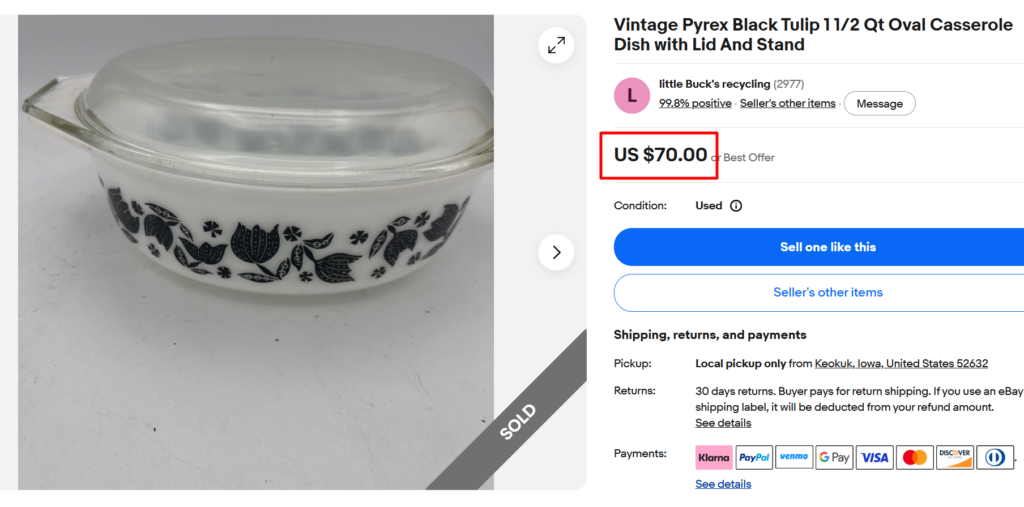
| Manufacturing Years | 1956 to 1957 |
| Shapes | 1½-quart oval casserole (043) |
| Key Features | Black tulips and pinwheels on white, clear lid |
| Collectors’ Notes | Cradle and lid add value. |
Black Tulip was one of the first promotional Pyrex pieces with a printed pattern. Corning released it as a seasonal “decorator casserole.”
The design is black tulips and pinwheels on the 1½-quart oval 043 white casserole with a clear lid and a metal cradle. Complete sets with the cradle are worth saving.
3
Balloons/Hot Air Balloons (1958)
Typically sells for $65 to $100 per bowl; $250 to $500 for a full set
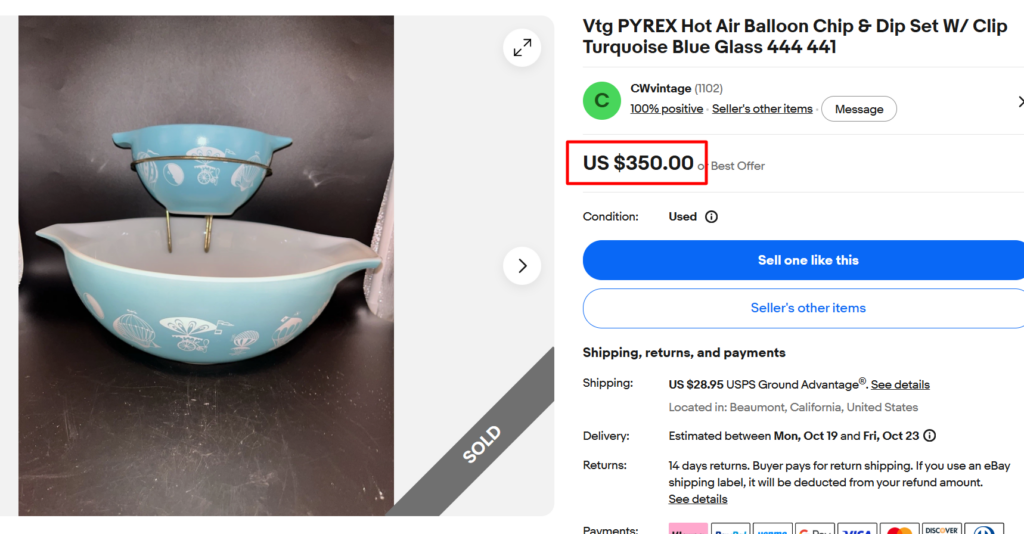
| Manufacturing Years | 1958 |
| Shapes | 441 and 444 Cinderella bowls with metal bracket |
| Key Features | White balloons, crescent moon, and flying bicycle on turquoise |
| Collectors’ Notes | Top value with the original bracket. |
Balloons, aka Hot Air Balloons, shows white hot air balloons, a crescent moon, and a flying bicycle on turquoise. It was the first promo design Pyrex sold as a chip-and-dip set, including a 4-quart 444 Cinderella bowl, a 1½-pint 441 bowl, plus a metal holder.
4
Turquoise Scroll (1959)
Typically sells for $50 to $125
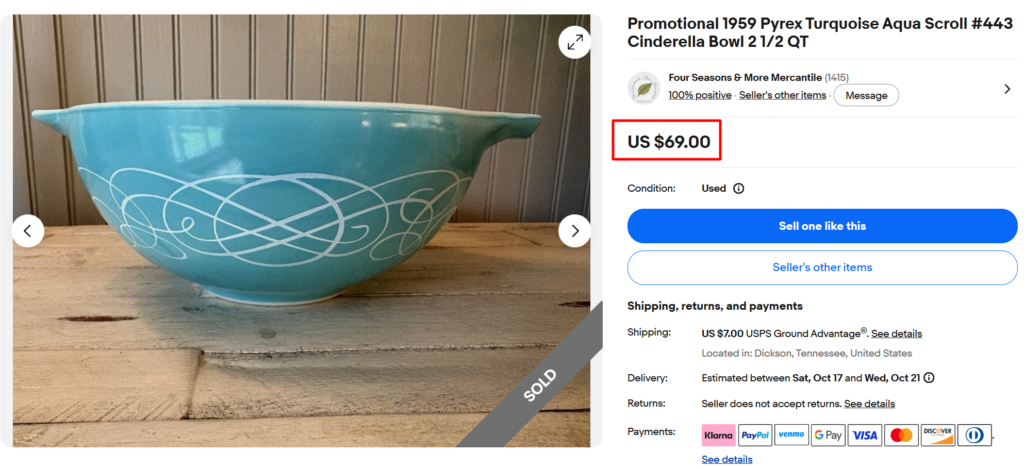
| Manufacturing Years | 1959 |
| Shapes | 2½-quart Cinderella bowl (443) |
| Key Features | white scroll print on turquoise |
| Collectors’ Notes | Most turn up as the bowl alone |
An ad in the December 1959 Ladies’ Home Journal promoted this bowl for punch, casserole dishes, soups, and even flowers. The bowl was available only in the 2½-quart 443 Cinderella bowl with the knob lid and candle warmer cradle.
This scroll pattern is printed in turquoise. The 1958 Corning Needlepoint promotion used the same bowl and color scheme, so check closely.
5
Atomic Starburst (1960)
Typically sells for $500 to $1,150 (high value with warmer)
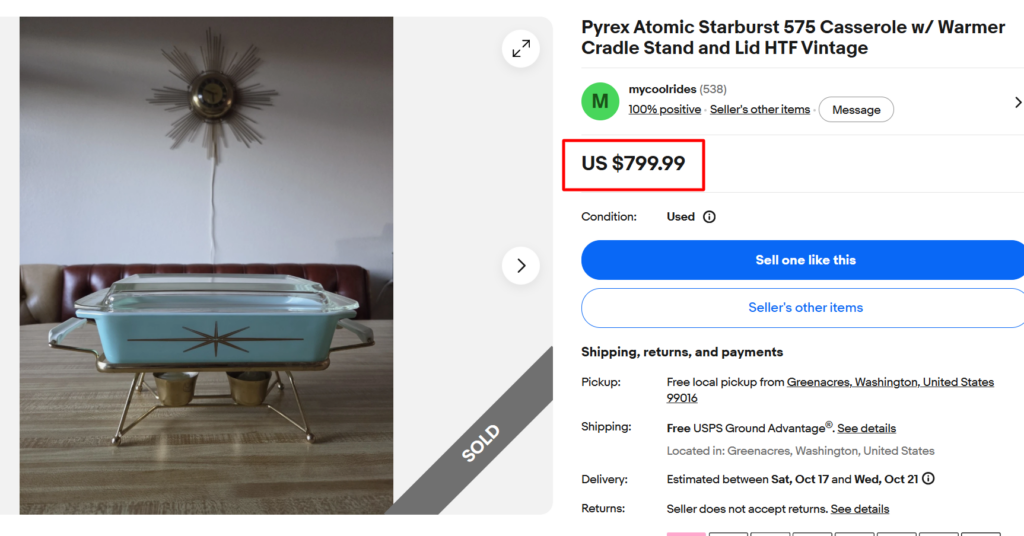
| Manufacturing Years | 1960 |
| Shapes | 2-quart Space Saver casserole (575-B) |
| Key Features | Gold eight-point star on long sides, turquoise body |
| Collectors’ Notes | The base reads “575-B” and “2 QT.” |
Atomic Starburst features a large, eight-pointed golden star on both long sides of a turquoise 2-quart 575-B Space Saver casserole. This dish sold for only one year with a lid, cradle, and candle warmer; those accessories are a must for top value.
6
Green Wheat (1960)
Typically sells for $60 to $350 (high for boxed sets with cradle)
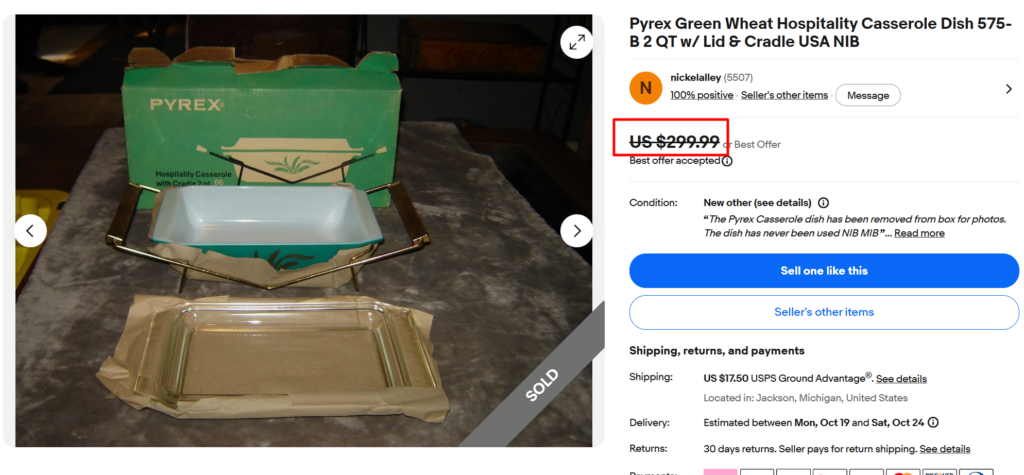
| Manufacturing Years | 1960 |
| Shapes | 2-quart Square Space Saver (575), cradle, clear lid |
| Key Features | Gold wheat on a blue-green body |
| Collectors’ Notes | Different from brown 1978 Wheat promo |
Green Wheat appears on a similar 2-quart Space Saver shape (575) like the Atomic Starburst; the two even came out the same year. This pattern shows a gold wheat stalk on the long sides on a blue-green body.
This design is worth about a fraction of Starburst, so it’s an easier one-year promo to own.
7
Floral/Green Honeysuckle (1960 – 1961)
Typically sells for $20 to $60
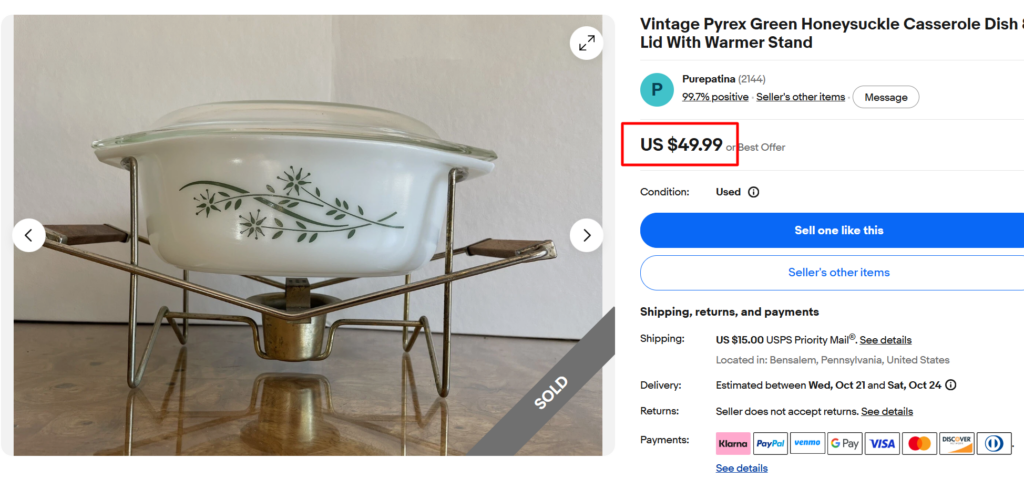
| Manufacturing Years | 1960 to 1961 |
| Shapes | 1½-quart oval casserole (043) |
| Key Features | Green floral and vine, cradle, candle warmer |
| Collectors’ Notes | Different from the 1965 Floral promo. |
This design shows green floral and vine print on a white body and vice versa. So, collectors also call this Green Honeysuckle. The pattern came on the 1½-quart oval 043 with a cradle and candle warmer. Both variations sell modestly as complete sets.
Three years later, Corning released this same design in gold for its Golden Honeysuckle line.
8
Golden Pine (1961)
Typically sells for $25 to $80
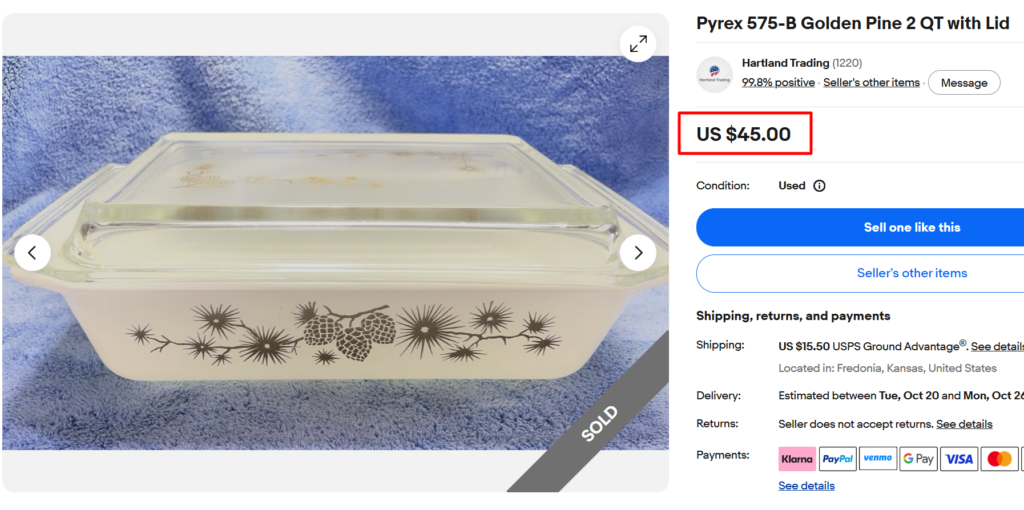
| Manufacturing Years | 1961 |
| Shapes | 2-quart Square Space Saver (575-B) |
| Key Features | Gold pine trees on white, decorated clear lid, cradle |
| Collectors’ Notes | Some sellers list it as “Golden Pinecone” |
Corning released Golden Pine as a Christmas gift to its customers in 1961. The advertisement showed Pyrex presents as “Always Welcome.”
This dish sold for only $5.95 and included a white 2-quart Square Space Saver casserole with gold pine trees, along with a cradle and gold-decorated clear lid. That lid hardly appears on the dishes, which makes complete sets collectible.
9
Autumn Floral (1966)
Typically sells for $80 to $200 for a set
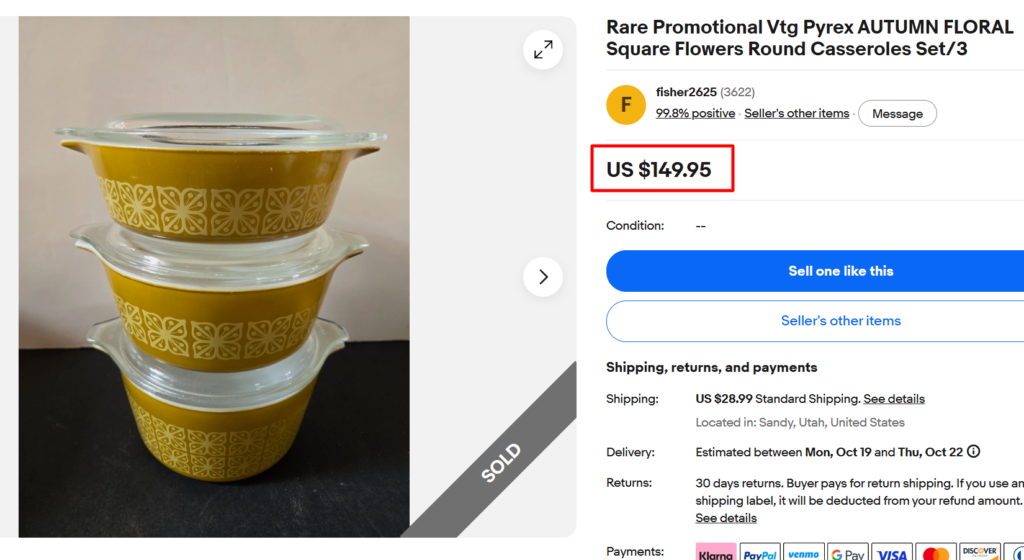
| Manufacturing Years | 1966 |
| Shapes | Cinderella round casseroles |
| Key Features | Yellow square flowers on mustard yellow, clear lids |
| Collectors’ Notes | Sellers often list it as “Square Flowers.” |
Autumn Floral came only as Cinderella round casserole sets, and it never appeared in Corning’s regular retail catalogs. Yellow square flowers wrap the lower half of each mustard-yellow dish under a plain clear lid.
If the motif looks familiar, it should. Corning later reused it on Verde, so check the colors before you buy.
10
Blue Barcode Stripe (1966)
Typically sells for $100 to $240 (blue); non-blue sets are rarer
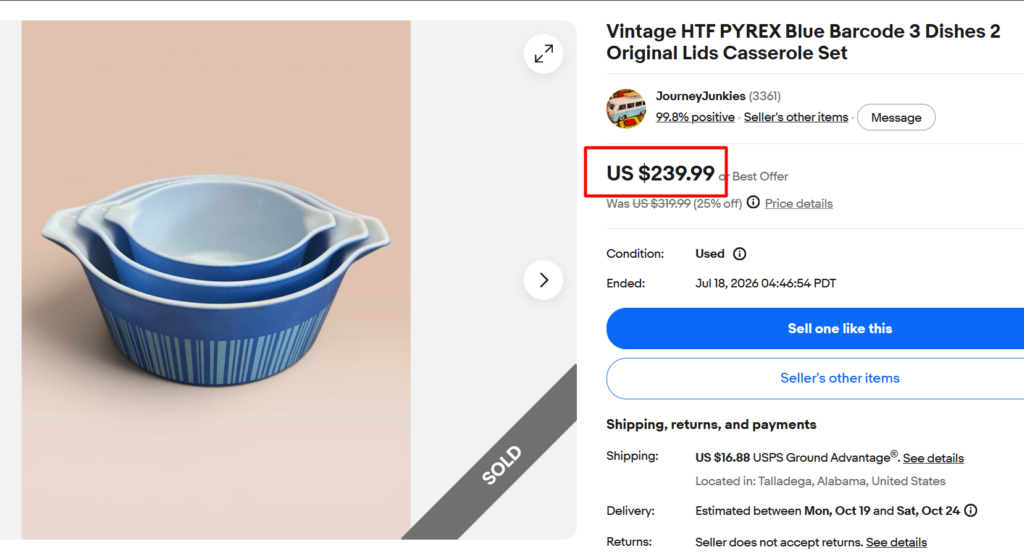
Officially released as Blue Stripe, collectors call it Barcode because the stripes really look like it. You’ll see pale blue vertical bars on a medium blue Cinderella round casserole. It came in the small 470 set as well as the larger 480 set.
Blue is the common version. Other color combinations exist as prototype sets and are worth a lot more.
| Manufacturing Years | 1966 |
| Shapes | Cinderella round casseroles |
| Key Features | Pale blue stripes on medium blue, clear lids |
| Collectors’ Notes | The orange-and-white barcode is rarer. |
11
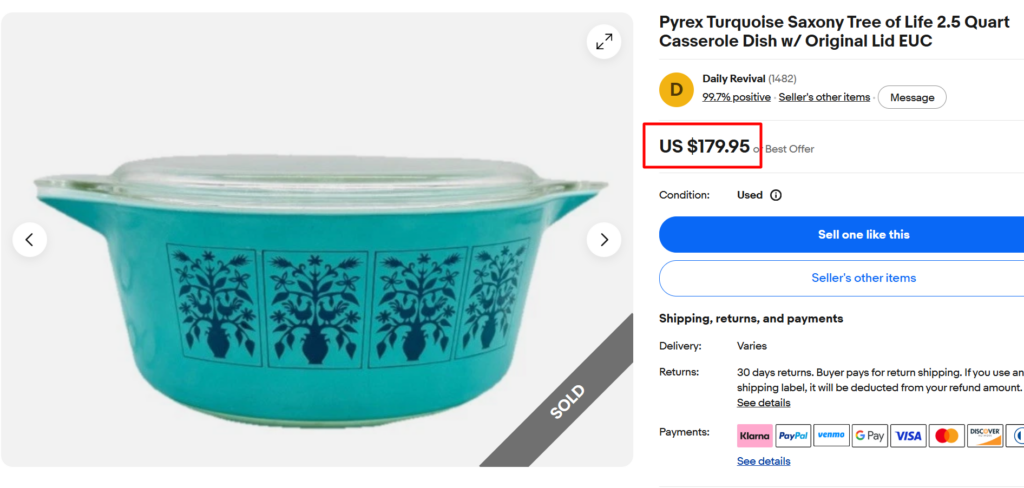
Saxony (1967 – 1968)
Typically sells for $100 to $200
| Manufacturing Years | Late 1967 to 1968 |
| Shapes | 2½-quart Cinderella casserole (475) |
| Key Features | Dark blue bird-and-tree squares on light blue |
| Collectors’ Notes | Sold in the 1968 gift lineup. |
Saxony shows dark blue square motifs of two birds in a potted tree on a light blue casserole. The motif gives it the nickname “Tree of Life.” It came only on the 2½-quart Cinderella casserole (475) with a cradle and warmer. The 1968 dealer catalog listed it as a $6.95 gift.
12
Blue Willow (1970 – 1971)
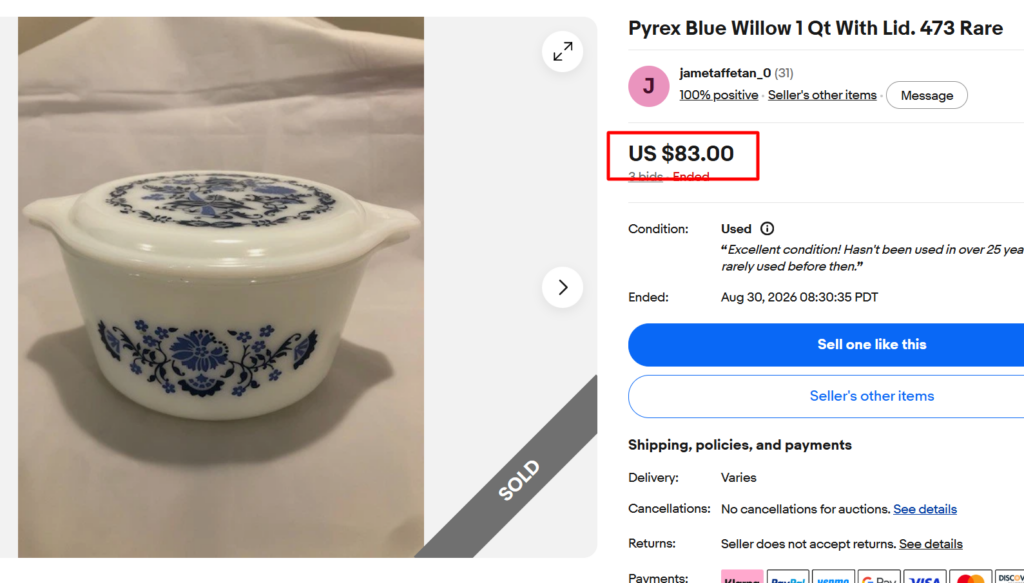
Typically sells for $45 to $100
| Manufacturing Years | 1970 to 1971 |
| Shapes | 1-quart Cinderella round casserole (473) |
| Key Features | Blue onion-style florals on white, matching printed opal lid |
| Collectors’ Notes | It’s not related to Blue Willow china. |
Officially known as Willow, this design is often listed as Blue Floral or Blue Willow. The navy-and-light-blue design is inspired by the blue onion pattern used for Meissen china in the early 1700s. (It’s not directly related to that.)
This pattern was available only on the 1-quart Cinderella casserole (473), and the opal lid matched it. Corning stopped making it in 1971.
13
Aztec, aka Navajo (1971)
Typically sells for $40 to $90
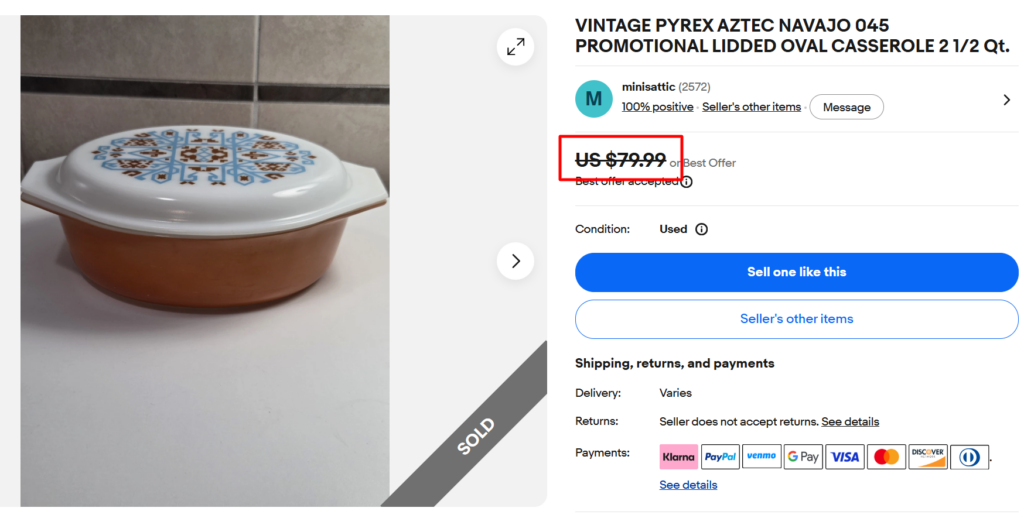
This 1971 promo pattern appeared on the lid. It shows a southwestern print in light and dark brown on an opal lid that sits on a plain brown 2½-quart oval 045 dish.
Some pieces come with a cork trivet and burnt-orange body. Corning sold this with a serving basket for one year.
| Manufacturing Years | 1971 |
| Shapes | 2½-quart oval casserole (045), printed opal lid |
| Key Features | Light blue-brown southwestern print on lid |
| Collectors’ Notes | A lidless dish sells for very low prices. |
14
Terra Cotta Rose (1978)
Typically sells for $20 to $50
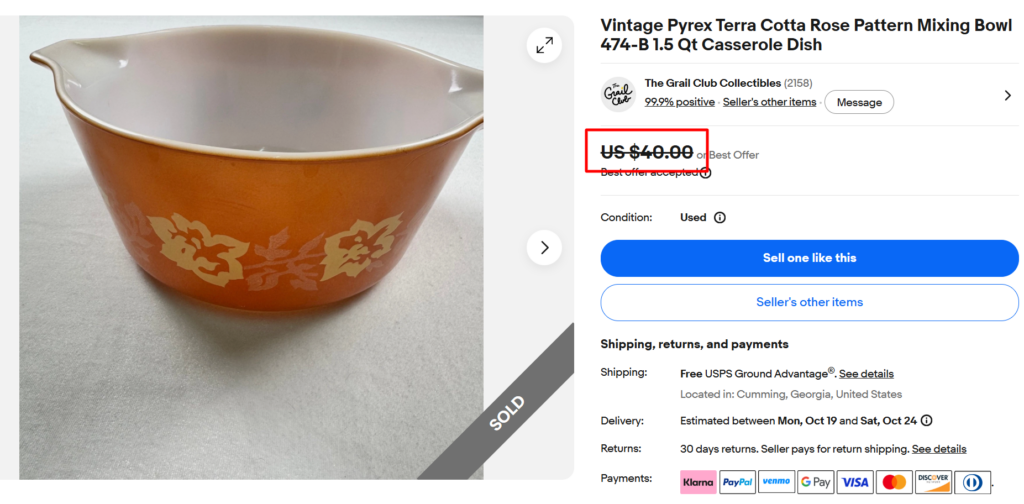
| Manufacturing Years | 1978 |
| Shapes | 1½-quart round casserole (474) |
| Key Features | Yellow roses on terra cotta orange |
| Collectors’ Notes | Most affordable one-year pieces |
Corning had stopped promoting its products during holidays by the late 1970s, rather bundling them in collections. This pattern belonged to the 1978 Designer Collection, which also had Spices, Daisy, Dynasty, and Wheat.
The pattern featured yellow roses on an orange terra cotta 1½-quart 474 round casserole. The dish originally came with a small wicker basket that adds value.
How to Tell If You Have a Rare One-Year Pyrex Pattern?
Each pattern on this list was produced only on one or two forms, so the base does half the job. Below are all the signs you need to confirm:
- Match the Model Number: The number is molded on the bottom (043, 443, 475, 575-B). Make sure it matches the form in the catalog. If there’s a Lucky in Love pattern on a square dish, you have the wrong set.
- Check the Pattern: Rub your finger across the design. It must be smooth and glossy. A dull, chalky design proves that it went through the dishwasher, which reduces its value.
- Count the Parts: Find the original lid, cradle, bracket, or basket. Complete sets cost much more than dishes alone.
- Check the Selling Price: Once you’ve checked everything else, look at sold listings of the same piece or pattern on eBay by searching the pattern name and model number.
Note: This article is intended for informational, educational, and entertainment purposes only. Some images are illustrative and may not represent actual brands, products, or related entities. All trademarks, product names, brand logos, packaging, and other intellectual property referenced remain the exclusive property of their respective owners. Any brand mentions or references are provided solely for descriptive and educational context and do not imply any formal or commercial association.