Found a pair of old earrings in your mother’s vanity drawers? Fit it over before you look at the fronts. The clasp and the little metal bits behind on the back are easier and more precise clues than the design to tell whether it’s a real antique or a modern piece.
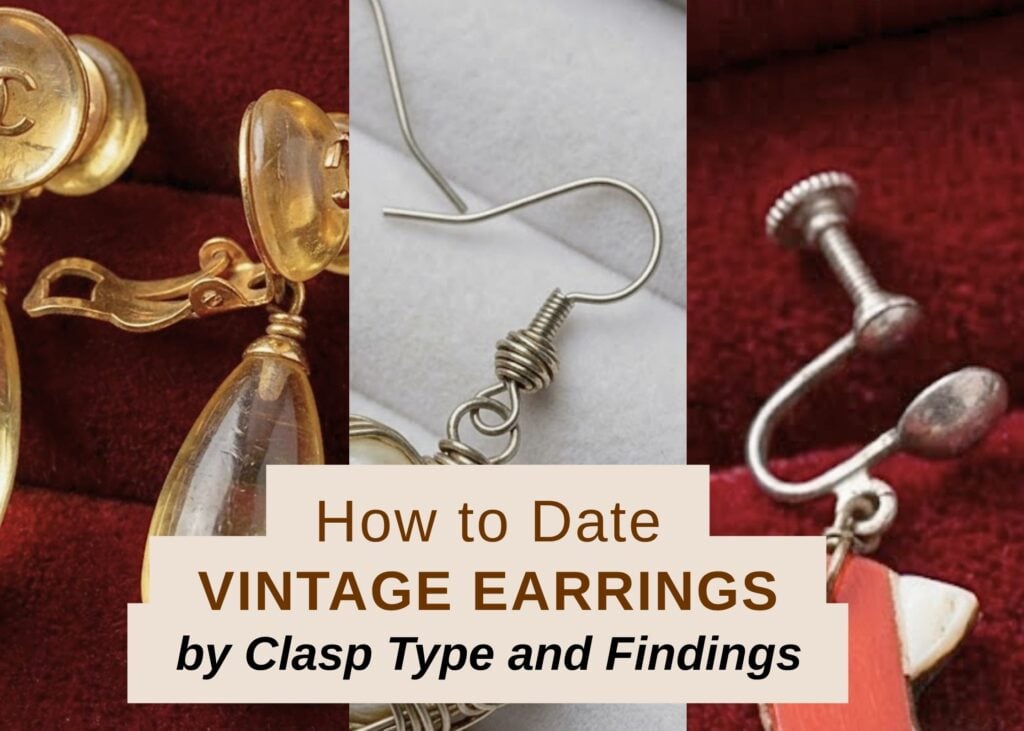
Why? Because fashion repeats itself. A Victorian-looking dangle could be from 1880, 1970, or last year. But the findings, meaning the ear wires, posts, clips, and backs, don’t. In this guide, you’ll learn to read the clasps and findings easily.
Pierced or Not Pierced: The First Clue
For most of jewelry history, ears were pierced. That changed briefly. Piercing went out of polite Western fashion around 1900 and stayed unpopular until the late 1950s, when it slowly came back and went fully mainstream by the early 1970s.
So, use this simple rule for antique and vintage earrings. If a pair is designed only for non-pierced ears, meaning clip-on or screw-back with no post, it most likely dates from roughly 1900 to 1970.
Pierced findings on a “vintage” pair usually mean either pre-1900 or post-1970.
Converted Findings?
Note that some old earrings could be remodeled. This means that an ear piercing pair designed in the Victorian era could have screw backs put on them during the 1920s to allow ladies to wear their grandmother’s jewelry without piercings.
So, always check the back of the earring for extra solder marks, mismatched metal color, or a fitting that looks slightly newer than the rest. Converted pieces are still collectible, but they don’t date to the finding.
Screw Back Earrings, Roughly 1900 to 1950s
The screw back was patented in 1894, but it didn’t catch on until after about 1909. From then through the 1950s, it was the go-to finding for non-pierced ears on both fine and costume pieces.
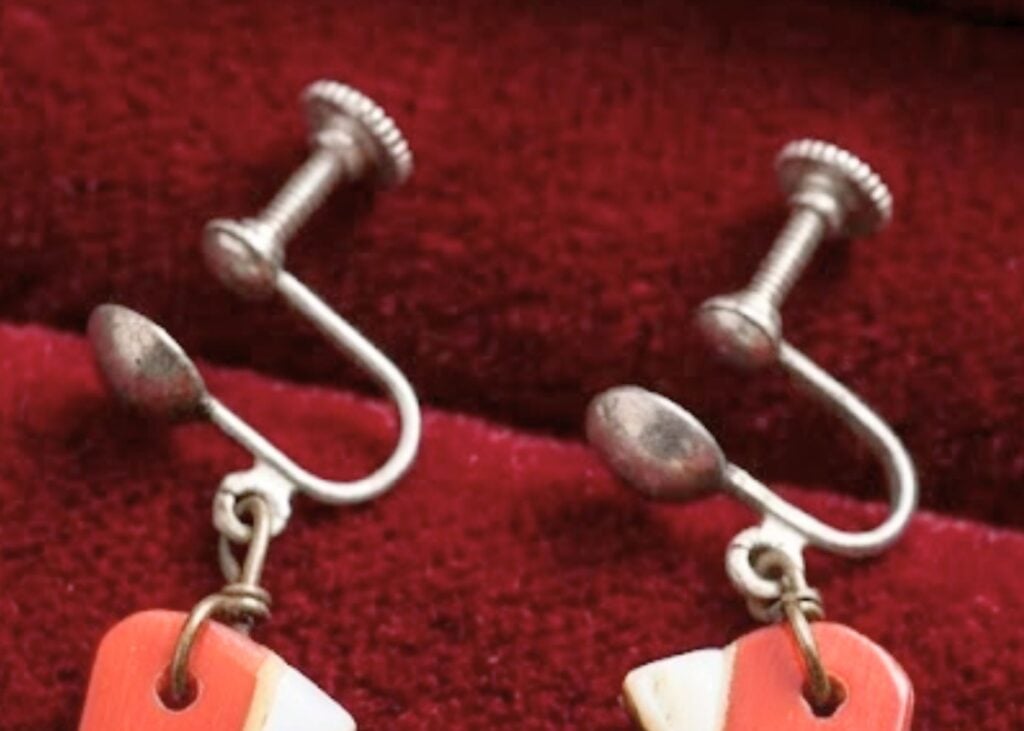
You can easily recognize a screw back by its threaded post, a small round disc, and a little wheel or paddle you turn to tighten the disc against the earlobe.
Old screw backs that date back to the 1900s and 1910s are small and thin, with only one flat disc on the back. In the 1920s and 1930s, the pad increased a bit in size, and there was also a pearl-shaped cover on the screw for comfort. The Art Deco earrings found within this window often feature a screw back with marcasite/rhinestones front.
Signed vintage screw-back earrings from names like Trifari, Coro, and Napier are the most collectible costume examples.
Collector’s Tip: If the screw wheel spins freely and the disc is symmetrical and machine-cut, you’re likely looking at post-1930s work. Handmade-looking, uneven discs point earlier.
Clip-On Earrings, Roughly 1934 to 1970s
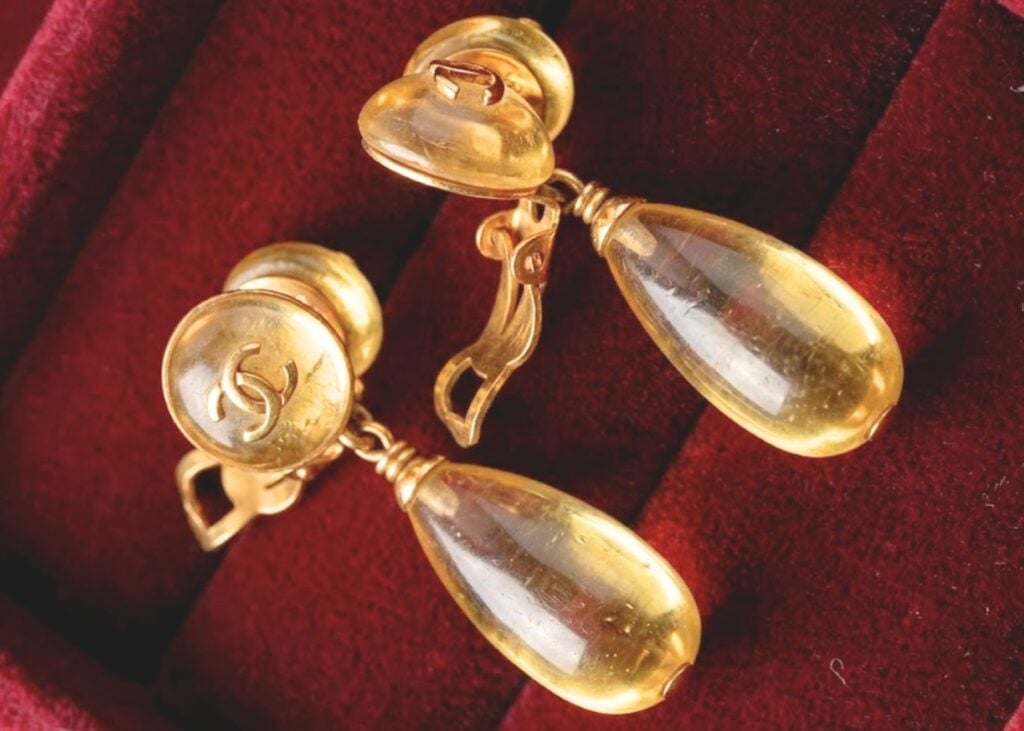
The clip-on was patented in 1934 and quickly replaced the screw back. By the 1940s, it was the dominant non-pierced finding, and stayed so through the 1960s.
There are three broad clip types, and each was trending in a certain period, which will help you narrow down the decade:
- Flat paddle clip, spring-hinged: This was the earliest style that was used from 1934 into the 1940s. It’s a simple flat pad pressed against the back of the lobe with a curved hinged arm. Often small and unpadded.
- Hinged paddle clip with a stronger spring: Popular from the 1940s through 1960s, these clips had a bigger pad, more tension, sometimes with a small textured or padded surface for grip. Most costume clip-ons have these.
- Adjustable comfort clip with a screw or lever: Patented in 1946 and famously used by Miriam Haskell from 1960 onward. It combines a clip mechanism with a tiny screw you turn to adjust pressure. This clip hints at a 1946 or later, especially 1960s and 70s piece.
When you combine the earring clip style with the base metal, the dating gets even more precise. Unmarked white pot metal usually means pre-1950, while marked sterling, gold-filled, or gold-plated clips point to the 1950s and after.
The most popular names to know for clip-ons include Trifari, Coro, Monet, Napier, Chanel, Christian Dior, Miriam Haskell, and Givenchy. Chanel and Dior vintage clip pairs are particularly sought after today.
Findings for Pierced Ears
Pierced findings have a longer design timeline because they have been used for centuries. So, you can learn a lot about the earrings’ age from the specific finding style on the back. Here are the major ones you must know:
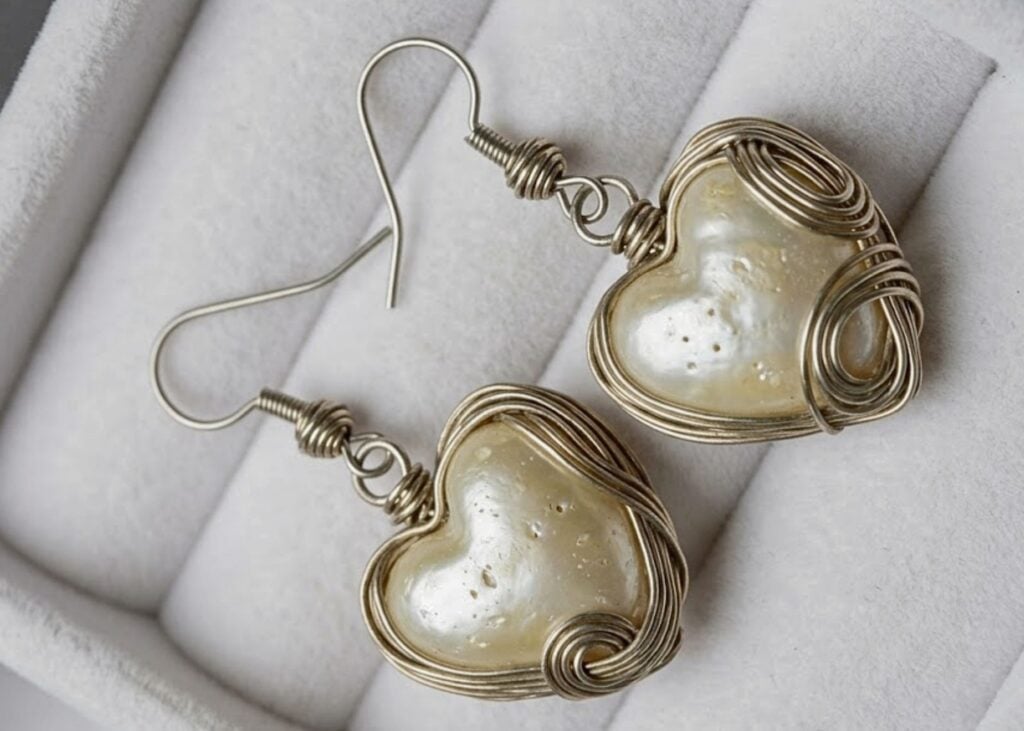
French Wire or Fishhook
It’s a simple curved wire that hooks through the ear. But it’s been used for hundreds of years, so a hook alone doesn’t date anything; you need to assess the workmanship.
Check these signs: Hand-forged Georgian and early Victorian hooks show slight irregularities, visible solder at the join, and softer, lower-karat gold. Machine-uniform hooks with a modern loop point to the 20th century.
Kidney Wire
Introduced in the 1870s. Named for its kidney-bean shape, it hinges closed to lock the earring against the ear. Here also, you will see the difference in the craftsmanship. Handmade Victorian kidney wires have visible solder joints and slight asymmetry.
Kidney wires came back in the 1970s in machine-perfect form, so a symmetrical, factory-clean kidney wire on a pair sold as Victorian is a red flag.
Lever Back
This is a hinged lever that locks flat against the back of the ear for security. It started appearing in the late 1800s and became common on fine European jewelry from the early 1900s.
Heavy, well-fitted lever backs on good gold usually mean quality workmanship, often European, from around 1900 onward.
Post and Butterfly (aka Push-back)
The post pierces the ear, and a small flat metal clutch pushes on from behind. This showed up in a limited form in the late Victorian era with hexagonal spring-loaded backs for heavy earrings.
The modern flat butterfly clutch became standard after about 1950 and mainstream after 1970. A pair called “Victorian” with a modern push-back butterfly is surely a reset piece.
Screw Post
A simple threaded post for pierced ears, which became popular mostly after the 1970s onward. It’s still a standard finding for fine studs today.
Read the Metal Marks as a Second Signal
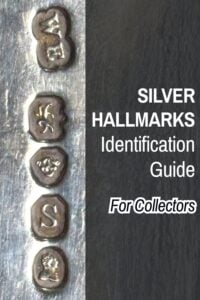
The finding style is a strong dating clue in itself, but the stamps and hallmarks add a second layer of confirmation. You’ll find them near the clasp, the earring hook, or the back plate.
On fine jewelry, the mark is often tiny and takes a loupe to read.
Below are the most common marks you’ll come across on any antique or vintage fine or costume jewelry today:
- “Sterling.” Common on US pieces from about 1906 onward, when the Stamping Act standardized the term.
- “925.” The modern international sterling mark. Widely used from the 1970s and after, especially on European and Asian pieces.
- “14K,” “10K,” “15K,” “18K.” 15K gold was a British standard used from 1854 to 1932, so a “15” mark is a narrow, useful dating clue.
- “Occupied Japan.” Used only from 1945 to 1952. Very tight window.
- “Western Germany” or “West Germany.” Used from 1949 to 1990.
- No mark at all. On costume jewelry made before the 1940s, this is normal. Don’t rule out an earlier date just because a piece is unmarked.
Common Mistakes to Avoid When Dating by Clasp
While all the above signs often tell the complete story about the earring, not every old earring is what its finding says. So, when you’re buying something from a thrift store or an antique mall, watch out for these:
- Reset stones in modern mounts: An antique dealer or previous owner might have reset old stones into a new pair with modern posts. The stones are old, the earring isn’t.
- Reproductions of Art Deco and Victorian styles: These are heavily copied. Modern reproductions usually have machine-cut symmetry, uniform solder lines, and 925 or newer marks.
- Signed doesn’t mean old: Chanel, Dior, and other manufacturers have been producing vintage-like pieces for years now. A Chanel-signed clip-on may date back to either 1962 or 2015.
- Weight is important: Gold and heavy costume jewelry from the old days is heavier than its modern reproductions.
Basically, just combine all the above four elements (the clasp style, the metal mark, the weight, and the front design) and then try to determine the age of old earrings. If all four elements agree on a decade, then you have determined the era of your jewelry.
Note: This article is intended for informational, educational, and entertainment purposes only. Some images are illustrative and may not represent actual brands, products, or related entities. All trademarks, product names, brand logos, packaging, and other intellectual property referenced remain the exclusive property of their respective owners. Any brand mentions or references are provided solely for descriptive and educational context and do not imply any formal or commercial association.