Antiques Know How Research
Waterford Crystal Patterns
Our analysis at Antiques Know How of numerous eBay sold listings and auction results indicates that vintage Waterford crystal typically ranges from $25 to $200 for common items, with rare patterns and exceptional sets reaching $1,000 to $2,000+. The top collectible Waterford patterns include Lismore, Alana, Clarendon, Glandore, and Powerscourt, along with colored prestige pieces, full stemware services, and early Irish-made etched pieces!
Antiques Know How
About Waterford Crystal Company
Waterford Crystal was founded in 1783, when William and George Penrose set up a glass factory in Waterford, Ireland, aiming to produce high-quality crystal like that of Europe. But the factory succumbed to financial difficulties in 1851.
The modern history of Waterford started in 1947, when Waterford Crystal was revived, attracting investment and Czech master craftsmen to establish the cutting techniques for crystal products.
By the mid-20th century, Waterford was shipping its crystal products worldwide, making it the most recognizable luxury brand from Ireland. And today, early Waterford crystalware has become a high-value collectible.
Most Valuable Waterford Crystal Patterns to Know!
Below are listed some of the most popular and valuable Waterford crystal patterns in the market today!
1. Lismore
Lismore is Waterford’s most iconic crystal pattern, designed by Miroslav Havel and introduced in 1952. It features alternating diamond and wedge cuts across clear crystal.
Early Lismore pieces made in Ireland before the 1970s are the most desirable and carry the highest collector value. Also, large forms, like decanters and vases, and full stemware sets in this pattern are worth the most.
Pre-1970 examples with the Gothic script Waterford mark are the priority finds.
| Average Value | $50–$500+ (singles), $500-$1,500 (sets) |
| Pattern | Lismore |
| Production Period | 1952–Present (pre-1970 Irish-made most valuable) |
| Collectibility | Very High |
| Collector Notes | Large decanters, vases, full stemware sets are most valuable |
Lismore Centerpiece Vase
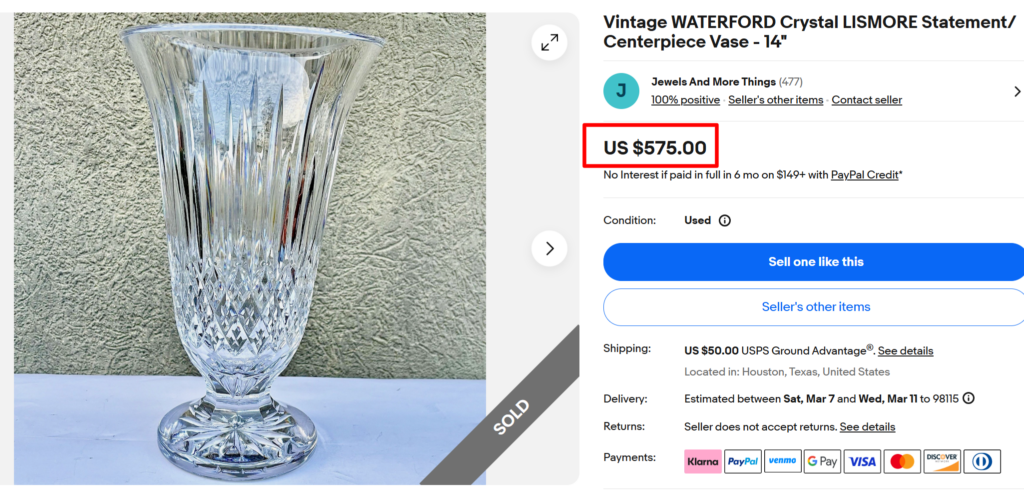
This massive 14-inch vase is a perfect example of why large-scale Lismore pieces are so highly valued. In new-like condition, these statement pieces can fetch up to $800!
2. Alana
Alana launched in 1952 alongside Lismore and features dense, crisscross diamond cuts across the entire surface of the piece. What adds to its rarity is that it was soon discontinued in the US market.
The all-over cut design makes it one of the most labor-intensive Waterford patterns. Decanters, whiskey sets, and full stemware services in Alana are particularly sought after today, more if found in original boxes or with matching accessories. Older pieces with the Gothic script mark are also quite desirable.
| Average Value | $40–$400 (decanters & sets higher) |
| Pattern | Alana |
| Production Period | 1952–Discontinued (for the US market) |
| Collectibility | High |
| Notable Pieces | Full whiskey sets, decanters, large vases |
Alana Prestige Lime Green Vase
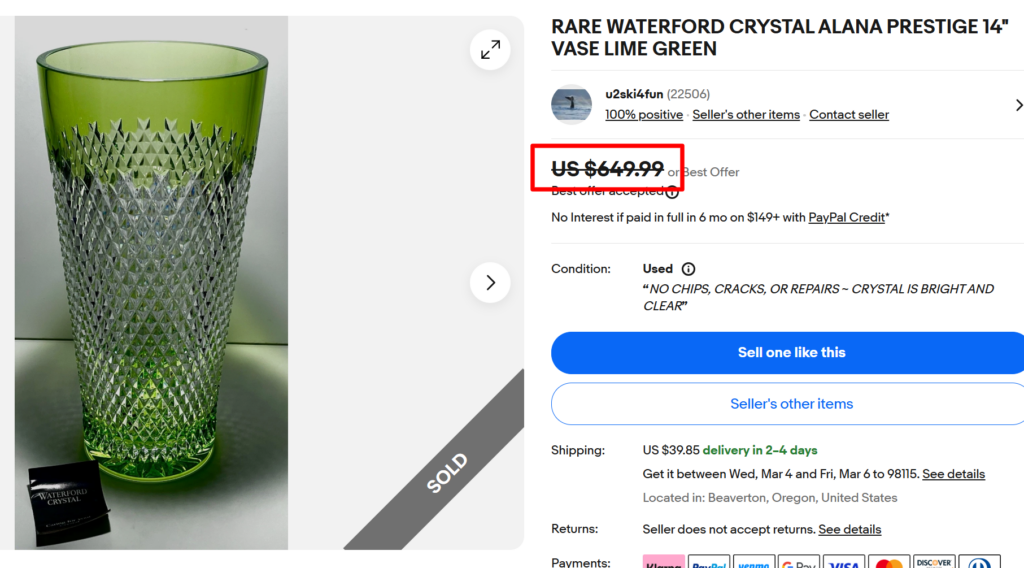
Alana “Prestige” versions are known for their oversized, all-over hand-cut forms, and vibrant colors like lime green, ruby red, turquoise, and amethyst. This vase shows the lime green casing, one of the rarest colors in the “Prestige” line!
3. Clarendon
Clarendon is a rare colored crystal pattern, available in ruby red and cobalt blue, cut to clear. The colored casing is applied over clear crystal and then cut through, revealing the clear layer in the pattern.
The casing technique requires each piece to be blown twice, making colored Clarendon significantly more complex to make than regular clear crystal patterns. This is what makes this pattern super collectible and valuable.
Complete sets of ruby or cobalt cordials, decanters, and vases, especially in original boxes, are a collector’s dream!
| Average Value | $80–$500; $800-$2,000+ (Full sets) |
| Pattern | Clarendon |
| Production Period | 1997 and 2008 (traces in 2017, too) |
| Collectibility | Very High |
| Collector Notes | Ruby is slightly rarer than cobalt. |
Clarendon Brandy Snifter Goblets
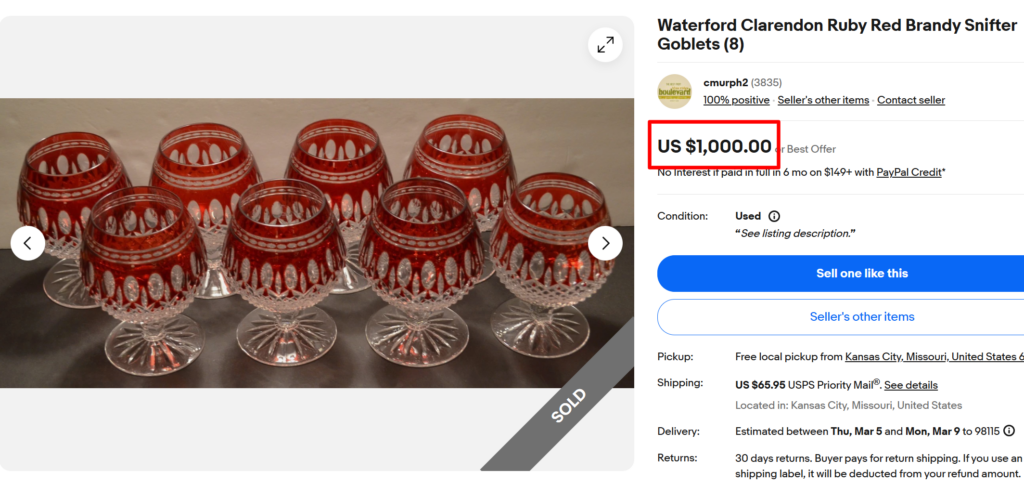
These ruby-red cut-to-clear snifters display the complex double-blowing technique unique to the Clarendon pattern. A full stemware set in pristine condition can easily fetch $800 to $1,000!
4. Glandore
The Glandore pattern is easily identified by its laurel-leaf etchings paired with a band of traditional diamond cuts, and usually a star-cut foot (base).
This crystal pattern has a romantic, old-world feel that distinguishes it from Waterford’s more geometric designs. Plus, original Irish hand-cut pieces are worth the most!
| Average Value | $50 – $180 |
| Brand | Waterford |
| Pattern | Glandore |
| Production Period | 1976 – 2017 |
| Collectibility | High |
| Collector Notes | Large punch bowls are valuable |
Glandore Punch Bowl
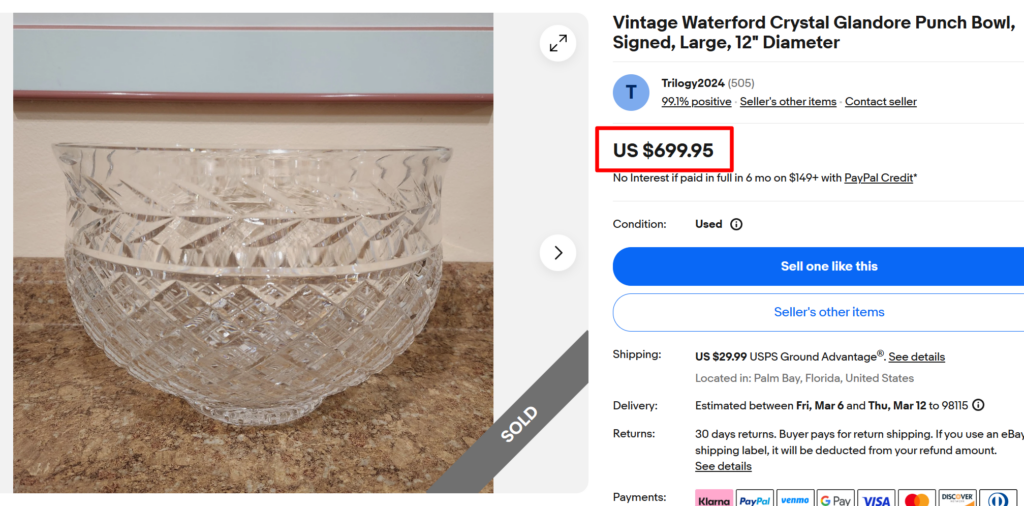
This large Glandore punch bowl highlights the pattern’s signature laurel leaf etchings. Large-form serving pieces like this are much rarer than standard rose bowls, which serve as both a dish and a centerpiece.
5. Colleen
Colleen is one of Waterford’s classic mid-century patterns, known for its fine vertical cuts combined with horizontal bands of diamond cuts. It comes in both short-stem and tall-stem variations.
Both versions are actively collected, but the tall-stem Colleen is rarer and commands higher prices. Besides, complete dinnerware and stemware services are also high-value items.
Colleen was produced for decades but has been discontinued, making full matching sets harder to assemble and, hence, more valuable.
| Average Value | $30–$250 (singles); $300–$900+ (sets & rare pieces) |
| Pattern | Colleen |
| Production Period | 1968–2018 (traces of production in 1953) |
| Collectibility | High |
| Collector Notes | Tall-stem pieces sell for more |
Colleen Prestige Crystal Ruby Red Bowl
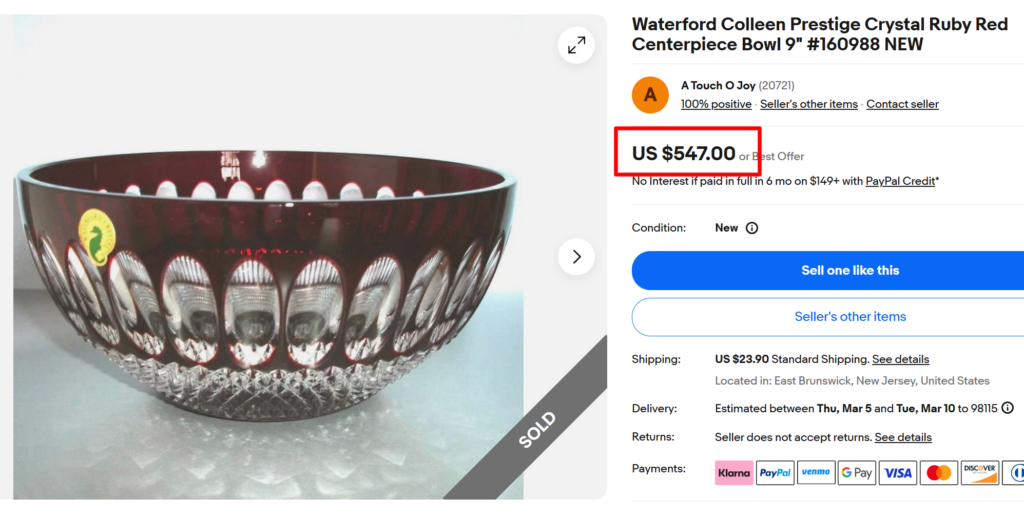
Colleen Prestige was a limited-edition Waterford release celebrating the 60th anniversary of its iconic “Colleen” pattern. These standout pieces have colored (ruby red or cobalt blue) casing cut back to clear. Large cased bowls like this are worth a few hundred dollars in good condition!
6. Araglin
Araglin is quite similar to Lismore, but features broader, bolder diamond cuts with fewer vertical wedge cuts between them. It was even marketed as a sister pattern to Lismore.
Discontinued in the United States, large Araglin pieces such as decanters and stemware sets are rare and highly desirable. Collectors also seek older Irish-made pieces with the Gothic Waterford mark.
| Average Value | $35–$350 |
| Pattern | Araglin |
| Production Period | 1985/1987 to 2021/22 |
| Collectibility | Moderate to High |
| Collector Notes | Pairs well with Lismore for mixed collections |
Araglin Footed Iced Tea Glasses
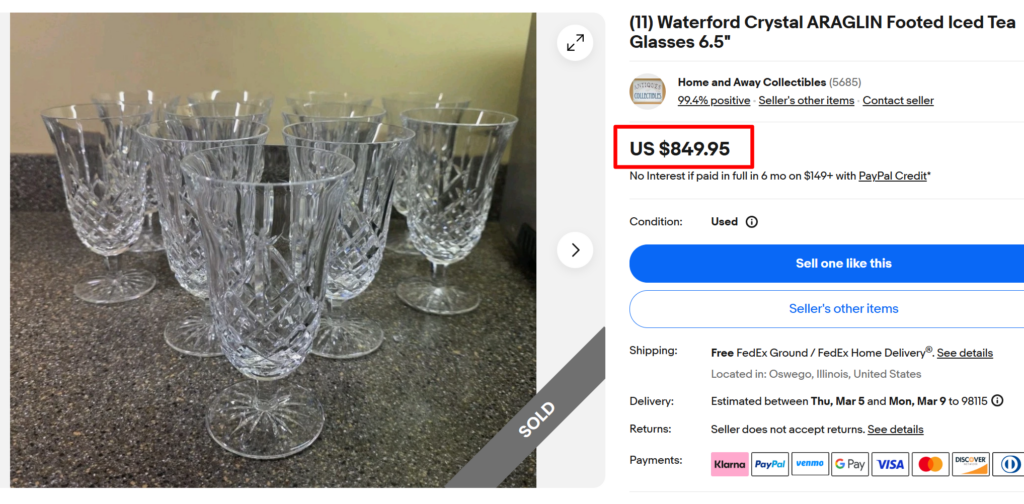
Standing 6.5 inches tall, these glasses feature the signature Araglin tulip shape with vertical wedge cuts. While single glasses usually go for $50-$70, large sets like this example can fetch a few hundred dollars.
7. Powerscourt
Powerscourt is easily one of Waterford’s most decorative patterns! It features intricate multi-level diamond and fan cuts, inspired by the ornate stonework and metalwork of Powerscourt Estate in County Wicklow, Ireland.
Powerscourt was later elevated into the Mastercraft Collection, with Mastercraft versions signed by individual craftsmen. These pieces command significantly higher prices than standard production pieces.
The pattern’s complexity made each piece more time-consuming to produce, limiting total output. Thanks to that, full stemware services and large centerpiece bowls are the most valuable Powerscourt finds.
| Average Value | $60–$600+ |
| Pattern | Powerscourt |
| Production Period | 1969 to 2017 |
| Collectibility | Very High |
| Collector Notes | Mastercraft signed pieces are valuable |
Powerscourt Hock Wine Glasses Set
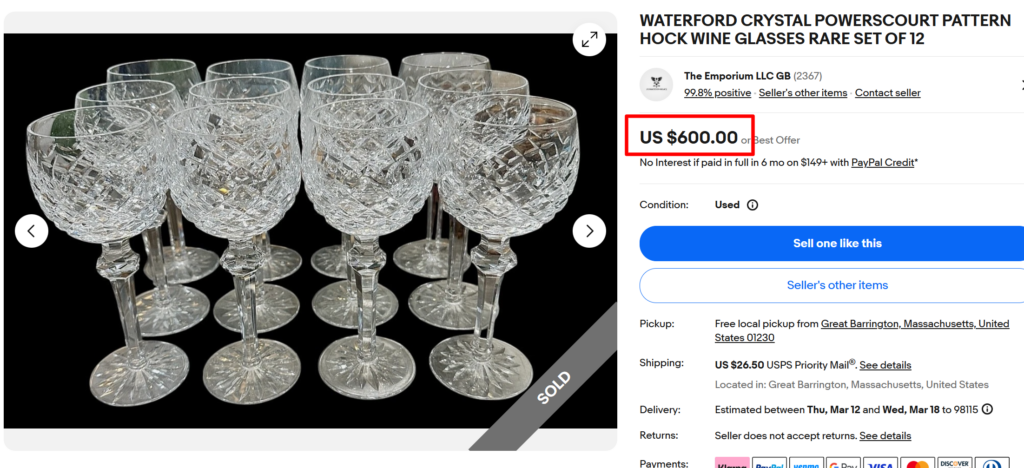
Large, matching sets of stemware in this highly decorative pattern are increasingly difficult to find, making them valuable today. An original box or labels on the pieces can further boost the value.
8. Boyne
Boyne is one of Waterford’s older patterns, produced from the 1970s during Waterford’s peak Irish manufacturing period! It was named after the River Boyne in Ireland,
The pattern features a combination of vertical flute cuts and horizontal diamond bands in a balanced, traditional design. Pieces bearing the older Gothic signature mark (before the seahorse was added) are the most sought-after pieces.
Old-fashioned glasses, water goblets, whiskey decanters, and large full-service sets from the 1970s are quite popular today!
| Average Value | $25–$200 (full services higher) |
| Pattern | Boyne |
| Production Period | 1968–2017 |
| Collectibility | Moderate |
| Collector Notes | 1970s Irish-made pieces with Gothic script marks are rare |
Boyne Hock Wine Glasses
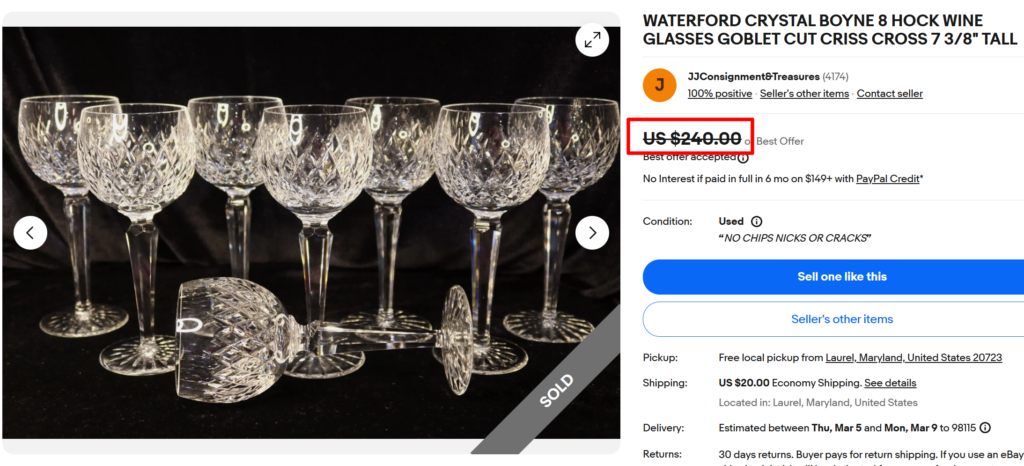
Boyne hock wine glasses stand 7 3/8″ tall, showing the design’s fine crisscross and flute cuts. These stay highly collectible among crystal collectors, especially in fine condition.
9. Kylemore
Kylemore is a discontinued Waterford pattern, named after the famous Kylemore Abbey in Connemara. You can spot it by its features: vertical flute cuts with horizontal diamond-cut bands, giving it a grand architectural look!
The pattern is harder to find than Lismore or Alana, and complete stemware services, especially the pre-1980s pieces with the Gothic Waterford mark, are the most desirable.
| Average Value | $40–$350 (sets $300–$700+) |
| Pattern | Kylemore |
| Production Period | 1966 – 2017 |
| Collectibility | High |
| Collector Notes | Identified by the vertical “wedge” cuts |
Kylemore Crystal Stemware
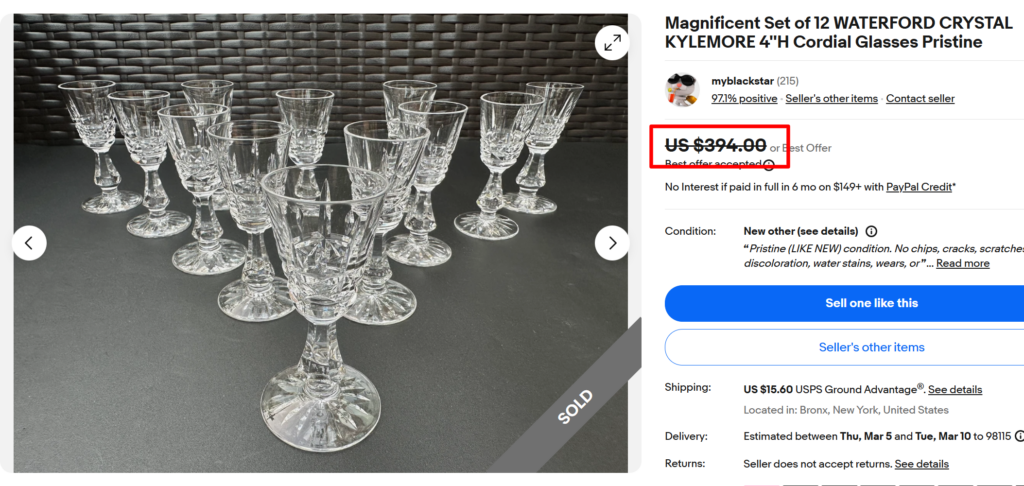
Kylemore is often confused with Lismore, but the cuts go much higher up the bowl. The 7-inch water goblet is the “anchor” piece of the set. Vintage versions made in Ireland have a noticeably better ring (ping) than modern ones.
10. Tramore
Tramore is known for a lighter design compared to Waterford’s more geometric heavy-hitters. It shows small, precise diamond cuts concentrated near the base of the bowl and fine vertical fluting extending upward.
Since the design is simpler, value is often found in large, matching sets and centerpieces!
| Average Value | $40 – $120 |
| Pattern | Tramore |
| Production Period | 1956 – 2017 |
| Collectibility | Medium |
| Collector Notes | Highly prone to rim nicks |
Tramore Fluted Champagne Glasses
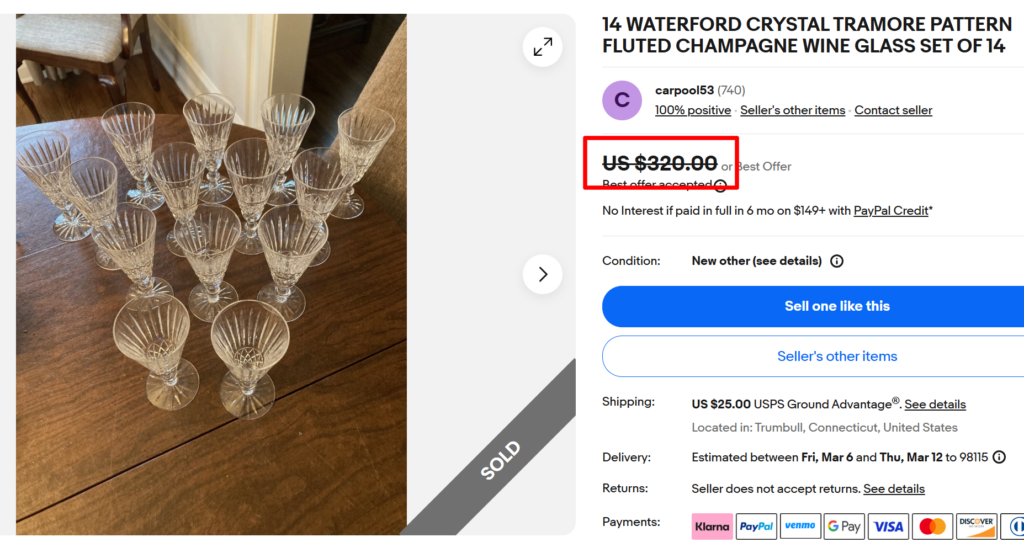
Fluted glasses perfectly complement Tramore’s vertical cuts, making them collectible pieces in this pattern. And so can be statement vases!
How to Spot Authentic Waterford Crystal Ware Worth Money?
Authentic Waterford Crystal ware has many distinct features that distinguish it from fake, later brands, and reproductions. Here are the main features that you, as a collector and seller, need to be aware of.
Acid-Etched Marks
Every authentic Waterford crystal glassware piece manufactured after the 1950s has an acid-etched ‘Waterford’ mark on the bottom.
Pre-1999 marks feature the Gothic script, while post-1999 marks feature the seahorse logo along with the Gothic script. If the mark is absent, it could be either a fake or a piece from before the acid-etching era.
Waterford crystal manufactured before 1960 may feature paper labels rather than acid-etched marks. But most paper labels are lost over the years. So, while original paper labels are desirable, their absence doesn’t negate authenticity.
The Country of Origin
For Waterford crystalware, the original country is a crucial identification and value clue. ‘Made in Ireland’ pieces are the most valuable to collectors, as they were created before the facility was moved to other countries.
Pieces with ‘Made in Germany,’ ‘Made in Slovenia,’ or similar marks are not as valuable to collectors as they were later productions, although they are real Waterford crystal!
The Pattern
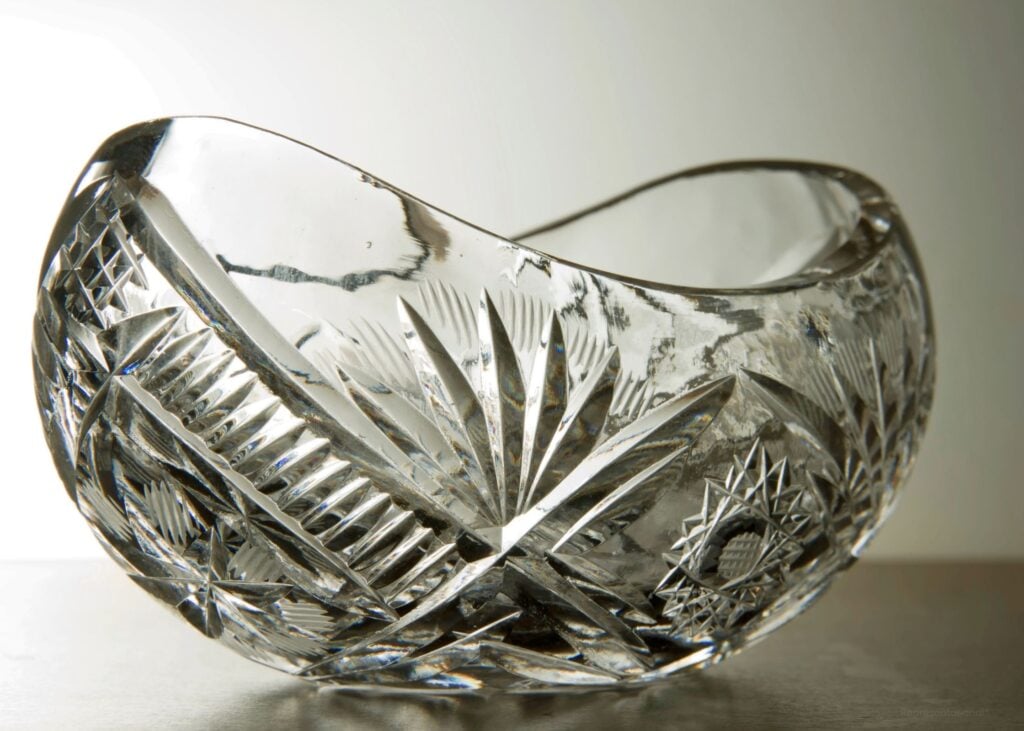
The pattern is an important identification and value factor. Many Waterford patterns are incorrectly identified, and this impacts pricing. So, make sure to cross-check any item in Waterford’s archived records before buying or selling.
You can also compare the cuts and designs to auctioned items and to completed eBay sales to identify the pattern correctly.
Collector’s Note: Beware of Marquis! It’s a sub-brand of Waterford featuring lighter-weight, affordable, lower-lead crystal. These pieces carry the Marquis mark and have less collector value than mainline Waterford Crystal.
Physical Features (Weight, Sound & Cut Quality)
Genuine Waterford Crystal is really heavy. This is because it has a lot of lead or barium in it. If a piece feels light for its size, it’s probably not Waterford Crystal.
Secondly, when you tap Waterford Crystal gently with your fingernail, it makes a clear ringing sound that lasts a bit, like a bell. If you hear a flat, short ‘thud’ sound, it could be a reproduction. This test works best on stemware bowls.
Lastly, real Waterford cuts are sharp and even. They are precise, while imitations often have shallow cuts. You can check by running your finger across the cut surface. Authentic Waterford cuts feel sharp and crisp at the edges.
Condition & Completess
Like other vintage glassware, condition and completeness matter a lot for Waterford crystalware. Even the most sought-after sets will lose value if the items have severe scratches, cracks, chips, or glass sickness.
Typically, items with their original labels, boxes, and in pristine condition are the most sought after and valuable.
Note: This article is intended for informational, educational, and entertainment purposes only. Some images are illustrative and may not represent actual brands, products, or related entities. All trademarks, product names, brand logos, packaging, and other intellectual property referenced remain the exclusive property of their respective owners. Any brand mentions or references are provided solely for descriptive and educational context and do not imply any formal or commercial association.