Antiques Know How Research
Sterling Silver Flatware Value
Antiques Know How’s in‑depth review of eBay sales shows that most vintage sterling‑silver flatware pieces sell for under $50 individually, while full services from top makers can range from about $850–$60,000+. The most notable silver flatware patterns include Chrysanthemum, English King, and Audubon by Tiffany, Chantilly, Buttercup, and Strasbourg by Gorham, Francis I and Burgundy by Reed & Barton, Towle’s Old Master, Wallace’s Grande Baroque, Whiting’s Lily, and Kirk’s Repousse. The value of old flatware depends on the maker, pattern complexity, rarity, completeness, early marks, and condition.
Antiques Know How
That old chest of flatware gathering dust in your kitchen can hide a lot more value than you think. All you need to do is ensure it’s genuine sterling silver from a renowned maker with a popular pattern.
Read along this guide to get expert tips to identify valuable vintage sterling silver flatware and discover some of the most wanted flatware designs in the vintage kitchenware market today.
How to Identify Genuine Sterling Silver Flatware?
To confirm whether your antique Sterling silver flatware is authentic, you need to check beyond the overall appearance. From hallmarks and maker marks to pattern details, here are six things that distinguish genuine sterling silverware.
Check for Sterling Marks
Before you even look for anything, you must know what sterling silver is. So, genuine American sterling silver contains 92.5% silver.
After about 1870, Sterling pieces were almost always stamped. So, flip a fork over and try to spot the word “STERLING” or the number “925” near the base of the handle. Both the marks confirm sterling content.
But not all silvery flatware will actually be sterling. Pre-1870 silverware made in America was generally made of coin silver (.900 fine), which was typically marked “COIN,” “STANDARD,” “PURE COIN,” or the letters “C,” “D,” or “S.” Some early American pieces have no purity mark at all.
Silverplate is another thing to check. Essentially, it is a base metal covered by a layer of silver. Most silverplate items will have one of the following markings: EPNS, EP, A1, Triple Plate, Quadruple Plate, or “1847 Rogers Bros”.
Collector’s Tip: If a piece bears only a maker’s name with no “Sterling” or “925” stamp on a post-1870 American piece, it’s likely silverplate until proven otherwise.
Weigh the Silver
Sterling flatware has noticeable weight. A standard sterling dinner fork weighs roughly 60 to 90 grams. A sterling teaspoon weighs about 25 to 40 grams. Silverplate pieces of the same size feel light by comparison.
Knives are a special case. Most sterling knives have hollow handles with stainless steel blades and a small weighted core inside the handle. So, don’t be alarmed by the lighter feel of a knife versus a fork.
Weigh the full set on a kitchen scale, convert to troy ounces (31.1 grams per troy ounce), and multiply by the current silver spot price. That gives you the melt floor. The collector value sits above it, sometimes far above.
Identify the Maker
After identifying the material used, the next thing to do is to find out who made the piece. The mark of the maker is found right beside the hallmark. Knowing the maker not only helps in identifying the item but also adds tremendously to its value.
Below are the five makers that collectors usually hunt for. Each brand used a distinctive trademark, which helps you to identify them easily:
- Tiffany & Co.: “Tiffany & Co.” spelled out, plus “Sterling” and often a date-letter or director’s initial
- Gorham: A lion, an anchor, and the letter “G” arranged in a row
- Reed & Barton: Eagle and “R & B” in a cartouche
- Wallace: “Wallace” or “R. Wallace” with a “W” and crossed keys
- Kirk: “S. KIRK & SON” or “KIRK STIEFF” with date variations
Besides these, Towle, Whiting, International Silver, Lunt, Stieff, Durgin, and Dominick & Haff are some other American makers worth looking at. Get familiar with their marks before you attribute anything.
Identify the Pattern
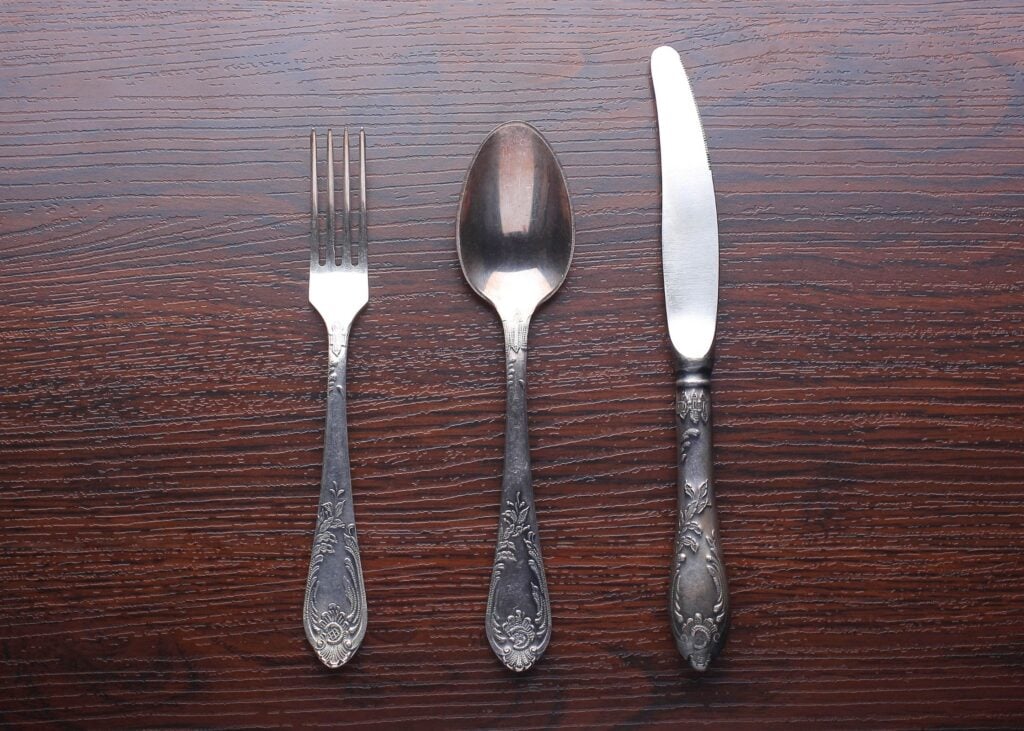
This is the decoration on the handle. After finding the manufacturer, the pattern will tell you when it was made and the price that collectors pay for it.
All major manufacturers used numerous patterns. So, match the handle to a pattern on an actual documented piece, completed auction viewings, or from brand catalogs, and you can confirm the introduction date and the current value.
Pattern identification also helps when the maker’s mark is worn off. A clear Versailles handle, for example, is almost certainly Gorham; no other major maker copied that exact multi-motif design.
Determine the Age
Correlate the date when the pwas introduced to the variants of the maker’s mark. For instance, while Gorham had been using the lion-anchor-G since 1865, the company did not begin adding “Gorham” until 1950. Therefore, a buttercup teaspoon that does not have “Gorham” written in script is earlier than 1950.
Kirk’s mark history is even more useful. Early Kirk pieces used “11 oz.” (coin silver), switched to “925/1000” in 1861, then to “Sterling” in 1914. The dating clue is built into the mark itself.
12 Most Valuable Sterling Silver Flatware Patterns & Makers
From Tiffany to Reed & Barton, this list displays the most valuable and collectible antique and vintage flatware from the most notable brands, and what they’re worth today.
1
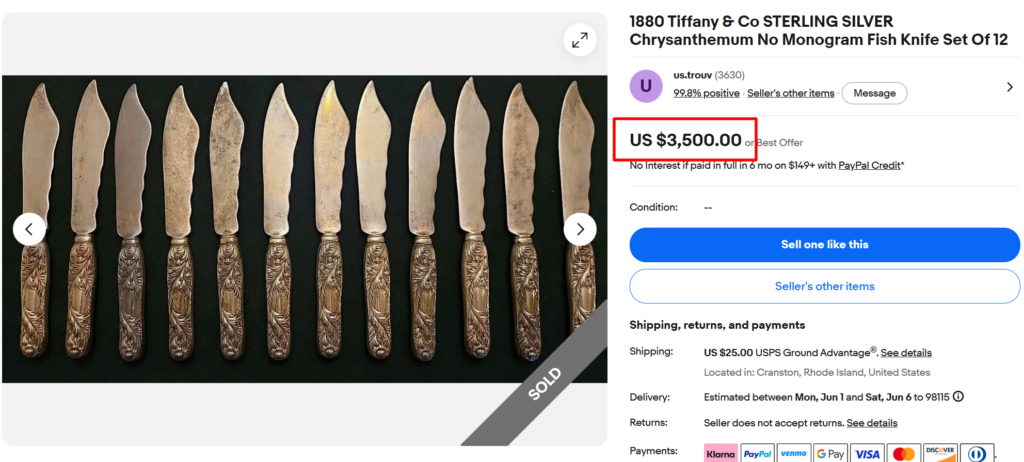
Tiffany & Co. “Chrysanthemum” Flatware
Full service sets $15,000–$30,000+
| Production Period | 1880 to present |
| Key Features | Deep relief chrysanthemum motifs |
| Collector Notes | The earliest examples weigh more and sell the highest |
Charles Grosjean designed Chrysanthemum in 1880, and it remains the most valuable Tiffany pattern ever. Each piece carries deeply sculpted chrysanthemum blossoms and leaves on a foliate ground. The back of every flatware piece is decorated as fully as the front.
Tiffany still produces the pattern, but original 19th-century examples bring the strongest prices. Large sets with services for 12 can fetch up to $15,000-$30,000+.
2
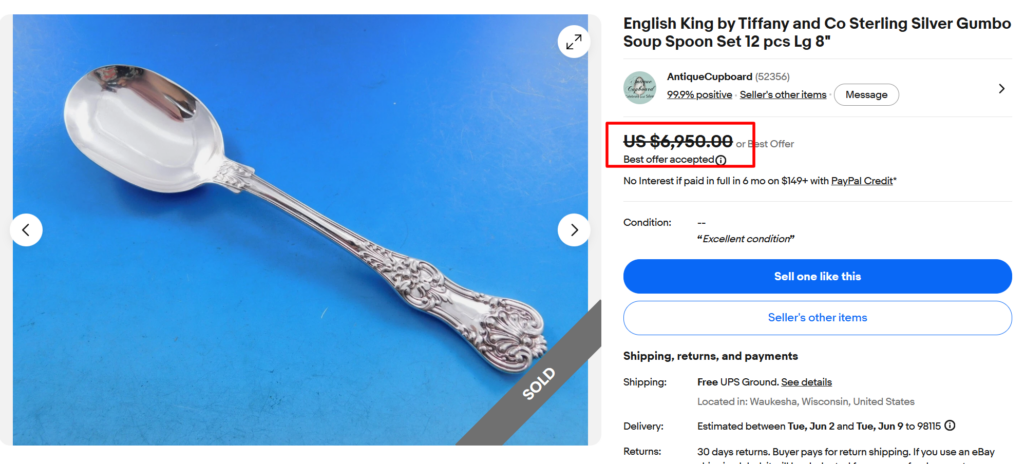
Tiffany & Co. “English King” Spoons
Full sets sell for $5,000–$50,000+
| Production Period | 1885 to present |
| Key Features | Foliate scrolls, scalloped tips |
| Collector Notes | Early “M” director Mark adds value |
Tiffany’s English King was also designed by Charles Grosjean in 1885, adapting the popular European “King” patterns for American buyers. The handle shows swirling foliate scrolls, scalloped tips, and scrolled edges.
Late 19th-century examples carry “M” or “C” director letters that pin them to specific decades and add a premium.
3
Tiffany & Co. “Audubon” Flatware
Full sets sell for $4,000–$60,000
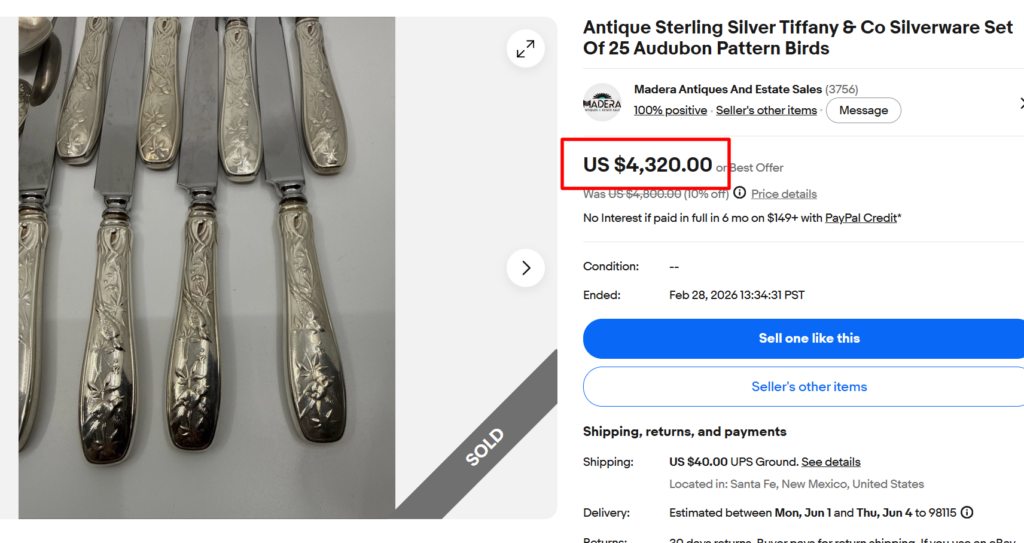
| Production Period | 1956 to present |
| Key Features | Different bird on every piece |
| Collector Notes | Fish forks bring thousands alone |
Released in 1956 and named for naturalist John James Audubon, this pattern shows a different bird on the front of each piece and a Japanese-style flower on the back. And that’s what makes full sets highly desirable and valuable.
The design adapts Tiffany’s 1871 Japanese pattern. Fish servers and other specialty serving pieces sell for the highest individual prices.
4
Gorham “Chantilly” Flatware
Services sell for $1,500–$7,500
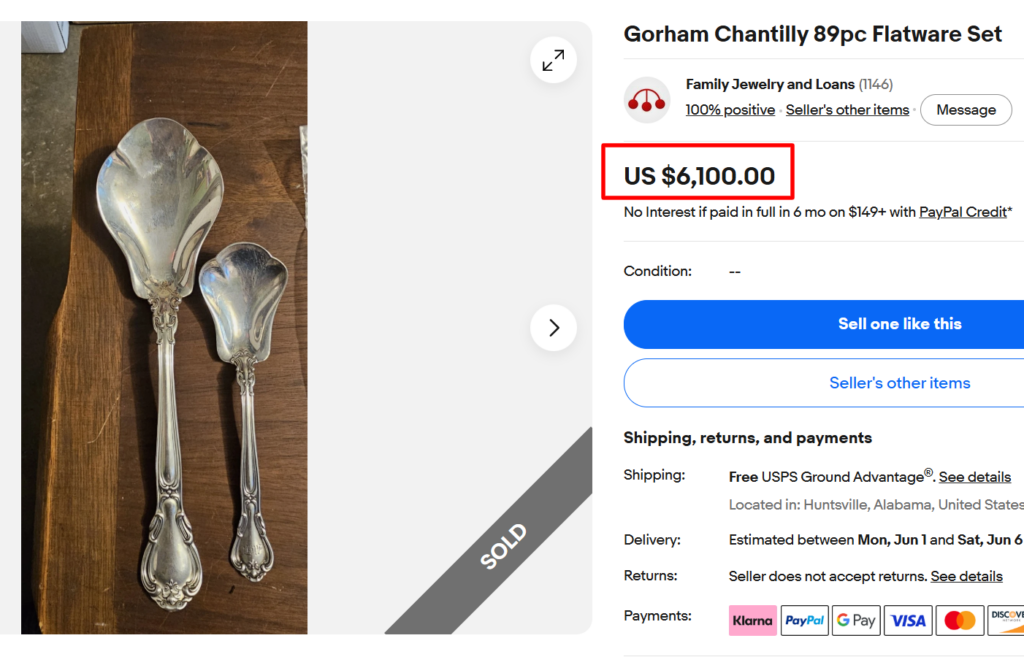
| Production Period | 1895 to present |
| Key Features | Fleur-de-lis tip, scrolled borders |
| Collector Notes | Pre-1950 lion-anchor-G mark preferred |
The Chantilly pattern by Gorham was introduced in 1895 and is considered to be the most successful sterling design to be made in America. Its handle is decorated with deeply engraved designs with fleur-de-lis decorations at its ends.
This cutlery has been selected by President George W. Bush for Air Force One, which gives it an historical appeal and boosts the collector value.
5
Gorham “Buttercup” Flatware
Services sell for $1,500–$10,000+
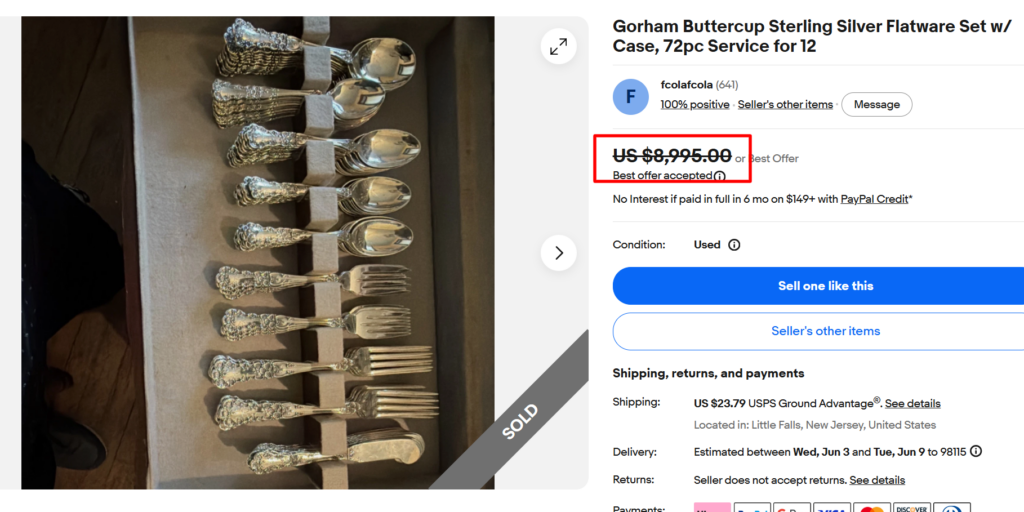
| Production Period | 1899 to present |
| Key Features | Floral cluster, satin finish |
| Collector Notes | Matte surface is original, not worn |
Buttercup arrived in 1899 and has stayed in production ever since. Each handle carries a cluster of buttercup flowers with raised petal work.
Gorham finishes the pattern in a satin “Gorham Grey” rather than high polish, so the matte surface is original, not damaged. Pre-1920 Buttercup examples with the lion-anchor-G stamp are the most valuable pieces to find today.
6
Gorham “Strasbourg” Flatware
Services sell for $3,000–$9,000+
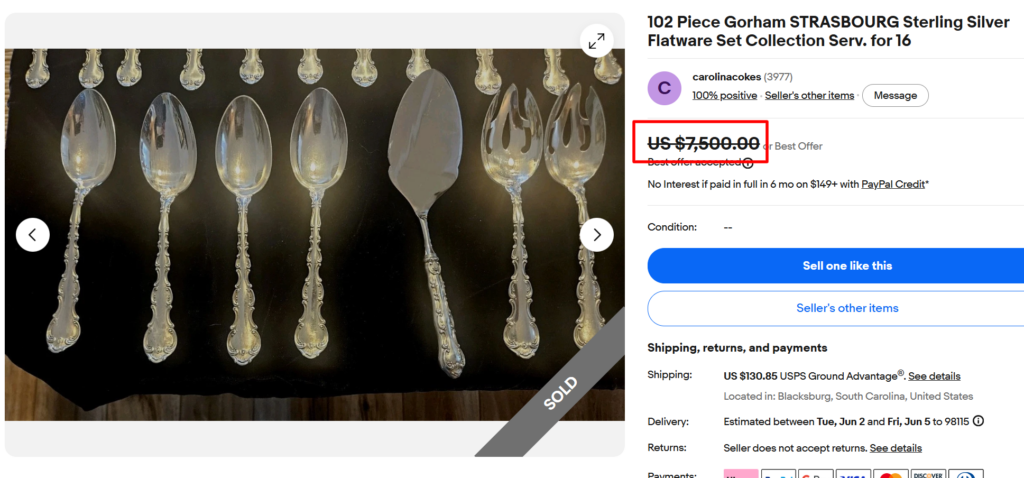
| Production Period | 1897 to present |
| Key Features | Rococo scrolls, shell tip |
| Collector Notes | Long production run keeps supply steady |
7
Reed & Barton “Francis I” Flatware
Full sets sell for $1,800–$15,000
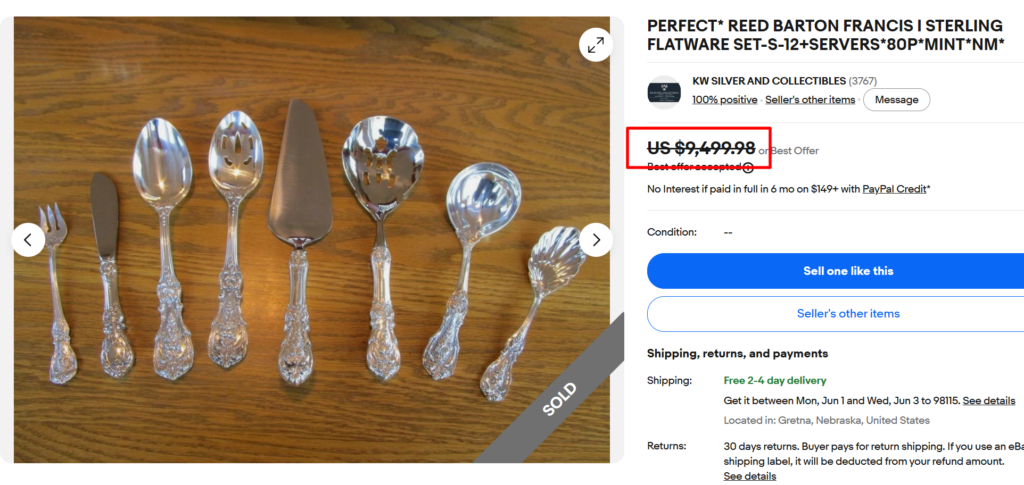
| Production Period | 1907 to 2015 |
| Key Features | Renaissance scrolls, fruit cartouches |
| Collector Notes | Embossed “Sterling / Reed & Barton” mark. |
Francis I was created in 1907 by Ernest Meyer, a French silversmith, and named after a French monarch of the 16th century. On its handle is rich Renaissance decoration featuring a cartouche of fruits and flowers.
What makes this silverware pattern unique is that each utensil type (spoons, forks, knives, etc) has a different fruit grouping. Reed & Barton produced the pattern continuously for over a century. Nonetheless, full sets are extremely valuable today.
8
Reed & Barton “Burgundy” Flatware
Full sets sell for $2,000–$7,000
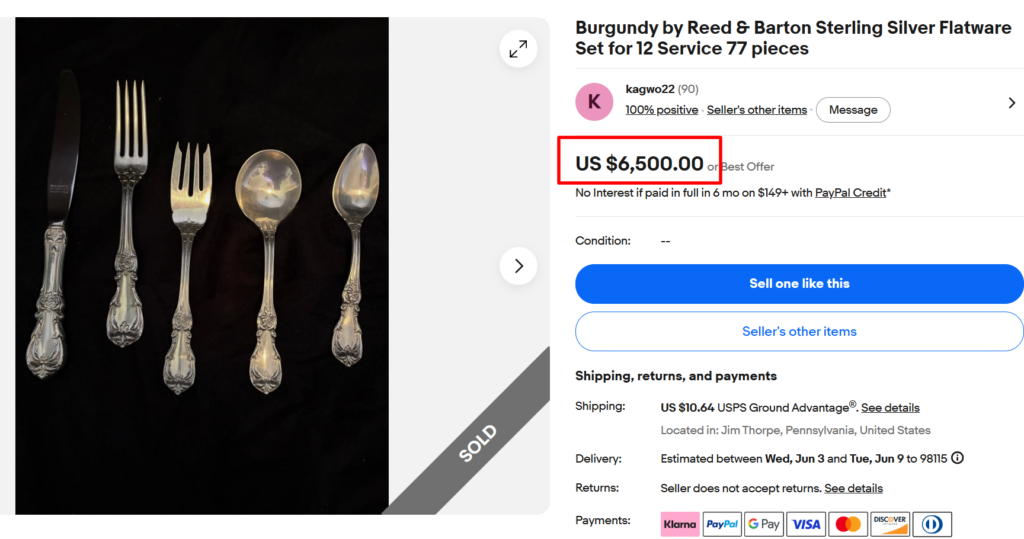
| Production Period | 1949 to discontinued |
| Key Features | Curved handle, scalloped tip, scroll |
| Collector Notes | Pairs well with Francis I sets |
Reed & Barton launched Burgundy in 1949 as a quieter sister pattern to Francis I. The handle carries a curved, scalloped silhouette with a narrow bead border and subtle French floral accents and scrolls along the edge.
This design became a wedding registry bestseller through the 1950s and 60s before being discontinued in 2019.
9
Towle “Old Master” Flatware
Sets sell for $850–$8,000
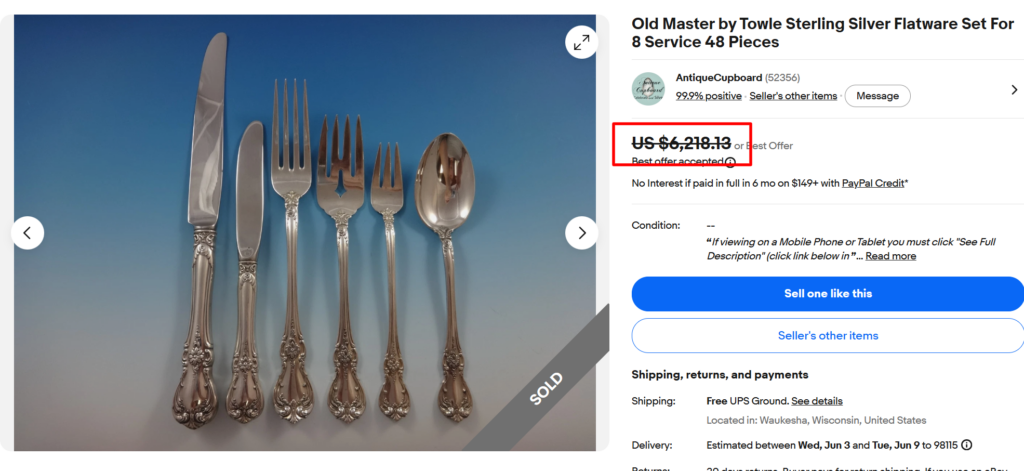
| Production Period | 1942 to discontinued |
| Key Features | Violin handle, center rosette |
| Collector Notes | Check for the “Towle Sterling Pat.” mark. |
Master silversmith Harold E. Nock designed Old Master for Towle in 1942. The handle has a violin shape with a crown of curling leaves at the tip, a center rosette with tendrils, and scrolls along the sides.
The pattern draws from Early Victorian decoration. Towle sets are common at estate sales today. For authenticity, check for the embossed “Towle Sterling Pat.” marking on the back of the handle.
10
Wallace “Grande Baroque” Flatware
Full sets sell for $4,500–$13,000
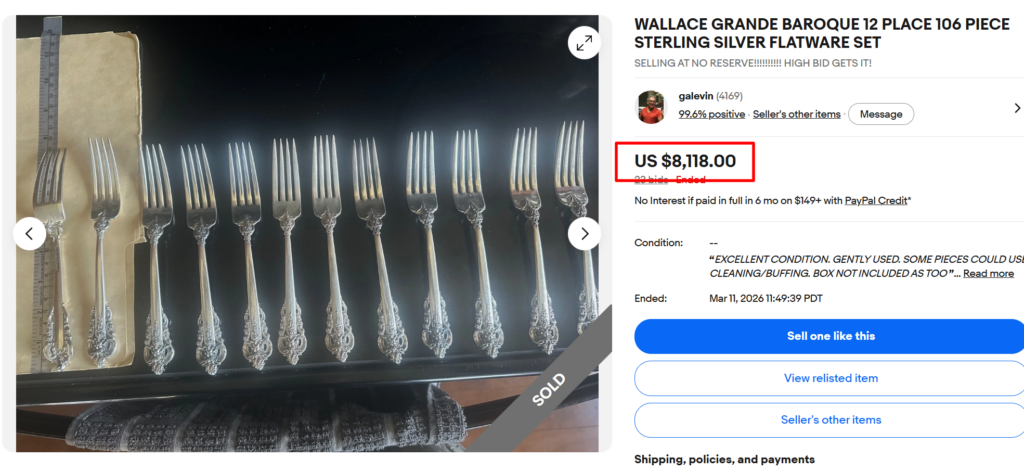
| Production Period | 1941 to present |
| Key Features | 3D acanthus, openwork detail |
| Collector Notes | Substantial handle weight is authentic |
This design looks like the name itself, Grand! William S. Warren designed Grande Baroque for Wallace in 1941. The handle carries three-dimensional sculptural work featuring pillars, acanthus leaves, and openwork, visible from front, back, and profile.
The pattern is heavy because the thick casting supports the deep relief. It remains a Wallace bestseller even after 80 years. But the earliest pieces with the Sterling markings are the most valuable.
11
Whiting “Lily” Flatware
Full sets sell for $4,000–$15,000+
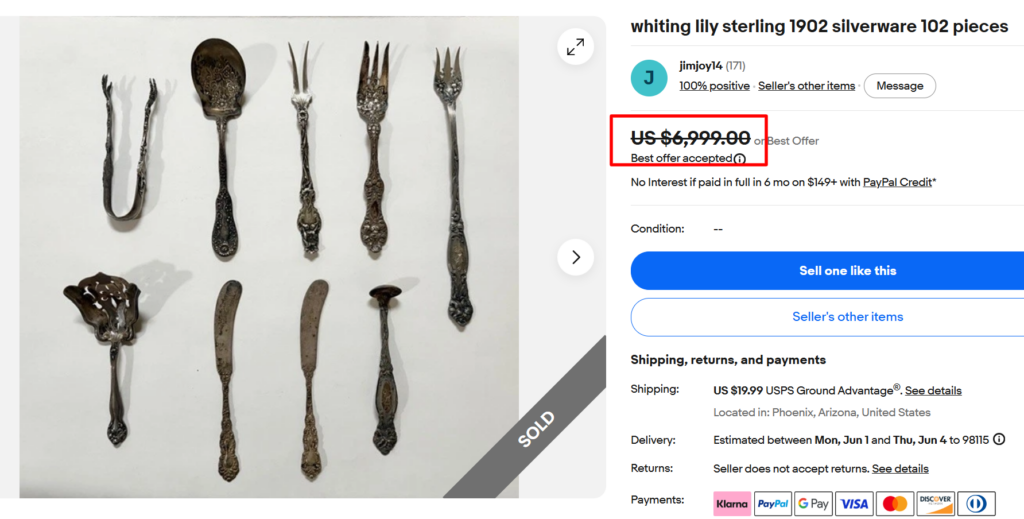
| Production Period | 1902 to present (made by Gorham post-1924) |
| Key Features | High-relief lily stalks |
| Collector Notes | Pre-1924 Whiting pieces weigh more, worth more |
Lily flatware handles carry high-relief stalks of blossoming lily flowers across the surface. Charles Osborne designed Lily for the Whiting Manufacturing Company in 1902. Later, this pattern was released by Gorham after it acquired the Whiting Manufacturing Company in 1924.
Original Whiting pieces (pre-1924, marked with a lion passant holding a shield with “W”) are heavier and more finely sculpted than later Gorham-made Lily pieces. These are also worth more.
12
Kirk “Repousse” Flatware
Full sets sell for $850–$7,000+
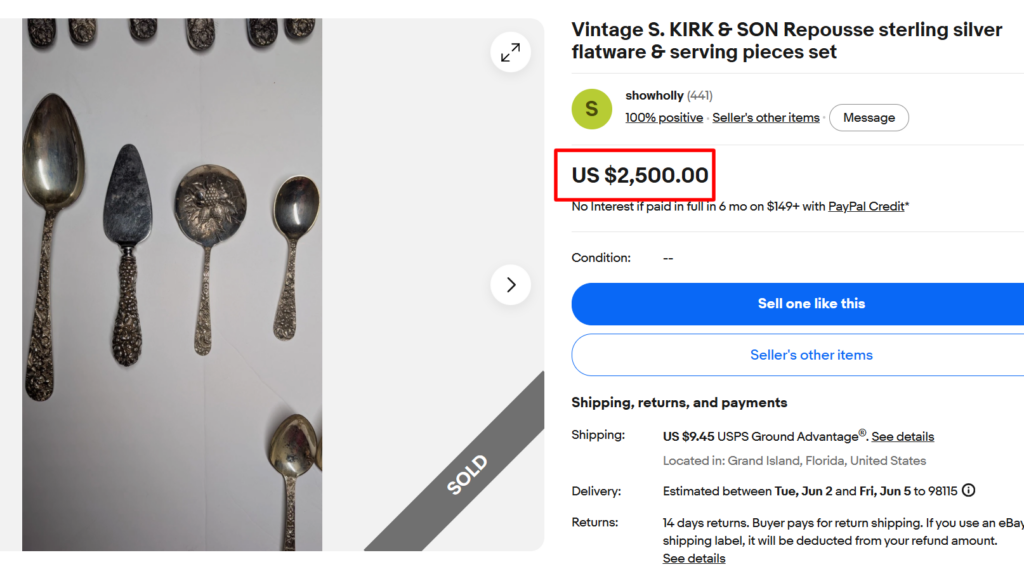
| Production Period | 1846 (flatware) to present |
| Key Features | Dense floral repousse relief |
| Collector Notes | Check for “S. Kirk & Son / Sterling” mark |
Samuel Kirk introduced the repousse technique to American silver in 1828 in Baltimore. The design appeared on flatware in 1846 and remains the oldest U.S. sterling pattern still in production.
You can spot it easily by the dense repousse work featuring flowers, foliage, and sometimes architectural scenes pressed in low relief. Each piece feels heavy from the deep work.
Authentic early pieces must bear the engraved Kirk & Son and Sterling marks on the back of the handles.
What Makes Sterling Silver Flatware Valuable?
Once you’ve confirmed sterling, several factors decide whether your set is worth melt price or several times that.
- Maker Prestige: The more notable the brand, the more valuable the flatware. Tiffany & Co. flatware sells twice or thrice as high as the similar Gorham or Reed & Barton flatware. Kirk, Wallace, Towle, and International rank just below that.
- Rare Patterns: Some patterns from a given maker sell at melt value; others bring three to ten times melt. The pattern matters more than the maker in many cases. If the pattern was limited, it’s even more desirable.
- Complexity of Pattern: The more intricate and complex the pattern, the more desirable it is. That’s why deep-relief patterns like Francis I and Chrysanthemum hold value better than plain patterns. Heavy hand-finishing boosts collector interest and value.
- Full Sets vs. Individual Pieces: A complete service for 12 in the original chest sells dramatically more per piece than the same forks sold individually.
- Serving Pieces: Unique pieces, such as asparagus forks, ice tongs, fish servers, soup ladles, and other specialty pieces, often sell for more than place forks and spoons.
- Condition & Repairs: Common issues like knife handles separating from blades, deep scratches, soldered repairs, and pitted spoon bowls all reduce value. Even cosmetic issues can cut prices by 30% or more.
- Monograms: Many people overlook this, but a monogram on the handle typically reduces resale value by 10% to 30%. Removing monograms (look for ground-out spots) hurts the value even more.
Note: This article is intended for informational, educational, and entertainment purposes only. Some images are illustrative and may not represent actual brands, products, or related entities. All trademarks, product names, brand logos, packaging, and other intellectual property referenced remain the exclusive property of their respective owners. Any brand mentions or references are provided solely for descriptive and educational context and do not imply any formal or commercial association.