Pick up a piece of white Depression glass at an estate sale, and the odds are decent that it came from one of two companies. Anchor Hocking or Hazel-Atlas. Both makers made lookalike bowls, tumblers, and dinnerware for decades, and telling them apart is not always easy.
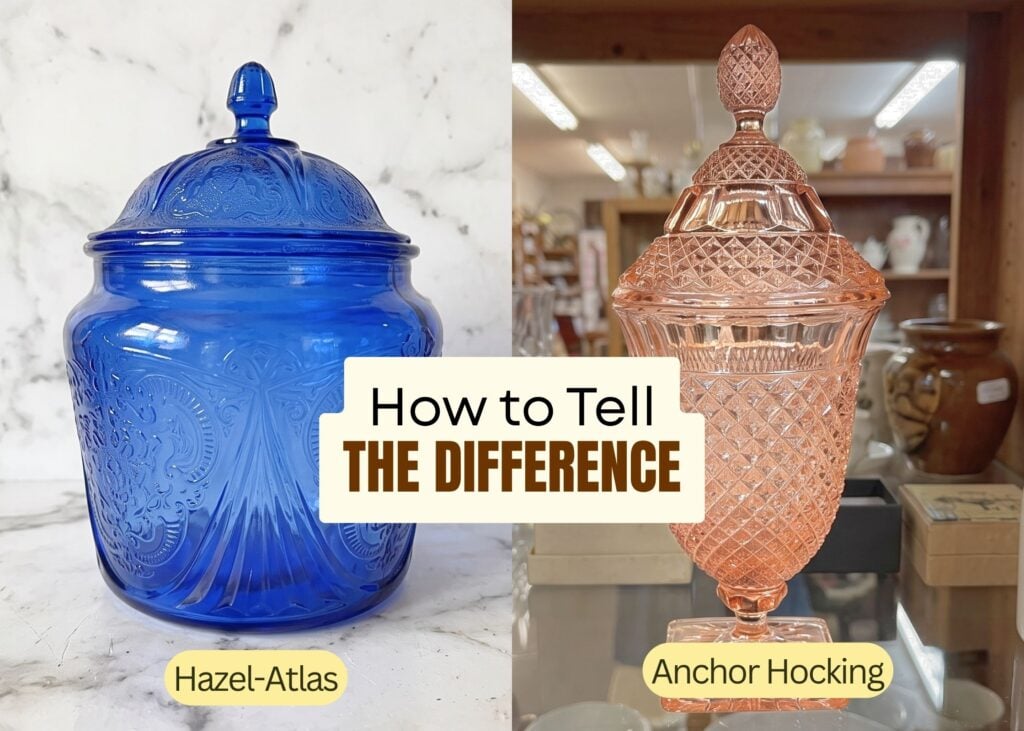
Both were giants of American pressed glass, and both made millions of pieces in the same colors and patterns, and misreading the maker can cost you real money. This guide helps you sort the two brands out easily.
A Quick Look at Both Companies
Hazel-Atlas came first. It was formed in 1902 in Washington, Pennsylvania, from a merger of the Hazel Glass Company and the Atlas Glass and Metal Company, and set up its headquarters in Wheeling, West Virginia. At its peak, it ran fifteen plants and was the country’s third-largest glass producer.
Anchor Hocking was originally known as the Hocking Glass Company, founded in 1905 in Ohio. Named for the Hocking River, this company later merged with Anchor Cap and Closure Corporation in December 1937.
These two glass companies had some overlap in the 1980s when Anchor Hocking briefly owned Hazel-Atlas, but Hazel-Atlas had closed its factories in 1956 after it had been purchased by Continental Can. Most of its plants had since been acquired by Brockway.
The Fastest Way to Tell Them Apart: Check the Mark
The Markings
Flip the piece over and check the base. That is where almost every question gets answered, since both companies molded their maker’s marks directly into the base of most production pieces.
Anchor Hocking mark: an anchor with a capital H sitting inside or over it. The classic version was used from 1937 through 1976 and shows up on Fire-King, Royal Ruby, Forest Green, and most post-merger production.
Hazel-Atlas mark: a capital H with a smaller capital A tucked underneath the crossbar. It looks a little like a small stool or bench. The company began using it in 1923 and kept it going until roughly 1964.
Collector’s Note: The Hazel-Atlas H over A gets mistaken for the Anchor Hocking mark constantly, even by dealers. The difference is simple. If there is no anchor shape, it is not Anchor Hocking.
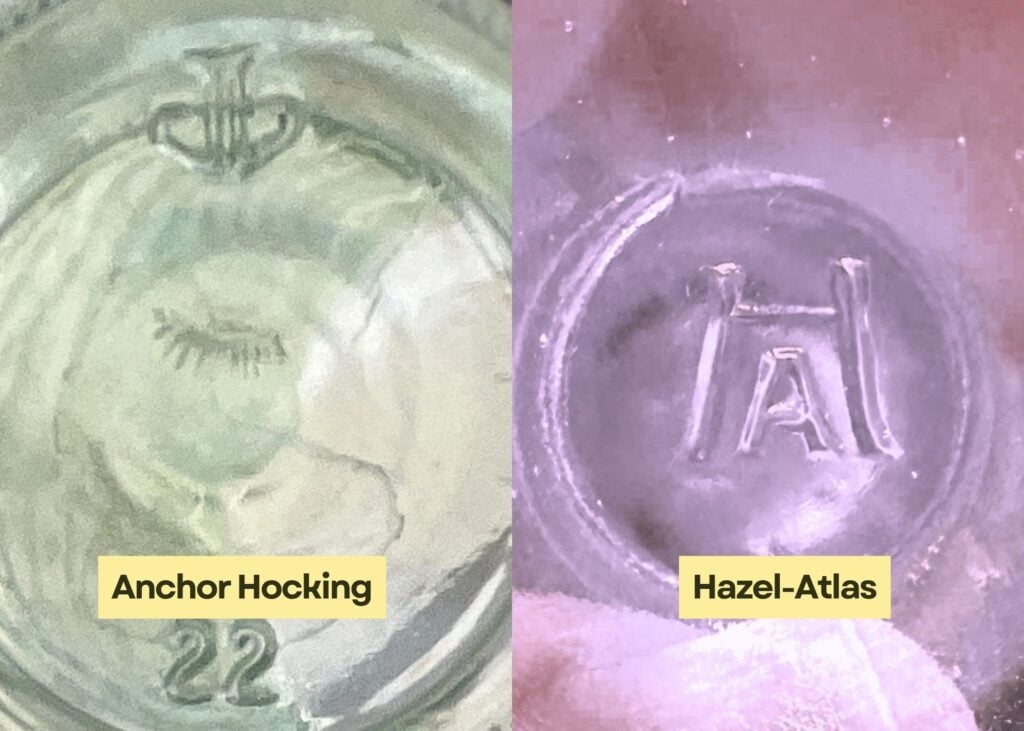
Pre-1937 Hocking Glass pieces usually have no mark at all, and some early ones carry a small H.G. Co. inside a shield.
Hazel-Atlas also produced plenty of unmarked pieces, especially small bottles and jars, where the mold left no room. When there is no mark, move on to color and pattern.
Color Signatures: What Each Company Made Best
They both used colors from a very similar palette, yet each company had its own unique color that would become famous.
Anchor Hocking became famous for Royal Ruby, a deep red transparent color introduced in 1938, and Forest Green, a rich dark green color. Their opaque white Fire-King pieces, particularly the Jade-ite pieces, are highly collectible.
The Hazel-Atlas company made its mark using Ritz Blue cobalt, a deep and vibrant blue found in Moderntone and Royal Lace items. Moroccan Amethyst from the early sixties, a deep purple, and Capri Blue, a light aqua, were also made during the same era.
Uranium glass is trickier than most guides admit. Hazel-Atlas made plenty of it in patterns like Florentine and Cloverleaf, and those pieces glow bright green under a UV light. Anchor Hocking made uranium pieces, too, in the early 1930s under the Hocking Glass name, in patterns like Cameo, Princess, and Mayfair. But Anchor Hocking stopped using uranium by the early 1940s because of the war, so anything post-merger will not glow.
The Milk Glass Test: Platonite vs Vitrock
This is where most misidentifications happen. Both companies made white opaque glass, and both look similar on a shelf. But they are not the same material.
Hazel-Atlas patented Platonite in 1936. It is a semi-opaque white glass with a slightly translucent quality, and it was stronger than traditional milk glass. Hold a Platonite piece up to a strong light, and you will often see a soft glow through the thinner walls. Hazel-Atlas used it heavily on Moderntone dinnerware, often with pastel or fired-on colors.
Anchor Hocking’s opaque white line was called Vitrock, made from the mid-1930s onward. It sits denser and more solidly white than Platonite, without that same hint of translucence. Their Fire-King Jade-ite and Ivory pieces from the 1940s and 1950s also fall into this family of dense opaque wares.
The finger test also helps. Platonite tends to feel slightly lighter and thinner; Vitrock and Fire-King pieces feel weightier for their size.
Pattern Recognition: Signature Designs
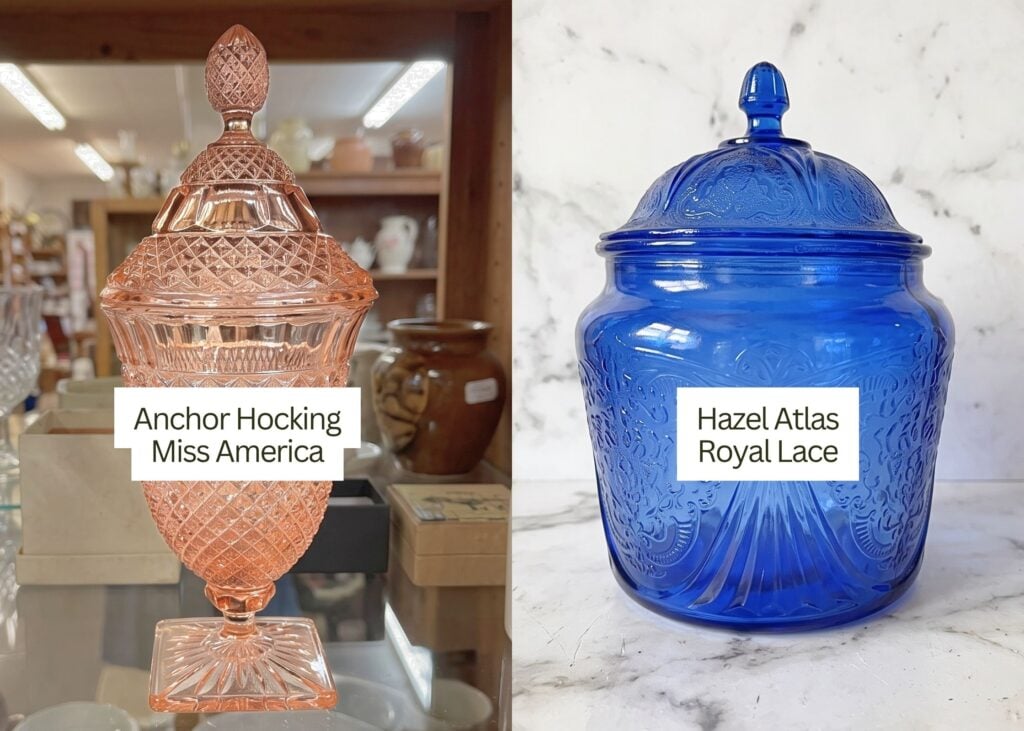
If the mark is missing and the color is ambiguous, patterns are the next clue. Each company stuck to its own mold library, so a design almost never crossed between the two, which makes patterns one of the most reliable ways to attribute an unmarked piece.
Anchor Hocking patterns to know:
- Miss America: starburst center with a cut-diamond design, made 1935 to 1938 in pink, crystal, green, ice blue, and red
- Manhattan: horizontal ribbed Art Deco design, produced 1938 to 1943
- Wexford: heavy diamond-point design produced from 1967 through the 1990s
- Bubble: raised dot pattern, especially collectible in Royal Ruby and Forest Green
- Royal Ruby patterns: Coronation, Bubble, and others
Hazel-Atlas patterns to know:
- Moderntone: concentric rings, most collectible in cobalt Ritz Blue
- Royal Lace: delicate lace-like scroll, produced 1934 to 1941 in pink, green, cobalt, and crystal
- Florentine (No. 1 and No. 2): poppy motifs, sometimes called Poppy
- Newport: geometric hairpin design
- Cloverleaf and Ovide: simpler patterns found across the Platonite line
Learning even five or six of these gives you enough to identify most unmarked pieces on sight.
Six Quick Physical Checks
When the maker is still not obvious, the piece itself gives you clues in how it feels, sounds, and finishes. Run through these:
- Weight in the hand: Anchor Hocking pieces, especially Fire-King, tend to feel heavier for their size.
- Mold seams: Hazel-Atlas seams often sit a little more visibly on the sides.
- Base finish: Anchor Hocking bases often have a smoother machine finish.
- Rim quality: Anchor Hocking rims tend to be cleaner and better finished.
- UV light test: If it glows bright green, it is likely Hazel-Atlas, or an early Hocking piece from the 1930s.
- Ring test: Give the rim a gentle tap. Fire-King has a duller ring. Hazel-Atlas Platonite has a softer thud.
Common Mistakes to Avoid While Identifying
- The Hazel-Atlas H over A gets called Anchor Hocking by so many sellers that some collectors buy misattributed pieces cheaply on purpose. Do not fall on the wrong side of that trade.
- Fire-King is not a separate company. It is an Anchor Hocking product line launched in 1942.
- Not all white glass is milk glass. Platonite and Vitrock are distinct products with different feel, weight, and translucence.
- Unmarked does not always mean fake. Plenty of authentic Depression-era pieces from both companies were never stamped.
Where the Value Lives
In case you want to find pieces to flip, check out the following. The pieces like Hazel-Atlas Royal Lace cobalt pitchers, Moderntone Ritz Blue dinnerware, and Florentine footed pitchers usually sell at more than two hundred dollars.
For Anchor Hocking, Royal Ruby Bubble punch bowl sets, Miss America pink pitchers, and Fire-King Jade-ite mixing bowl sets are the reliable earners.
For both brands, complete sets almost always outsell individual pieces by a wide margin.
In conclusion, remember the markings, commit some patterns to memory, and always have a little UV flashlight with you. This is all that distinguishes between those collectors who see the value and those who pass it by.
Note: This article is intended for informational, educational, and entertainment purposes only. Some images are illustrative and may not represent actual brands, products, or related entities. All trademarks, product names, brand logos, packaging, and other intellectual property referenced remain the exclusive property of their respective owners. Any brand mentions or references are provided solely for descriptive and educational context and do not imply any formal or commercial association.